Amid rising tension in Minneapolis over his administration’s immigration enforcement actions, President Donald Trump is threatening an option that would allow him to significantly expand the military’s domestic presence.
Invoking the centuries-old Insurrection Act would give the president latitude to send the military into Minnesota over the objections of state and local officials, and allow those troops to take an active role in law enforcement.
“If the corrupt politicians of Minnesota don’t obey the law and stop the professional agitators and insurrectionists from attacking the Patriots of I.C.E., who are only trying to do their job, I will institute the INSURRECTION ACT, which many Presidents have done before me, and quickly put an end to the travesty that is taking place in that once great State,” the president said on social media Thursday morning.
Why We Wrote This
The 1807 Insurrection Act allows presidents to deploy a military presence on U.S. streets in rare circumstances. President Trump threatens to invoke it as protesters clash with ICE in Minnesota.
There are multiple scenarios in which a president could invoke the act, as detailed in a Monitor explainer published in November, and the law allows the act to be used even if a state’s governor objects.
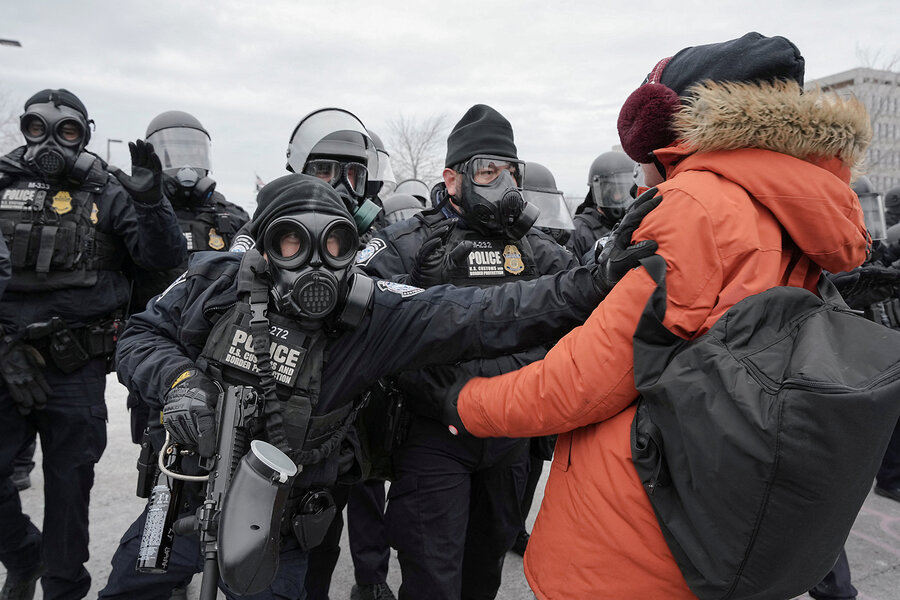
The administration’s aggressive immigration enforcement has prompted protests in cities including Los Angeles, New York, and Portland, Oregon. Since federal law enforcement personnel have surged to Minneapolis in recent weeks, they’ve been met by protests and by people alerting others to ICE’s presence in their neighborhoods. On Jan. 7, Minneapolis resident Renee Good was stopped on a street where ICE vehicles were driving, when officers tried to get her out of the vehicle, and one officer moved in front of her car. She turned to drive away when the officer shot her as he sidestepped her car.
The fatal shooting galvanized public opposition to ICE in Minneapolis. People there clashed with federal law enforcement Jan. 14 after a federal officer shot a Venezuelan man in the leg as he was, according to the Department of Homeland Security, resisting arrest during an attempted traffic stop. Minneapolis Mayor Jacob Frey and Minnesota Gov. Tim Walz, both Democrats, have called for protests to be peaceful as well as for ICE agents to leave the city.
“Let’s turn the temperature down,” Governor Walz wrote in a social media post, framing his comments as a “direct appeal” to Mr. Trump. “Stop this campaign of retribution.”
The Insurrection Act, passed in 1807, allows the president to deploy the military to suppress a rebellion or enforce the rule of law in emergencies. It has been used rarely, most recently in 1992 during riots in Los Angeles.
Mr. Trump has raised the prospect of using the act to quell immigration-related protests in Portland, to address crime in San Francisco, and to skirt legal setbacks to his deployment of the National Guard in major U.S. cities. During a meeting with military leaders on Sept. 30, Mr. Trump suggested cities could be used as “training grounds” for the military.
The president never invoked the act, and has since withdrawn National Guard troops from Chicago, Los Angeles, and Portland. On Thursday, White House press secretary Karoline Leavitt responded to a reporter’s question about whether Mr. Trump would invoke the act in Minnesota by saying that only the president knows what he is going to do.
A state could challenge the use of the act. But experts say a president has wide latitude to decide when the law should be invoked, which allows deploying troops if he or she “considers it necessary” to suppress “insurrection, domestic violence, unlawful combination, or conspiracy” that prevents the execution of laws or deprives people of their rights.