A US ‘nuke sniffer’ plane has made a rare arrival in Britain – as Donald Trump assesses whether to carry out a strike on Iran’s nuclear facilities.
The aircraft was observed at an undisclosed British airbase on Thursday where US special forces were also seen carrying out ‘fast roping’ training drills – a technique used to deploy troops behind military lines.
This is only the third time in 40 years that it has been sent to a UK airbase, as deployment to Europe is unusual and normally concerns missions close to the Russian border.
The WC-135R aircraft is used to test if there have been radiation leaks into the atmosphere related to detecting nuclear explosions and incidents.
It was deployed in 1986 after the Chernobyl disaster, in 2011 after the Fukushima Nuclear Power Plant incident, during North Korean nuclear tests and at the start of the Ukraine Russian war in 2022.
The unusual arrival of the plane has now fueled speculation of preparations for conflict with Iran.
A US naval strike group arrived in Middle East waters on Monday, with Trump warning it was ‘ready, willing and able’ to hit Iran ‘if necessary’.
He said on Wednesday that ‘time is running out’ for Iran to negotiate a deal over its nuclear programme, which the West believes is aimed at making an atomic bomb.
The United States had hit Iranian nuclear targets when it briefly joined Israel’s war against Iran in June.
Trump is still weighing up options against Iran, including targeted strikes on security forces and leaders to inspire protesters to overrun government buildings.
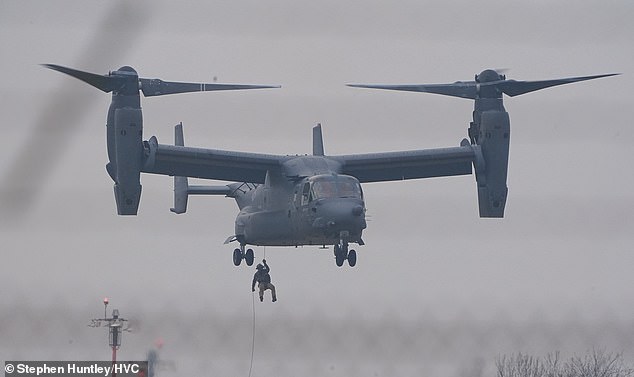
Special forces have been seen practicing ‘fast roping’ from an V-22 Osprey aircraft
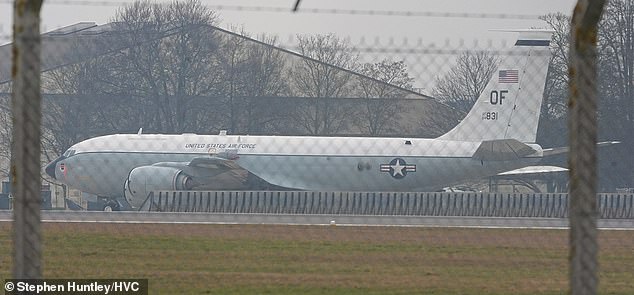
A US WC-135R Constant Phoenix ‘Nuke Sniffer’ plane has arrived in the UK
Iran has now vowed a ‘crushing response’ to any attack.
Washington and Tehran have exchanged sharp warnings since a protest wave in Iran led Trump to threaten military action over a violent crackdown, while the Islamic republic blamed the United States for fuelling what it deemed ‘riots’.
The face-off has sent diplomatic shock waves across the region, with calls for negotiations to defuse tensions drawing in key regional actors.
Iranian officials have ratcheted up warnings that Tehran would respond forcefully to any US military action, while not ruling out diplomatic solutions.
Iran’s army chief Amir Hatami on Thursday vowed a ‘crushing response’ to any attack, according to state television, which reported 1,000 ‘strategic drones’ had joined the combat regiments.
Senior Hezbollah official Nawaf al-Moussawi warned yesterday that the result of American military action against Iran was unpredictable: ‘What holds the United States back is its inability to predict the aftermath of the strike’.
Asked whether the Lebanese terror group, which is backed by the regime, would support Iran if it were attacked by the US, he said: ‘We will cross that bridge when we get to it.’
Two US sources familiar with the discussions said Trump wanted to create conditions for ‘regime change’.
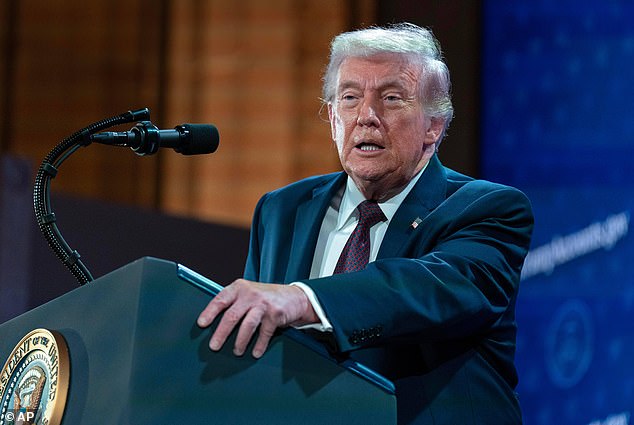
Iran vowed a ‘crushing response’ to any attack after Donald Trump (pictured) warned time was running out for a nuclear deal
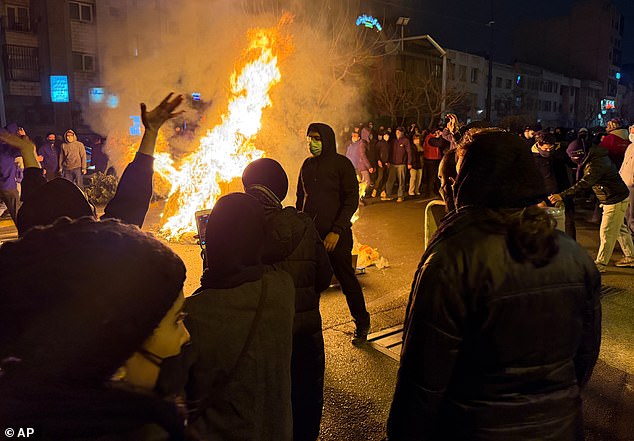
Iranians attend an anti-government protest in Tehran, Iran, January 9
To do so, he was looking at options to hit commanders and institutions Washington holds responsible for the violence, to give protesters the confidence that they could storm government and security buildings, they said.
One of the US sources said the options being discussed by Trump’s aides also included a much larger strike intended to have lasting impact, possibly against the ballistic missiles that can reach US allies in the Middle East or its nuclear enrichment programmes.
The other US source said Trump has not yet made a final decision on a course of action including whether to take the military path.
Four Arab officials, three Western diplomats and a senior Western source whose governments were briefed on the discussions said they were concerned that instead of bringing people onto the streets, such strikes could weaken a movement already in shock after the bloodiest repression by authorities since the 1979 Islamic Revolution.
Alex Vatanka, director of the Iran Program at the Middle East Institute, said that without large-scale military defections Iran’s protests remained ‘heroic but outgunned’.
A senior Iranian official told Reuters that Iran was ‘preparing itself for a military confrontation, while at the same time making use of diplomatic channels’.
However, Washington was not showing openness to diplomacy, the official said.
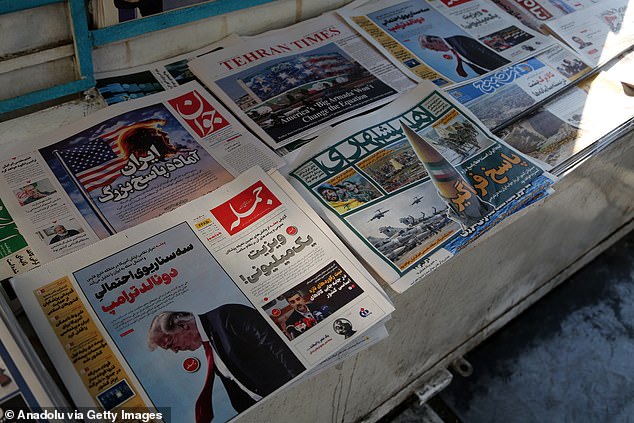
Newspapers in Iran’s capital Tehran prominently featured statements by US President Donald Trump suggesting that military options could be considered, January 28
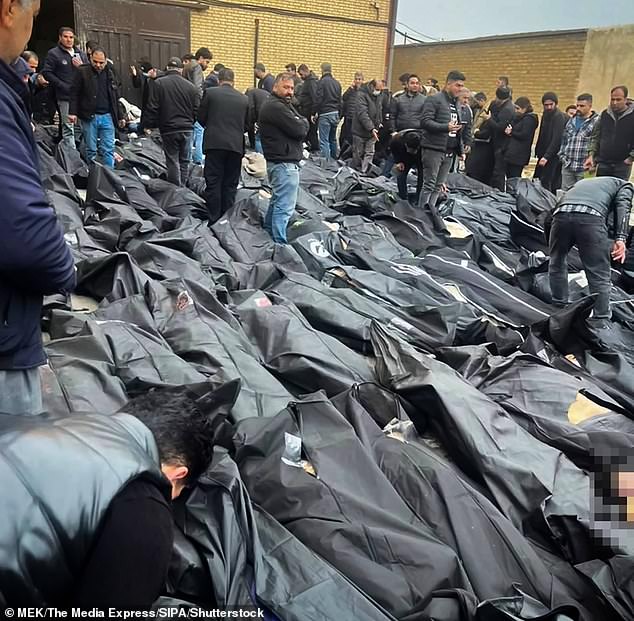
Families gather at the Kahrizak Coroner’s Office confronting rows of body bags as they search for relatives killed during the regime’s violent crackdown on protests, January 13
Tehran, which says its nuclear program is civilian, was ready for dialogue ‘based on mutual respect and interests’ but would defend itself ‘like never before’ if pushed, Iran’s mission to the United Nations said in a post on X on Wednesday.
Seyed Abbas Araghchi, Iran’s foreign minister, warned on X that Iran’s forces were ready to retaliate.
He said: ‘Our brave Armed Forces are prepared – with their fingers on the trigger – to immediately and powerfully respond to ANY aggression against our beloved land, air, and sea.
‘The valuable lessons learned from the 12-Day War have enabled us to respond even more strongly, rapidly, and profoundly.
‘At the same time, Iran has always welcomed a mutually beneficial, fair and equitable NUCLEAR DEAL – on equal footing, and free from coercion, threats, and intimidation – which ensures Iran’s rights to PEACEFUL nuclear technology, and guarantees NO NUCLEAR WEAPONS.
‘Such weapons have no place in our security calculations and we have NEVER sought to acquire them.’