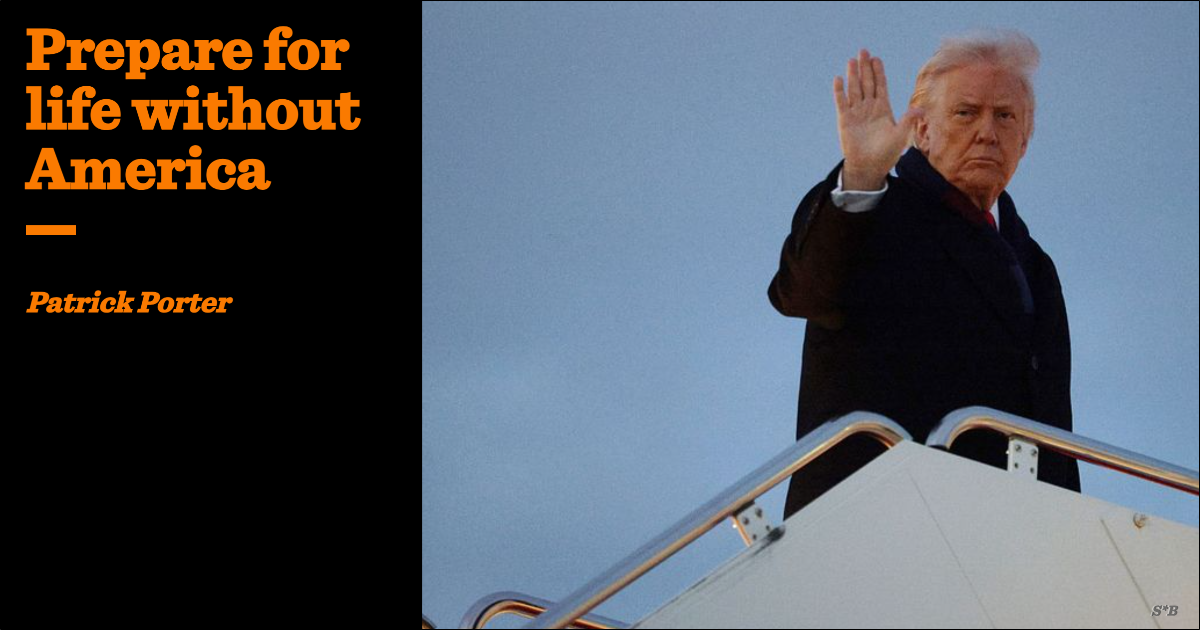
A Holocaust survivor once said, “If someone says they want to kill you, believe them.” A similar logic holds generally in the harsh world of international politics. If a superpower, your main security provider and senior ally, announces that you will have to take charge of your own defence, believe it. President Donald Trump’s National Security Strategy does exactly that. It contains this simple statement, a signal amidst much noise: Washington’s policy is now “[e]nabling Europe to stand on its own feet and operate as a group of aligned sovereign nations, including by taking primary responsibility for its own defence, without being dominated by any adversarial power.”
“Taking primary responsibility for its own defence.” This is not the kind of vacuous, non-strategic fare that formal, public declaratory “strategic” documents usually serve up. Admire it or hate it, this NSS is strategic in the sense that it prioritises and ranks things ruthlessly. And the line about European responsibility goes beyond the traditional American complaint about European overdependency, reheated and louder. This goes beyond the Trumpian signature tune of “spend more on defence or else.” This goes beyond coercive redistribution of labour within the alliance, with the hegemon still picking up a large slice of the tab. No, the NSS signals a fundamental, transatlantic burden shift. It doesn’t mean this development is certain. We, those in the North Atlantic area who are anxious about America’s future posture, cannot be certain about the future, especially regarding what are ultimately choices and decisions. But it does demonstrate, beyond doubt, that such a future is plausible. Therefore, it is worth preparing for.
It is a future long feared. British Prime Minister Winston Churchill, in the depths of World War Two, was anxious about postwar American withdrawal, reckoning over-pessimistically that Washington would not garrison Europe for longer than one or two election cycles. They ended up staying a little longer, not only to check Soviet power but to contain and pacify an unruly and warlike continent and prevent a hostile Eurasian hegemon seizing command of the region’s wealth and resources. Churchill was right, though, to recognise the defining quality of U.S. superintendence. It was choosing to be extra-regional for the time being. It could leave.
Every incentive points towards the U.S. doing significantly less
A bargain formed that Washington is tiring of, and on bipartisan lines. America would do the lion’s share of security work, standing sentry and providing the protection of conventional military presence and an umbrella of extended nuclear deterrence, in exchange for European deference and peaceful existence as satellites under America’s protective wing. That relationship has a complex and at times tense history, but the deal held.
That was then. Now, every incentive points towards the U.S. doing significantly less, by an order of magnitude, and the rest of the North Atlantic area doing significantly more. The temptation for those on the receiving end will be to hope that this is partisan politics and that it will go away. Or, to judge that this is primarily an expression of MAGA ethnonationalism, with its ethnic, skin-colour conception of what “European” means. But this would be imprudent. It would be wiser to estimate that this statement above all reflects a more profound, structural shift in the balance of wealth and power in the world. Even if Atlanticist Democrats make a comeback and win back the presidency and congressional control, a similar predicament confronts Europe. The long party of a peaceful, rich life under America’s overwatch may be coming to an end.
Is this too pessimistic, too Trump-specific?
First, consider the structural forces at work, or what Elbridge Colby (who has surely shaped this document, as Undersecretary of Defence, calls “deep structural realities”). The tectonic shift underway now is simple but fundamental. Asia matters increasingly. China is America’s largest, wealthiest adversary and peer competitor since Britain. Compared to earlier eras, the present distribution of power makes the prospect of Russia seizing control of continental Europe too limited to focus American minds. That doesn’t mean Moscow needs no containing, especially if it prevails in Ukraine and raises its ambitions further. Only, America increasingly will expect European states to do most of the containing. It is rather a power ten times Russia’s size in a wealthy region that will likely attract American priorities. True, the Trump NSS does not play up China as its “pacing challenge” or hegemonic rival in the way its predecessor documents did. And the whole contest with China plays out over multiple fronts, from AI to trade. But Trump still commits to the status quo over Taiwan, and to military preponderance in the region. That isn’t primarily about counter-piracy or drug interdiction. This is a demanding commitment. Moreover, the American state does not otherwise have much spare capacity to tap into in order to uphold primacy in three theatres, given the growing fiscal demands of ageing citizens and its commitments elsewhere, not to mention the strain on its shipyards and defence industrial base. Washington will hardly put the cause of subsidising European defence above funding social security, or above limiting the tax burden. We might complain that Trump’s America, despite its civilizational obsessions, is still willing to play armourer and patron to wealthy Gulf regimes, ones that also embrace Wahhabi Islam. Well, that’s true, but it’s also tough luck. China and Asia, and the Gulf and Iran, will likely take precedence over Europe and Russia.
Let us not sentimentalise American Democrats or Atlanticists
Second, consider the agents. Let us not sentimentalise American Democrats or Atlanticists. Let’s deal with any wishfulness that the clear warning in the NSS is just an eruption of partisan, Trump-Vance, blood-and-soil ideology. Even anti-Trump forces that get anywhere near power in America ultimately approach international politics transactionally — even if they are politer about it — and despite their vocal claims to the contrary. A glance at history suggests the problem. Democrat presidents, including those of a liberal disposition, have been ruthless in the past about white, Christian Europeans. Franklin Roosevelt’s United States did not exactly rush to the aid of embattled continentals against Nazi Germany and Fascist Italy, instead aiding from a remove while waiting for opinion to shift. The maker of the atomic bomb initially designed it to be rained down on Germany. John F. Kennedy threatened West Germany’s Chancellor Conrad Adenauer that he might withdraw troops from Europe if Bonn pursued nuclear proliferation or failed to offset Washington’s costs by buying American. Lyndon Johnson’s administration also chafed at “free riding” allies, and insisted on offset agreements on a similar basis. President Barack Obama’s Secretary of Defence, Robert Gates, issued a blunt warning that unless the decline in European defence capabilities was not halted and reversed, future US political leaders would judge the continental commitment not worth the cost. Europe has halted and reversed the decline to an extent, of course, partly under Trump’s pressure. But evidently it has not raised its investments enough to satisfy those leaders. And given all else America demonstrably cares about in the world, it probably cannot.
The most serious question is not what is likeliest to happen. We can’t know, and can only judge with imperfect information. The most serious question is how we should think and act, given the shadow of a less American Europe, perhaps even a post-American one. Though an important part of our statecraft ought to be to encourage the former over the latter.
For those who wish for permanent American protection and who prefer remaining semi-autonomous wards of a superpower, things might still work out for the best. We could be on the cusp of “good” emperors (as defined by Atlanticists, at any rate), a succession of Romney and/or Biden presidents who will strive to maintain U.S. primacy in the world, and hold on to European commitments. That could happen, though it would be rough weather for America’s net solvency, given the growing strain on its power and commitments abroad and at home. We can wish for this to happen and fancy that if we denounce MAGA enough, and appeal to Washington’s reverence of history and shared ties, and defeat Trumpian or Putinist forces at home, it will all go away. That posture amounts to making ourselves hostage to fortune. To paraphrase Suz Tzu, the wiser course is not to hope your ally sticks around, but to be ready if it departs.