Power: The Downfall of Huw Edwards (Channel 5)
Huw Edwards is very disappointed.
We know this because this week the disgraced newsreader launched a broadside at Channel 5 for airing a two-part drama that depicts him as a sexual predator.
The unflinching hour and 50 minutes telling how Edwards groomed and abused a vulnerable teenage boy, repeatedly coercing him into acts of depravity, is gruelling and deeply upsetting to watch.
It also reveals that, months after Hateful Huw left the BBC, he was still trying to make contact with his victim – sending him a message that simply read: ‘Guess who?’
But Edwards, 64, wants us to know that he is the real casualty.
In an exclusive statement to the Daily Mail on Monday, he complained of his ‘fragile state’, his ‘struggle with persistent mental illness’ and its ‘severity’.
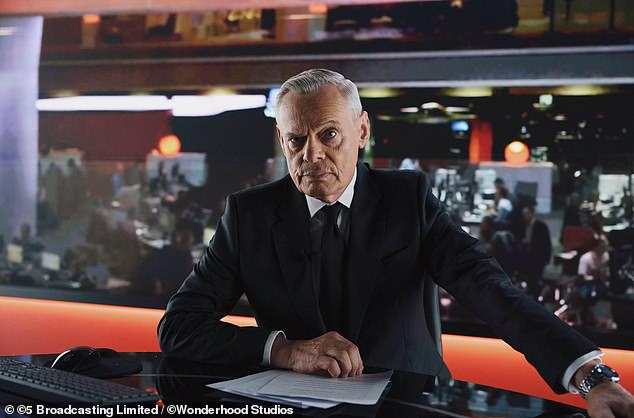
Pictured: Martin Clunes potraying Huw Edwards in the Channel 5 drama – Power: The Downfall of Huw Edwards
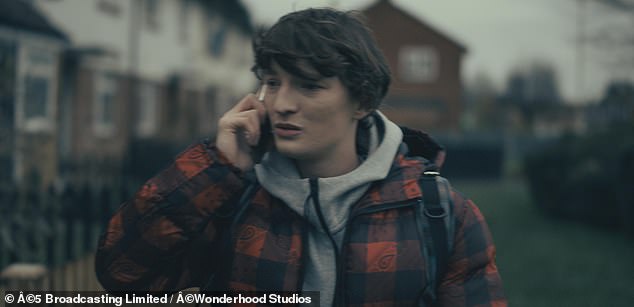
The unflinching hour and 50 minutes telling how Edwards groomed and abused a vulnerable teenage boy (Pictured: Osian Morgan, playing a boy named Ryan in the drama)
This technique for deflecting criticism has worked for him before. No doubt he has found it an effective and unanswerable excuse for much of his life.
But it won’t work any longer. Power: The Downfall Of Huw Edwards, featuring a merciless performance by Martin Clunes, exposes this trick and many others that the BBC paedophile relied on to manipulate everyone around him.
We see him controlling his victim by announcing his ‘disappointment’ over the slightest things to gain the upper hand.
Everyone around him is on tiptoes for fear of putting a foot wrong – especially ‘Ryan Davies’, who was 17 years old when he was introduced online to Edwards.
Ryan isn’t the boy’s real name. But he, his mother and his stepfather have co-operated with the film-makers, allowing us to see how Edwards bombarded him with sickening text messages and demands for naked photos and striptease videos, as well as lobbing wads of cash at him.
Every minute of it is horrible, and the worst parts are truly sickening. We are used to seeing Edwards glowering at us across a desk, but what he does at his desk in his home study, while watching a livestream video of Ryan, is too hideous to describe.
Edwards protested this week that the drama is ‘hardly likely to convey the reality of what happened’.
But that is true only in the sense that the screenplay, by Mark Burt, errs on the side of caution. Just about everything we see him do is morally despicable.
But the only illegal acts, such as downloading sexual images of children, are those which he has admitted.
Nothing graphically obscene is shown. When Edwards lures Ryan to a hotel, for example, and marches him upstairs to a bedroom, we stay outside when the door closes.
Whether the drama implies that Edwards has committed worse crimes is up to the viewers’ interpretation.
One aside from an investigative journalist implies the BBC was aware of multiple complaints against him for at least five years before he was suspended and subsequently allowed to resign.
A moment towards the conclusion, when his career was in ruins, I found particularly chilling.
In a phone call to Ryan, stewed in whisky and self-pity, he implied that neither of them had much to live for. ‘I’m feeling like ending it, baby,’ he bleated.
We were left to draw our own conclusions and reflect that, if Ryan were to end his own life, a lot of Edwards’s problems might have gone away.
Clunes delivers an extraordinary portrayal that captures the body language, demeanour and menace of the man without descending into impersonation.
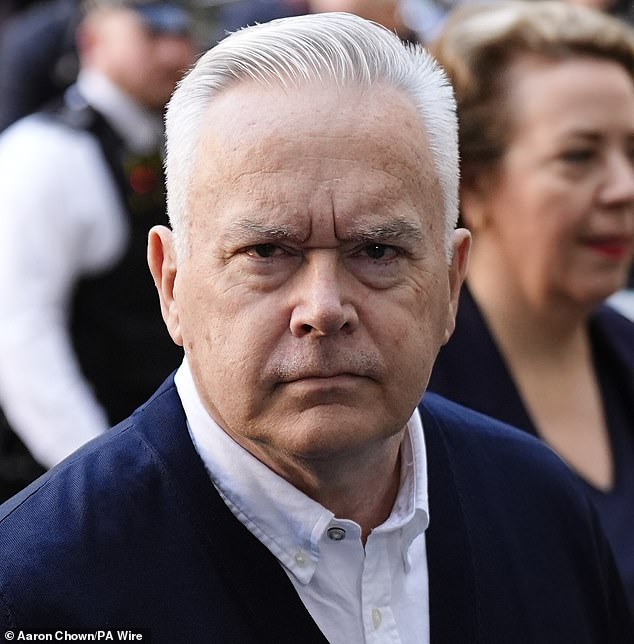
Pictured: Disgraced ex-BBC newsreader Huw Edwards arriving at Westminster Magistrates Court in London on September 16, 2024
His Welsh accent (never a Clunes strong point) sometimes wavers, but his refusal to allow Edwards an ounce of sympathy does not.
The actor was no less obdurate during interviews this week.
He yesterday told Susanna Reid on Good Morning Britain: ‘I appreciate he’s upset by the fact that we’ve made this programme, but he would have reported on other downfalls, other people’s disgraces, without a second thought.’
The story opens with Edwards in a black tie in front of the camera, about to deliver news of the Queen’s death to the nation in September 2022.
It returns to that day – the high point of his career – several times, both to illustrate how far he has fallen in the nation’s esteem and to compare the reality of his seedy personal life with the professional image.
We see him surrounded by BBC sycophants, lapping up their praise and murmuring: ‘Oh, I don’t know about that… I’m just doing my job.’
And we join him on his daily jog as he prepares mentally to project the right image, muttering a mantra: ‘Heartbroken but austere.’
These glimpses of Edwards as he likes to see himself are rare. Mostly, the story is told through the experiences of Ryan, played with intense sensitivity by Osian Morgan.
When we first meet Ryan, he’s living at home on an estate in Cardiff with his depressed mother, Carys (Sian Reese-Williams), and his aggressive, disparaging stepfather, Mick (Jason Hughes).
Secretly gay and bitterly lonely, Ryan is starstruck when a creepy acquaintance, Alex, puts him in touch with Edwards.
The boy has no idea that Alex is supplying the newsreader with vile pictures of children, and it isn’t clear how this porn dealer knows that Edwards would welcome an introduction to an emotionally needy teenager.
But their first exchange of texts leads to a gift of £500.
More money follows, much more, as the older man urges his naive new friend to send him pictures.
They talk, and Edwards praises him for looking even younger than his years.
It’s quickly apparent that, even more than money, what Ryan craves is acceptance.
He needs the approval of a father figure – a yearning that Edwards is quick to twist to his advantage, by ordering the boy to call him ‘Daddy’.
His real children (he has five) are never mentioned. Nor do we see his wife, Vicky Flind, or even hear her voice off-camera.
What we do see is his cruelty. In his frequent phone conversations with Ryan, sometimes late at night when both are in bed, he will withdraw his blessings for the most trivial reasons. In the space of a breath, he can go from calling him his ‘baby’ to scolding him for using slang or failing to send explicit photos.
His favourite weapon is his ‘disappointment’. His scowl is so severe, so implacable – staring out of Ryan’s phone, just as he used to fix the camera with his glare on News At Ten – that the boy will do anything he is asked to win back approval.
The drama ends with a gimmicky touch: seated at his newsreader’s desk, Edwards announces his conviction for possessing obscene images of children, including one aged under nine years.
‘Despite the seriousness of my offences,’ he adds smugly, ‘I was able to avoid imprisonment and still remain at liberty. And that’s all from me.’
It certainly is. This drama cannot depict the full depravity of the man who was once Britain’s most trusted broadcaster, but it leaves us in no doubt of the depths of his evil.