
We’ve been awfully lucky with the price of gasoline and oil in general, even with these oil tanker seizures and the build-up rumblings around Venezuela in general.
For all that the oil markets are used to swinging wildly at upsets, these haven’t rattled them too badly.
This is a fascinating four-minute discussion with former CNBC international correspondent Michele Cabrusa-Cabrera on why Trump’s ‘reinvigoration’ of the Monroe Doctrine in applying pressure to the Maduro regime is seen by many as a welcome change. Cabrusa-Cabrera fingers Venezuela as one of the leading causes of instability in the Americas and cites statistics such as that country’s residents being a huge proportion of our national illegal immigration problem. More than 25% of the Venezuelan population has left the country, she says, totaling over 8 million people. Three-quarters of a million came our way, millions more flooded the neighboring countries around Venezuela, and vicious Venezuelan gangs have used them as footholds.
Any movement on Maduro’s financial underpinnings, as far as his desperately needed oil money goes, doesn’t have the same impact on oil markets as attacks in the Red Sea, although there is still some fidgeting.
Also, the type of heavy sour Venezuela produces is used for specific fuels, and its removal from the market creates pricing pressures.
Oil markets are on edge as the U.S. escalates its seizures of sanctioned oil tankers off the coast of Venezuela, boarding a second tanker on Saturday before pursuing a third out into the Atlantic on Sunday. These actions, coming on the back of Trump’s announcement of a blockade of all sanctioned oil tankers entering and leaving Venezuela, have ratcheted up tensions between the two countries.
…In response to the seizures and broader geopolitical tensions, oil prices have rallied from near multi-year lows, with WTI rising toward $58 and Brent trading at around $62.
For physical oil markets, there are three factors driving that price increase, two of which are easily overlooked. The first, and most obvious, of these factors is the supply that is currently being taken off the market or could be taken off the market in the future. The second is associated with the type of oil that is being removed from the market. Finally, the way in which this oil is being removed from the market represents a broader structural risk for barrels of oil on the other side of the world.
On the supply side, there are an estimated 75 tankers idling off the coast of Venezuela, with roughly half of them on the U.S. sanctions list. Reuters claimed that roughly 11 million barrels of oil and fuel were stuck in Venezuelan waters after the U.S. seized the first oil tanker. If that oil continues to be disrupted, then Venezuela could ultimately be forced to shut in production as it will run out of storage. In a worst-case scenario, that could mean up to 500,000 barrels per day of oil being taken offline. While we remain far from that scenario, the supply side risk remains very real.
Then there is the type of oil. Venezuela produces a heavy, sour crude that is used for specific market segments and cannot simply be replaced by any other barrel on the market. Its crude feeds complex refineries, which are designed to convert it into middle distillates like diesel and jet fuel. When this type of crude is removed from the market, buyers have a limited choice of other producers they can turn to, with Canada, Mexico, and Russia being the most prominent. This phenomenon is similar to what happened when Russian barrels were first sanctioned following its invasion of Ukraine in 2022.
In a side note, Russian oil is cratering at $34 bbl. Putin’s war is getting very expensive, and his oil is not going to finance it at that rate with the sanctions in place.
🔥Russia’s flagship Urals grade slumped to as low as $33-35 per barrel at Black Sea & Baltic ports, the deepest discount since the invasion, as US sanctions on major producers disrupt flows & slash revenues critical to sustaining Putin’s war machine
— 𝐀𝐧𝐧𝐚 𝐊𝐎𝐌𝐒𝐀 | 🇪🇺🇫🇷🇵🇱🇺🇦 (@tweet4Anna_NAFO) December 22, 2025
It’s a double-edged sword, though, as US frackers will start shutting down production when barrel prices slip below $50. Right now, Ukraine, Venezuela, Chinese short-term stockpiling, and the Red Sea shipping difficulties are forming a floor under oil’s price at $50-60 bbl.
This is keeping our national gasoline average, sans California, at the entirely reasonable rate levels. We paid $2.30 gal this weekend in Alabama. Around the neighborhood here, in West Florida, we’ve seen it as low as $2.45. Triple A has today’s national average at $2.82 gal.
What’s coming down the pike is something out of the control of the fossil fuel industry, but most assuredly driven by hostility to it.
The price for a barrel of oil today is $57.
National average price of gas at the pump is $2.84 per gallon.
California average is $4.18 per gallon (2nd highest in the nation)
If politicians in California want to address “affordability” they need to do a 180° turn and embrace… pic.twitter.com/lGFT6p7Y1S
— Mike Netter (@nettermike) December 27, 2025
In California, where Governor Gavin Newsom’s war on fossil fuels is a long and ugly story of hubris, the exercise of power, and empty political posturing run amok, besides the refineries leaving the state I’ve posted continually about, I’ve just learned that there could be another expensive fuel squeeze coming, thanks to the legislature.
In 2014, a bill called SB 445 was signed into law that was laden with lots of uber-green goodies. One of the little-noticed provisions in the almost 12-year-old legislation goes into effect on the 1st of next month. The deadline to comply is, like, in two days.
If you’ve hesitated to buy an electric car because it’s typically easier to find a gas station than a charging station, California has a solution for you.
Fewer gas stations. And higher gas prices.
You may see a number of gas stations closing down in 2026 due to Senate Bill 445, which requires the owners of single-walled underground storage tanks containing hazardous substances – gasoline, for instance – to permanently close or replace them. The deadline is this Wednesday, December 31.
Back when SB 445 was signed into law by Gov. Jerry Brown in 2014, the deadline date at the end of 2025 probably seemed so far away that it couldn’t possibly cause any political damage to the politicians who approved it. Now that it’s here, all the current politicians can answer constituents’ questions about local gas stations closing by solemnly pointing to the law and saying they didn’t do it. See how this works?
Whether gas stations comply or close, the regulation’s effect on California gas prices is to push them higher, either from reduced competition or higher costs passed through to customers.
The worry was about the refinery closures spiking gas prices. If there are fewer places to buy less gasoline, how high can gas prices go? The unintended consequences reach across all age groups.
Thank you! For seniors who drive very short distances, and can only afford to refill 1/4 of a tank each time, driving around to find a cheaper station isn’t always an option.
— CA OldGirl Christie, Gavvy’s troll (@CABirdGirl2) December 28, 2025
How’s that war on fossil fuels and the green transition going for the state? 100% ready to run on their own after all the pain and heartache the governor and toadies have caused citizens and residents alike?
Not even close. Look at those ‘import’ numbers. That’s the electricity the state is buying to keep lights on.
Checking back at 11:30 p.m., we see California’s grid relying on imported electricity to meet more than 39% of the state’s demand. Batteries fizzling from 20% earlier this evening, down to 4.4% as the midnight hour approaches. Solar and wind energy can’t power California. https://t.co/0PzQx5dpsj pic.twitter.com/VWtZVoQzEY
— Susan Shelley (@Susan_Shelley) December 27, 2025
Check out this little factoid.
Well…huh.
“California imports more wind power than it produces. This may be surprising to anyone who has witnessed the seemingly endless miles of wind turbines in the California desert.”https://t.co/iGcUg5S3ty pic.twitter.com/83eCzAmzFS— tree hugging sister 🎃 (@WelbornBeege) December 29, 2025
CALIFORNIA IMPORTS MORE WIND ENERGY THAN IT PRODUCES
What a bill of goods these people have had shoved down their willing throats.
Right now, even with the sun shining somewhere and what renewables they have cranking away until the sun goes down and the wind dies off, over 10% of the California grid would be dark if they couldn’t buy power from outside the state.
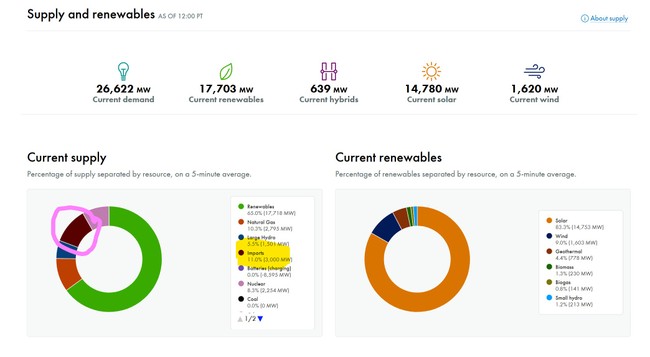
That’s pathetic. And imported electricity is EXPENSIVE electricity because you have to outbid other people who need it to lock on a price. Or, when you really need it in an emergency, you have to both pray they have it available and then pay the out-the-wazoo going rate. Ask the British – they know all about emergency power purchases.
East Coast rate payers will soon, too, and that’s the second of my incoming price shocks.
There is something on the East Coast called the PJM.
PJM is a regional transmission organization (RTO) that coordinates the movement of wholesale electricity in all or parts of 13 states and the District of Columbia.
This is a big RTO, and it recently had what’s called a capacity auction to lock on enough power, aka extra in times of stress, for the states and D.C. that it serves.
It couldn’t.
The RTO couldn’t buy enough power, even though it offered prices as high as the government rate cap on megawatt costs, to ensure reliable electricity in extremis for the region in the coming year. They still came up short of what they needed. The scary part is that the artificial government cap was set at over $333 MW/day, and that wasn’t enough to buy them what they needed, thanks to population growth and the explosion of electricity-gobbling data centers.
PJM rate-payers, however, are going to be on the hook for what the RTO had to pay to get what they could.
As one author explained it, you cannot buy electricity ‘from power plants that no longer exist.’ But you sure as hell are going to pay the piper for knocking them down before their time, lemme tell you.
It’s always the #math that bites them.
The latest PJM capacity auction cleared at the maximum allowed price—$333 per megawatt-day—and still came up short. Even at the price cap, the market could not buy enough power to meet PJM’s own reliability standard.
Capacity auctions exist for one reason: to make sure the lights stay on when the system is under real stress. Not on a mild spring afternoon. On the worst day of the year—when demand peaks, equipment is strained, and weather is working against you. This auction tested that standard and found the system wanting.
This did not happen overnight. Electric demand has been climbing for years. Data centers multiplied. Electrification mandates piled new load onto the grid. Population shifts changed where and when power is used. Utilities, regulators, and planners saw it coming. The forecasts were published. The warnings were filed. No one was caught by surprise.
Supply, meanwhile, lagged badly.
New dispatchable power plants take years to permit, finance, and build. Those timelines grew longer, not shorter. Projects bogged down in regulatory reviews. Lawsuits became routine. Interconnection queues stretched out for years. At the same time, existing power plants—coal, gas, nuclear—were pushed into early retirement. The math stopped working.
Capacity markets do not reward good intentions. They pay for performance when things go wrong. Power that runs when the grid is under stress earns full value. Power that depends on weather does not, because weather does not take orders. Batteries help, but only for so long. New plants cannot appear on command.
For decades, coal, natural gas, and nuclear plants carried the system. They ran day and night. They showed up during heat waves and cold snaps. They kept reserve margins healthy and prices stable. Policy choices accelerated their exit before replacements were ready.
The auction simply counted what was left.
By the time bidding hit the price cap, PJM still had not secured enough dependable capacity. That is not a market failure. That is a supply failure. You cannot buy power plants that no longer exist, no matter how high the bid.
What it says about what these politicians have done to the grid and American energy independence is criminal. Had there not been that government cap?
Katy bar the door…and there still would not have been enough electricity to safely cover the capacity needed.
…However, by far the biggest risk was the shocking revelation in the auction report appendix that the simulated clearing price without the cap is $529.80/MW-day, about 60% higher than where price controls helped keep the clearing price.
Below is the key section from the latest PJM BRA, conveniently found in the appendix on the second to last page. What it reveals that instead of the $333.40 clearing price, “for the 2027/2028 simulated BRA, all prices cleared at $529.80 except the DOM LDA which cleared at $542.83.” This means that uncapped prices would be 60% higher than market-cleared. Also, for context, in the 2026/2027 simulated BRA, all prices cleared at $388.57, in other words on an apples to apples basis, data centers would have pushed electricity prices 40% higher, all else equal… and assuming there were no price controls.
Yet what may be even more troubling is that even assuming fully unregulated markets, with no cap or floor, the “cleared capacity is approximately 800 MW higher compared to the cap and floor case.” Which means that even at much higher prices, there is only less than 1GW capacity in the largest US grid system, which is catastrophic for an AI and data center cycle which expect dozens if not hundreds of GWs will be added magically over the next 5 years!
PJM is the perfect case study in government picking winners, then acting shocked when the grid gets brittle and expensive. If your electricity bill would “explode” without price controls, the real problem is the policy created an artificial shortage in the first place.
— rowdyamerican (@rowdyamerican69) December 26, 2025
They should just call the ‘magic gigawatts.’ That’s what the Green grifters have been selling the entire time – unicorn fart magic.
So. as this goes forward, the good folks in the PJM area of service…
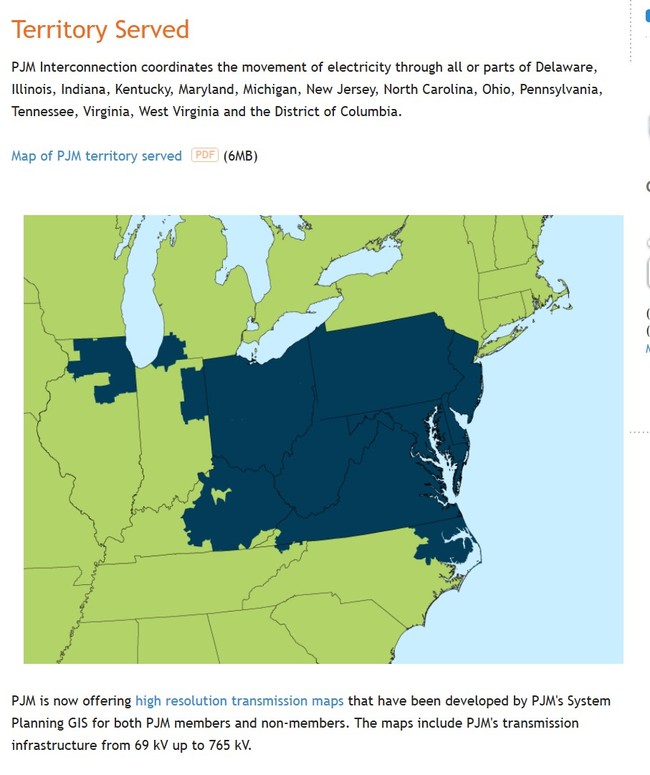
…should probably start setting aside some extra pesos for the summer months when the A/C draws a lot, or even this winter if you’ve gone all electric and it gets, like, you know – cold.
It’s gonna cost you, probably sooner rather than later.
…Now the bill comes due.
Capacity costs from this auction will be baked into electric rates for years. Households will see higher monthly bills regardless of fuel prices or weather. Businesses will face higher fixed costs that squeeze margins and weaken competitiveness. Manufacturers will factor those costs into decisions about where to invest—or whether to invest at all. This is the real-world cost of pretending supply does not matter.
And here I’ll bet you thought you were paying out the nose already.
Just wait until you’re paying, and PJM can’t keep the lights on. It won’t be the utilities’ fault – they tried.
Thank your blue state governors and legislators, the ones you all keep re-electing.
It’s ALL on them.
Please help Ed, David, John, and me continue exposing Democrats’ plans to lead America down a dangerous path.
We’d love to invite you to join Hot Air VIP and use promo code MERRY to get 74% off your membership!