Police took a DNA sample from an embroidered pillow case at the home of Madeleine McCann days after she disappeared, a court heard.
A forensic officer from Leicestershire police was let into the McCanns’ home in Rothley in Leicestershire to obtain a sample days after Madeleine vanished from a holiday apartment in Praia da Luz, Portugal, on the evening of May 3, 2007.
Sarah Measures spoke on the phone to Madeleine’s mother Kate McCann, who was still in Portugal at the time, while she was in her home to discuss what items would be suitable for obtaining a sample, jurors were told.
The details into the actions of police in the days after Madeleine’s abduction were revealed in court on Monday, where a Polish woman, Julia Wandelt, is on trial accused of stalking Mrs McCann and husband Gerry.
Over two years, from June 2022 to February 2025, Wandelt, 24, allegedly bombarded the couple with phone calls, texts and emails claiming to be their daughter and turned up at their home in Rothley, Leics, to demand a DNA test.
She and her co-defendant 61-year-old Karen Spragg, of Caerau, Cardiff, both deny one count of stalking.
Leicester Crown Court heard on Monday that Madeleine’s DNA sample taken from her bedroom pillowcase in 2007 was recently used to compare to Wandelt’s after she agreed to give a sample in prison in February this year.
Jurors heard it was obtained by Ms Measures on May 14, 2007 when she went to the McCanns’ home and was granted access by the McCann’s solicitor Richard Jones as the McCanns were still in Portugal.
In her statement read to the court Ms Measures said: ‘During the course of my examination I recall speaking with Kate McCann on the telephone’ about where best to obtain a sample, which was then taken from a pillowcase on Madeleine’s bed.
The court heard a DNA profile was also obtained from neonatal blood drops taken shortly after Madeleine was born, which was compared to the pillow case profile.
The blood sample related to pinprick screenings taken routinely after birth.
Later the court heard from forensic scientist Rosalyn Hammond, who compared Madeleine’s samples with those of Wandelt.
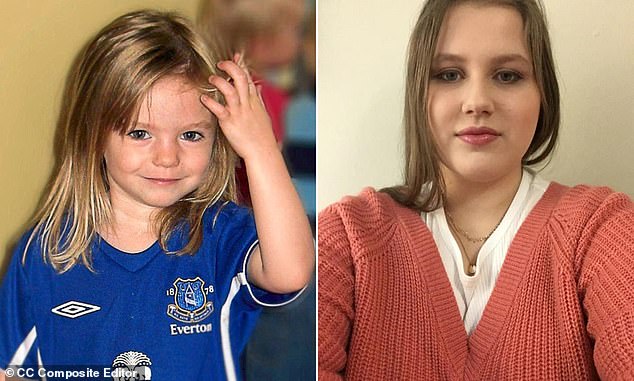
Julia Wandelt, right, claimed to be Madeleine McCann in a series of texts, calls and emails
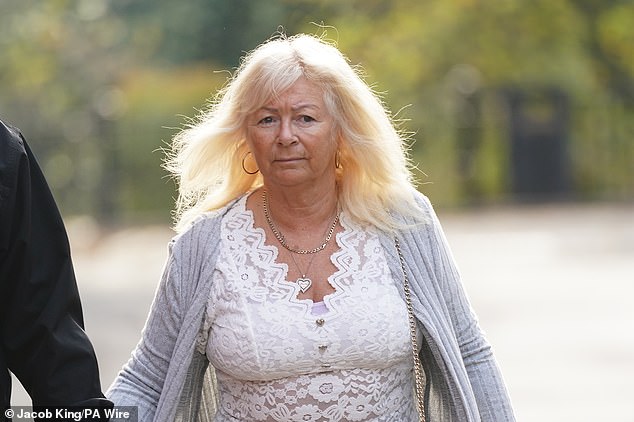
She is on trial with co-defendant Karen Spragg, 61, of Cardiff, pictured arriving at court last week
Michael Duck KC, prosecuting, asked if there was ‘scientific support or otherwise for the proposition that Julia Wandelt is Madeleine McCann?’
Ms Hammond replied: ‘I would say they are not the same person.’
Mr Duck said: ‘Are there any areas that match?
Ms Hammond replied: ‘There are seven areas where they have the same component…out of 32. They happen to have the same component at those designations.’
Mr Duck said: ‘Is that a feature that could arrive with any two random samples?’ to which Ms Hammond replied: ‘Yes exactly.’
Mr Duck went on: ‘As far as the primary consideration whether Julia Wandelt could be Madeline McCann scientifically, what does it show?’
Ms Hammond said: ‘The profiles from the two samples are different so Julia Wandelt cannot be Madeleine McCann.’
She was also asked to look at ‘whether in fact she could be the child of Kate and Gerry McCann’. Mr Duck said: ‘Any prospect of Julia Wandelt being the biological child or either Kate of Gerry?’
Ms Hammond replied: ‘It shows she is not the biological child of Kate and Gerry McCann and neither is she the biological child of either one of them.’
She added: ‘Looking across the whole profile I was satisfied Julia Wandelt is not the biological child of Kate and Gerry McCann.’
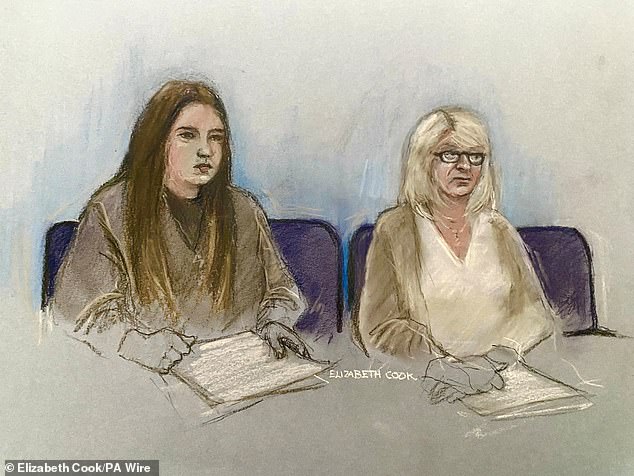
A court sketch of Wandelt (left) and Spragg (right) in the dock at Leicester Crown Court
Later she was also asked about claims by Wandelt has made that she was an almost 70 per cent match to a DNA profile obtained from the floor of the holiday apartment in Portugal, contained within the PJ files, the files from the Portuguese police investigation into Madeleine’s disappearance and released online.
Mr Duck asked if she was aware of the PJ files which he said ‘rightly or wrongly are fairly freely available on the internet’.
She was then asked about a message sent by Wandelt in February 2025 in which she claimed to be a 69.23 per cent match to the DNA floor profile.
The court heard it was a male sample and Ms Hammond was asked to compare it with Mr McCann’s sample.
Mr Duck said: ‘Can you help us with your conclusion?
Ms Hammond said: ‘The floor profile does not match the profile of Gerry McCann. It is a different profile.
‘The components on the profile do not match. Gerald McCann does not match the floor profile so he cannot be the source of that profile.’
Mr Duck said: ‘As far as the floor DNA is concerned did you also conduct an exercise of comparing the floor DNA profile to that of Julia Wandelt?’
Ms Hammond said: ‘Yes I did.’ She was also asked if there was any ‘parent child relationship’ to the floor sample being potential parent, a father, of Julia Wandelt.
Mr Duck said: ‘What please were you able to conclude from your scientific examination?’
Ms Hammond replied: ‘Julia Wandelt is not the child of the person who left the floor profile.’
The court heard Ms Hammond has a degree from Cambridge University in natural sciences and has worked as a forensic scientist for 36 years.
Under cross examination she was asked why the sample from Mr McCann was obtained in 2019.
She said: ‘It related to some of the work I was doing at the time. It was at my request.’
Later the court heard from Stacy Gorman, who is based in Washington in the US, and who has been involved in the Find Madeleine campaign since 2007. She said she would speak to the McCanns around once a month with updates.
Ms Gorman told the court she first started receiving emails from Wandelt claiming to be Madeleine in 2022 but did not reply and instead forwarded them to Operation Grange, the Metropolitan Police investigation into her disappearance, until she was told to stop after she was ruled out.
Ms Gorman told the court she feared Wandelt’s claim to be Madeleine would harm the investigation into her disappearance. She said the website regularly received messages from people claiming to be or having seen Madeleine but Wandelt’s contact was ‘very persistent and much more frequent’.
She said that while Wandelt’s emails were not aggressive, she had a ‘big following’ on social media – ‘more than one million’ and they would ‘bombard’ the email address.
Asked by Nadia Silver, prosecuting: ‘What specifically was your concern about that level of contact?’
Ms Gorman replied: ‘Julia’s contact wasn’t aggressive but a lot of the people were extremely aggressive, they were talking about conspiracy theories…’
Asked what impact it had on her she replied: ‘When it first started I felt very sympathetic and so did Gerry and Kate, they basically said she is unwell and they showed her a lot of grace.’
But she said she became concerned about the impact on the police investigation. She told jurors: ‘If people thought Julia was Madeleine, if people thought Madeleine was found they would stop searching for Madeleine. ‘
Under cross examination she was asked about an offer of £10,000 to be given to a Madeleine charity if a DNA test was carried out. Asked about this Ms Gorman said: ‘I don’t remember that at all.’
The trial continues.