I yearn for the days when we pretended not to have any spies. In our missions abroad, they were known as ‘the unmentionables’, the same word that Victorians once used to describe underwear, necessary but unseen.
My old diplomatic friend Christopher Meyer, who had done his share of embassy duty in dark, sinister places, spoke knowingly of what he called ‘The Organs of Intelligence’, but would go no further.
The old Diplomatic List, now no longer published, listed the telephone number of what it coyly called ‘Century House’, the tatty tower block near Waterloo Station from which the Secret Intelligence Service (SIS) then operated.
I rang it once to see what would happen, but couldn’t think of anything witty to say, and hung up.
An old friend of mine, whose father had been an ambassador, was once invited to a discreet and tasteful building near Trafalgar Square, and asked over a pleasant lunch if he might like to be a spy. He politely turned them down.
It always amused me that these know-all geniuses had failed to discover the rather obvious truth that he was a ferocious supporter of Tony Benn, and not really their type.
We know that they made use of some very unreliable sorts, especially that gaggle of drunks and Communists, Philby, Burgess, Maclean and Blunt who so blatantly betrayed us all in the 1950s.
I can’t think of any great triumphs they have ever scored. In the early months of the Second World War, two of their top operatives were kidnapped on the Dutch border by the Nazis, who already seemed to know rather a lot about SIS, certainly far more than the British public did. They don’t seem to have been much use in preventing the 1956 Suez disaster, or the 2003 Iraq disaster, or David Cameron’s mad and shameful Libyan war in 2011. Did they predict the collapse of the USSR?
And over the past 50 years we have had the books of John le Carre (real name David Cornwell) who knew quite a bit, having worked for our Secret Police, MI5, before switching to SIS. These books, portraying an organisation in thrall to the Americans, trapped in the past and riven by internal suspicion, do not suggest that the Service is especially distinguished or useful.
Technically it is not even allowed to operate on home soil. So why has it been licensed to go public and to go into domestic politics?
Last week the head of SIS, the ultra-mysterious, vaguely unreal Blaise Metreweli, appeared in semi-public. She chose not to venture beyond her own private dining room at SIS’s grandiose new HQ.
After bestowing a sweet smile on the BBC’s intrepid security correspondent, Frank Gardner, she launched into a barrage of official flannel and contentious politics, in which she tiptoed around China, which has been busy all week trampling on the agreement it signed with us to respect freedom in Hong Kong, by jailing the dissident Jimmy Lai, a British citizen. But she spoke of Russia almost as if we were at war with Moscow, where in fact we still have an embassy, and the BBC keeps an excellent correspondent.
Is this her job? I would love it if Parliament would actually debate the Russia-Ukraine issue, but it never does, as there no longer seem to be any independent-minded MPs.
But I am not sure SIS should be doing so. Ms Metreweli is not a minister, responsible to the Commons. However much we may respect our spies, they are there to advise our elected government, not to make or declare policy.
I think they should go back into the shadows, and justify their enormous secret budget by making us safer.
I know that James Bond has been one of our most successful exports, but he never actually existed, and we should not make gods out of his prosaic and politicised successors.
A guide to a century of change
I love old guidebooks and advertisements because they tell the truth about the past which biased historians often miss. My lovely old 1905 Ward Lock guide to London reveals two things that may astonish BBC types.
In that year the guide lists only 17 foreign embassies in London. The whole idea of what amounts to a nation has totally changed in 120 years, which may be why we nowadays have so many wars about borders. The same book notes that the most recent census shows 135,377 persons ‘of foreign birth’ in our then Imperial capital.
It notes where they all lived (the Swiss favoured Westminster, the Italians Holborn, for example) and most of the French citizens in London were non-domestic cooks, while the Germans ‘mostly engaged as waiters, commercial clerks and tailors’.
A golden opportunity missed
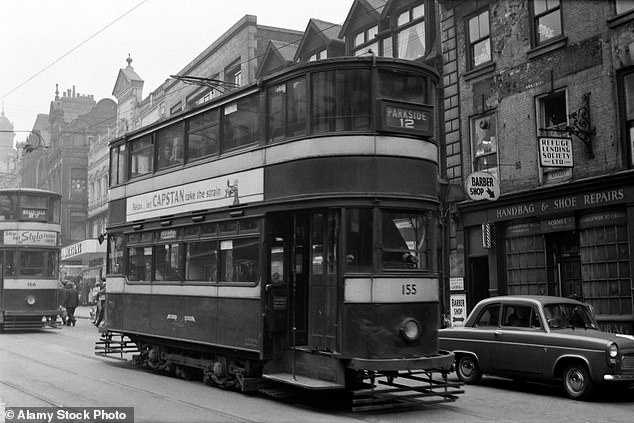
A tram scheme in Leeds has been put off until the 2030s, its old system was axed in 1959
A plan to give poor Leeds trams again has been put off till the 2030s, which I fear means forever. Leeds, like most major British cities, once had a dense tram network, green and civilised.
But the car lobby got rid of them. The writer Keith Waterhouse remembered, as a young reporter in Leeds in the 1950s, some local Alderman boasting that he would soon get rid of them all. They ‘got in the way’ of the cars, which have since turned out to be so noisy, dirty, dangerous and greedy for space. Now, people are grasping this was a mistake. It was the cars that got in the way of the trams.
Cities all over France are rebuilding lost tram networks, luring drivers out of their cars. We will do this in the end. It would be a much better way of spending money than on useless spectaculars such as HS2.
The darker and grimmer life gets, the more Christmas glows and sparkles. It is not tainted by crude commerce or dimmed by bad news on the TV. It is ‘the true light, which lighteth every man that cometh into the world’. I discovered this many years ago in several glum and violent places where I had to spend the treasured season. And so I wish you all a very happy and blessed Christmas, despite everything.