Thousands of pet monkeys could be seized and killed as a ban on keeping the animals looms.
The RSPCA estimates there are between 4,000 and 5,000 marmosets, capuchins, squirrel monkeys and other primates in UK homes.
Under new laws coming into place on April 6, owners will have to prove they can keep monkeys and primates to high ‘zoo-level standards’ as well as require a licence.
But a mere three applications for licences were made to local authorities in England by the start of November, according to a freedom of information request, despite applications being open for a year.
The ban, introduced under Rishi Sunak‘s government, was signed into law in 2024.
Lord Douglas-Miller, former Animal Welfare Minister, said: ‘Anyone who fails to provide the same welfare standards as found in a zoo faces a fine and having the primate removed from their care.’
While local authorities said owners would be given time to meet new regulations, the standards, which include indoor and outdoor access, sufficient cover enclosure size and UV light levels, are zoo level.
It means many owners will likely fail to meet the high standards and face losing their primates.
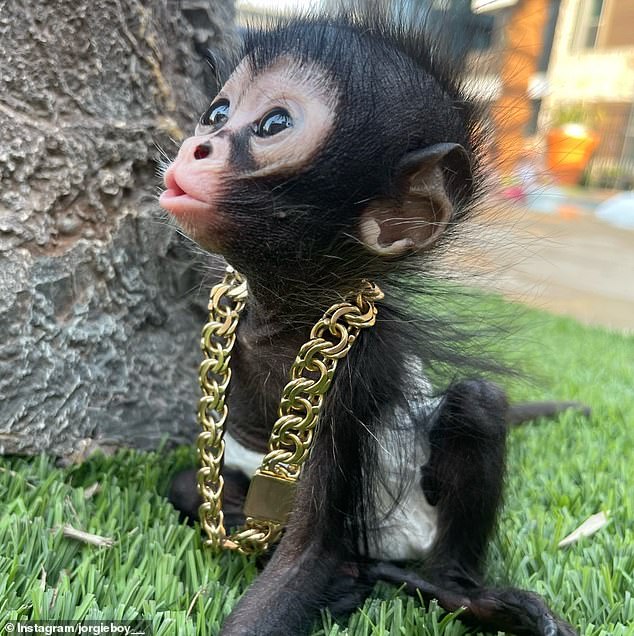
Thousands of pet monkeys could be seized and killed as a ban on keeping the animals looms
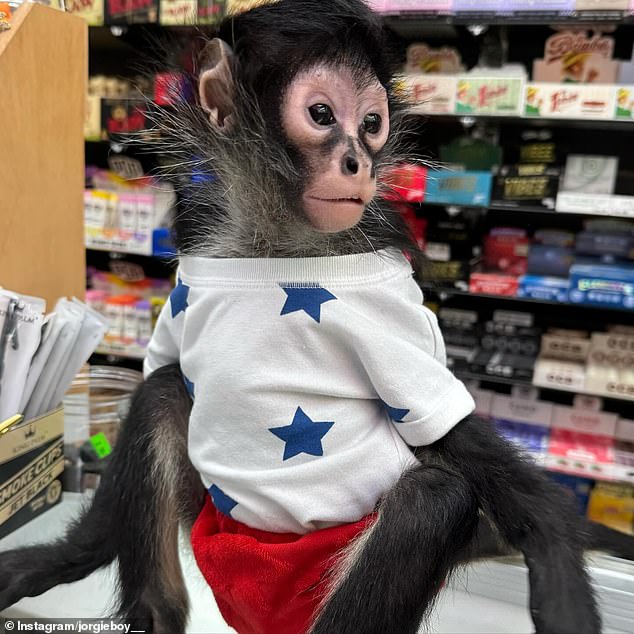
The RSPCA estimates there are between 4,000 and 5,000 marmosets, capuchins, squirrel monkeys and other primates in UK homes
Some could be rehomed in sanctuaries but ill pets could face euthanasia.
Chris Lewis, of Born Free – a wildlife charity – told The Times: ‘As soon as the local licensing authority seizes an animal, it becomes their responsibility.
‘If primates have serious health conditions, there will have to be decisions made as to what is the kindest thing for that animal.’
The trend for keeping monkeys as pets in recent years has been blamed on social media and celebrity monkey enthusiasts including Justin Bieber, whose pet Capuchin monkey OG Mally was confiscated from him in Germany in 2013 by customs officials.
Many owners keep them in poor conditions without a suitable diet or enough daylight.
When the law was introduced, RSPCA Head of Public Affairs David Bowles said: ‘Meeting the needs of monkeys and other primates is practically impossible to do in a household, domestic environment.
‘That’s why this legislation will be a really important moment for animal welfare – ensuring primates can only be kept in an appropriate environment, as we all strive to create a better world for every animal.
‘Too often, our dedicated officers are called to properties where monkeys live in the wrong surroundings, eat totally inappropriate diets and are at risk of suffering behind closed doors. This new law has the potential to change that.’
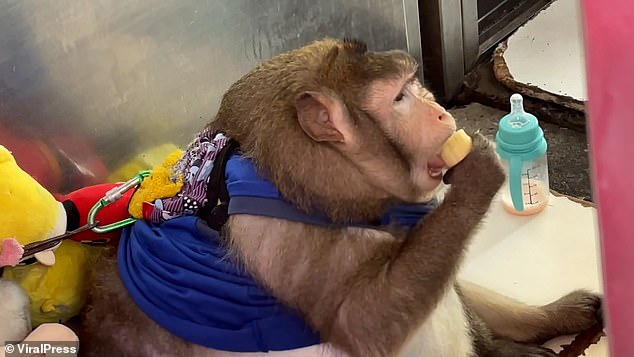
Under new laws coming into place on April 6, owners will have to prove they can keep monkeys and primates to high ‘zoo-level standards’ as well as requiring a licence
The Local Government Association said: ‘It is essential that the new licensing process for keeping primates is fully funded and that councils are supported to implement it.’
The Department for Environment, Food and Rural Affairs said: ‘Primates are highly intelligent and complex animals, and new laws mean that, where they are kept by private keepers, they must be provided with zoo-level welfare standards.
‘We urge private keepers to make sure they are licensed and complying with these high welfare standards, and we are working with local authorities on how to enforce the new licensing scheme.’