Palestine Action’s co–founder can proceed with a High Court challenge against the Government over the group’s ban as a terror organisation, the Court of Appeal has ruled, as it dismissed a Home Office appeal.
Huda Ammori, co–founder of Palestine Action, launched a legal challenge against Home Secretary Yvette Cooper after the group was proscribed as a terror organisation in July.
The decision followed a series of actions by members which culminated in activists breaking into Brize Norton RAF base and vandalising British military planes.
The ban, which began on July 5, made membership of, or support for, the direct action group a criminal offence punishable by up to 14 years in prison.
Mr Justice Chamberlain later cleared Ms Ammori to proceed with a challenge over the ban after finding that two arguments put forward on her behalf were ‘reasonably arguable’.
But in September, the Home Office brought an appeal against this decision to the Court of Appeal in London, claiming a judicial review through the courts should be a ‘remedy of last resort’. This appeal has now been dismissed.
At a hearing last month, barristers for the Home Office said Ms Ammori could bring her legal challenge to the Home Secretary and then the Proscribed Organisations Appeal Commission (POAC), rather than the High Court for a ‘judicial review’.
Lawyers for Ms Ammori said the POAC was not the only suitable place to challenge the lawfulness of a ban.

Palestine Action co–founders Richard Barnard and Huda Ammori, pictured in 2023 – Ms Ammori has won the latest stage in a court battle to challenge the group’s proscription as a terrorist organisation
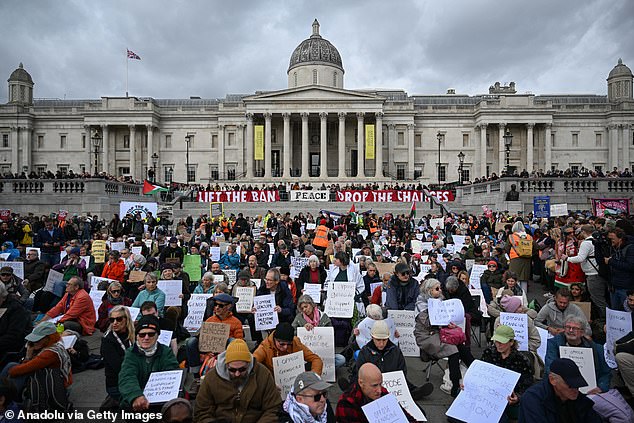
People stage a protest to demand the British government to lift its ban on Palestine Action in Trafalgar Square on Saturday, October 4
Reacting to the ruling handed down on Friday, Ms Ammori described the verdict as a ‘huge victory’ against ‘one of the most extreme attacks on civil liberties in recent British history’.
It comes after weeks of protest in support of the group that have seen more than 2,000 people arrested, mainly for expressing support for a proscribed organisation, according to campaign group Defend Our Juries. A total of 134 people have so far been charged with the offence.
Hundreds have descended on central London every Saturday and unveiled signs that read: ‘I oppose genocide, I support Palestine Action.’
The Home Office last month launched an appeal to prevent the judicial review from going ahead and instead called for the ban to be reviewed by the POAC.
But today judges ruled that this would not be appropriate as this process is not intended in cases where a group wishes to appeal against the initial decision to proscribe it.
They also agreed Ms Ammori can bring two further arguments into the High Court challenge, over whether then–home secretary Yvette Cooper had ‘regard to relevant considerations’ and whether she had complied with her own policies.
Two further grounds of appeal were dismissed.
In a 37–page judgment, the Lady Chief Justice Baroness Carr, sitting with Lord Justice Edis and Lord Justice Lewis, said the process of applying for deproscription and appealing against a refusal at POAC ‘is intended to deal with another situation’.
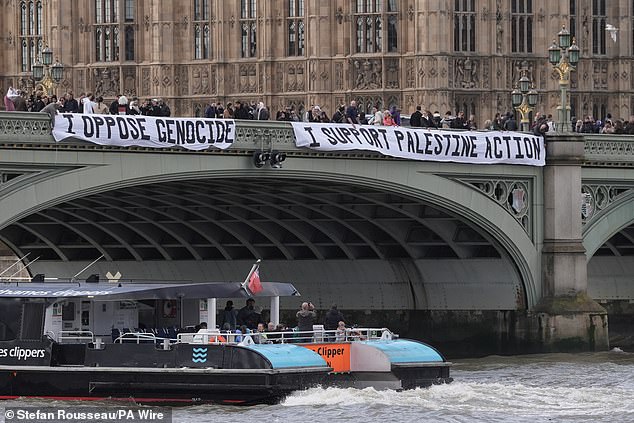
Protesters unfurl a banner on Westminster Bridge as part of a demonstration organised by Defend our Juries, in support of Palestine Action on October 4
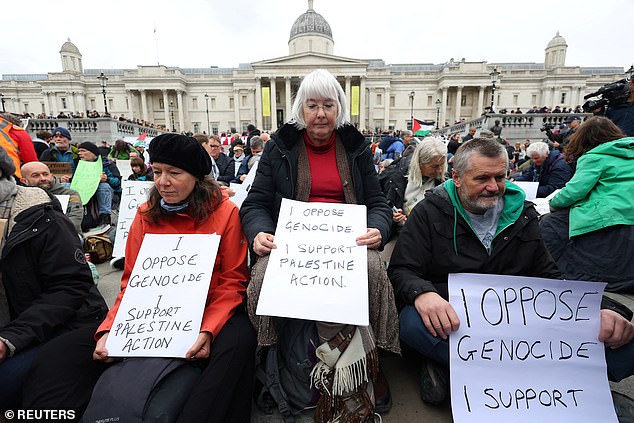
Protesters hold signs declaring their support for Palestine Action during a protest in Trafalgar Square, central London on October 4
Baroness Carr said the process ‘is not intended to be a means of challenging the initial decision to proscribe and does not provide for the removal of the consequences of an initial decision to proscribe an organisation’.
Giving her conclusion, she said that relying on an application to the Home Security and POAC review was not ‘not an available, nor in any event an adequate, alternative remedy to a claim for judicial review of the initial decision to add an organisation to the list of proscribed organisations.’
In a summary of the Court of Appeal’s decision, Baroness Carr added: ‘Judicial review would be a quicker means of challenging the order proscribing Palestine Action than applying to deproscribe.
‘Judicial review would enable the High Court to give an authoritative judgment on whether or not it was lawful to proscribe Palestine Action.
‘That judgment could then be relied on in criminal courts hearing charges against any person arrested in connection with their support of Palestine Action.’
After the ruling Ms Ammori said: ‘This is a landmark victory: not only against one of the most extreme attacks on civil liberties in recent British history, but for the fundamental principle that Government ministers can and must be held accountable when they act unlawfully.
‘The Government’s effort to avoid judicial scrutiny of its blatantly anti–democratic proscription – branding a protest group as ‘terrorists’ for the first time in British history – has backfired spectacularly, and we now head into the judicial review in November with an even stronger legal footing.
‘Arresting peaceful protesters and those disrupting the arms trade is a dangerous misuse of counter–terror resources, with over 2,000 people having now been arrested – a staggering 3,100 percent increase in counter–terror arrests.
‘Rather than being used to protect the public, the Terrorism Act is being used as a political tool to silence them.
‘This ban doesn’t just affect Palestine Action supporters – it casts a chilling shadow over anyone speaking out against Israel’s atrocities and the UK’s complicity in them, and sets a dangerous precedent that can be used against any protest group.
‘It’s time for the Government to listen to the overwhelming and mounting backlash – including from the United Nations, human rights watchdogs and free speech defenders to the former Director of Public Prosecutions, as well as the vast majority of its own Party members and voices across the political spectrum – and lift this widely condemned, utterly Orwellian ban.’
A Home Office spokesperson said: ‘We note the decision made by the Court of Appeal, and will now carefully consider the implications of the ruling.
‘Palestine Action has conducted an escalating campaign. This has involved sustained criminal damage, including to Britain’s national security infrastructure, as well as intimidation, alleged violence and serious injuries.
‘Palestine Action remain a proscribed group and those who support them will face the full force of the law.
‘Everyone should remember: supporting Palestine and supporting a proscribed terrorist group are not the same thing.’
Currently, 81 organisations are already proscribed under the 2000 Act, including Hamas, al Qaida, and National Action.
The judicial review which will examine Palestine Action’s proscription will begin on November 25.
Responding to today’s ruling, Kerry Moscogiuri, Amnesty International UK’s Director of Campaigns and Communications, said: ‘It is welcome news that the court has upheld the decision for the judicial review to go ahead.
‘There are serious human rights concerns around the proscription decision and the consequences it has had on free speech and assembly rights.
‘Amnesty International UK and Liberty will be intervening in the case to raise our urgent concerns about the disproportionate use of the government’s terrorism powers in proscribing Palestine Action.
‘It is clearly in the public interest for the proscription decision to be subject to full judicial scrutiny.’