Our neighbours, whose garden backs onto ours, have had a strong floodlight with sensor installed in their garden.
They say it is for security purposes, which is fair enough, but the light comes on throughout the night – it’s very sensitive.
It’s waking up my six-year-old daughter as she sleeps that side of the house – that’s despite having blackout blinds, as the light is so bright.
I politely knocked and asked if they could switch it off in night-time hours. They were sympathetic and said they’d look into it, but nothing has changed. What’s our next move?
It’s seriously impacting our quality of life, and I don’t understand the need for a light to come on from 10pm to 6am.
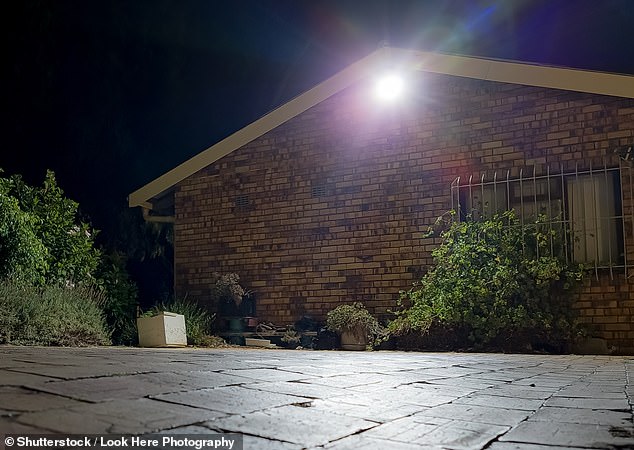
Strong light: A This is Money reader’s neighbour had a bright floodlight with sensor installed, overlooking his daughter’s bedroom (file image)
Jane Denton, of This is Money, replies: A growing number of households seem to be installing glaringly bright lights outside their properties, even when they know full well the lights will be a nuisance for neighbours.
You adopted the right approach in trying to have a polite conversation with your neighbour about the problem, but it has made no difference.
You should consider trying to talk to your neighbour about this once more, before taking further action. You could also try writing a polite note to your neighbour explaining the problem and how it is affecting your family at night. This is something I have done in the past and it did work; the security light was switched off.
Your next step would be to start making a note of the dates and times your daughter’s sleep is interrupted by the light. This diary of incidents would be needed if you made a compliant to your council about your neighbour’s floodlight.
The council would only be able to act if the problems could be branded a statutory nuisance.
An alternative option would be to bring a private nuisance claim against your neighbour. However, going down this route would be costly and time-consuming. I spoke to two solicitors for their thoughts on your problem.

Manjinder Atwal is a director of housing and property litigation at Duncan Lewis Solicitors
Manjinder Atwal, a director of housing and property litigation at Duncan Lewis Solicitors, says: Your frustration in relation to this issue is completely understandable.
Security lighting can be helpful, but when it is excessively bright, badly positioned or overly sensitive, it can cross the line from reasonable use into a legal nuisance.
In England and Wales, this kind of issue usually falls under the law of statutory nuisance.
Local councils have powers under the Environmental Protection Act 1990 to investigate complaints about artificial light, which is prejudicial to health or a nuisance.
Importantly, this does not just mean industrial floodlights, it can also include domestic security lights if they are intrusive enough.
From your description, a powerful sensor light activating repeatedly through the night and shining directly into a child’s bedroom, could potentially meet that threshold.
The test is whether the interference is unreasonable, taking into account factors such as brightness, frequency, direction and the character of the area.
Your first step, which you have already taken, was right: speak to your neighbours calmly and politely.
Most disputes of this kind are resolved informally. If nothing has changed, I would suggest writing a short, polite letter confirming the problem, explaining the impact on your daughter’s sleep, and asking again whether they could adjust the angle, reduce the sensitivity, install a hood or limit the operating hours. Keep a copy.
If that does not work, the next step would be to contact your local council’s environmental health department.
They may ask you to keep a diary for a couple of weeks recording when the light comes on and how it affects you.
An officer can then assess whether it amounts to a statutory nuisance. If they agree, the council can serve an abatement notice requiring the neighbour to remedy the issue. Failure to comply can lead to fines.
Of course, it is worth remembering that your neighbours are entitled to take reasonable steps to protect their home, particularly if they have recently got a dog and are concerned about security.
The law does not prohibit security lighting; it simply requires it to be used in a reasonable fashion.
Court action through a private nuisance claim is technically possible, but it is expensive and should be a last resort. In most cases, council involvement is enough to prompt sensible adjustments.
Ideally, this ends with a practical solution, angling the light downward, reducing its sensitivity, or setting it to switch off after a certain hour.
Small changes such as these can make a big difference to your family’s quality of life without escalating the dispute.
Joanne Ellis, a partner and dispute resolution specialist at Stephensons, says: This must be very difficult for you, especially as it is affecting your daughter’s sleep.
It sounds like there are two issues with the lights: firstly, their sensitivity, and secondly the brightness when they are triggered.
I appreciate that you have already tried to speak with your neighbour, but I would suggest trying again.
Wherever possible, the best way to resolve this is by agreement.

Joanne Ellis is a partner and dispute resolution specialist at Stephensons
In the meantime, I would strongly recommend keeping a log of when the light comes on at unsocial hours or when it wakes your daughter.
Light monitors are available and may help support your log. You should also consider any additional practical steps you could take. Would extra fencing or screening help?
It is possible that the brightness and frequency of the light could amount to a legal nuisance, depending on how unreasonable and excessive it is, and the impact on your reasonable enjoyment of your property.
The starting point would be to take your log to your Local Authority’s Environmental Health Department and ask them to investigate.
They should at least look into your complaint. Local authorities do have powers, including serving an abatement notice on your neighbour and seeking enforcement through the Magistrates’ Court.
Some local authorities also offer free neighbour dispute mediation services, and I would strongly recommend exploring any mediation option to help reach an agreement.
If formal action becomes necessary, you will need a report from an independent expert to assess the extent of the issue and whether the light is unreasonable.
If the report supports your position, you may be able to bring private nuisance proceedings to seek an injunction to limit the use of the light.
Lastly, it is always worth checking your deeds and Land Registry documents to see if there are any provisions, such as restrictive covenants, that may assist you.