Emmanuel Macron’s longer term legacy will not be one of style over substance, but of creating a certain idea of France’s place in the modern world
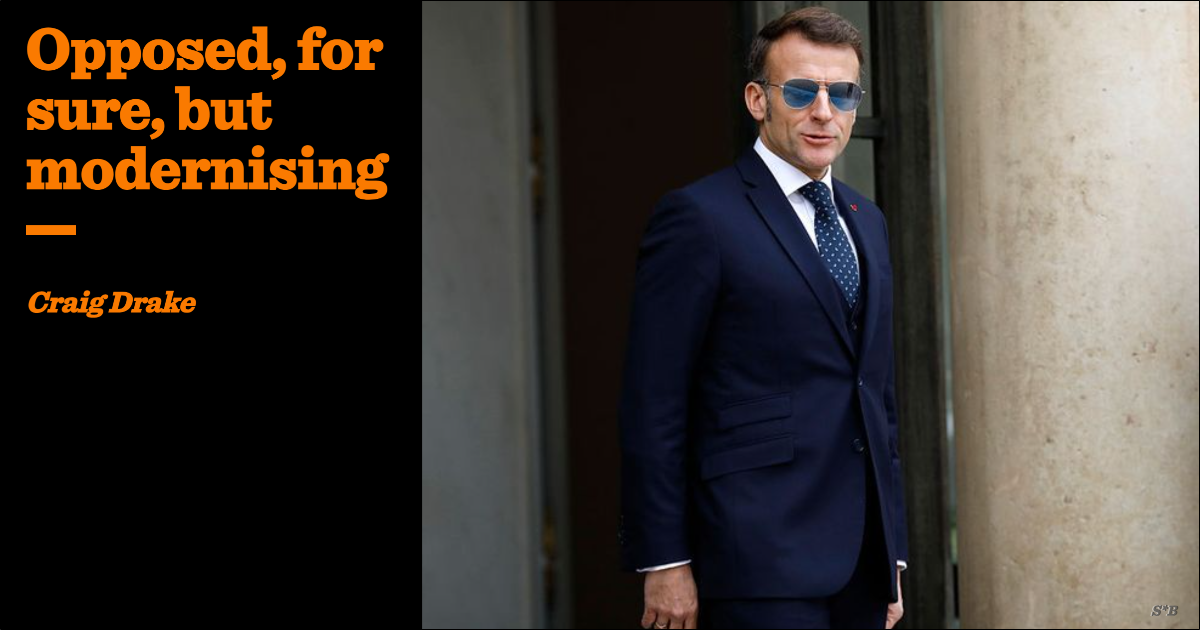
Seeing French President Emmanual Macron sporting his preposterous mirrored aviator sunglasses at every international summit he can fly a jet to, all while a resolution to France’s domestic political situation slips further from his reach, it’s convenient to caricature his legacy of one of much ambition bulldozed by entrenched interests, and of style over substance. But it is short-sighted not to see the cumulative effects of his modernising reforms over his 12 years in politics; not just in terms of his legacy, but for would-be successors seeking to repudiate Macronisme too.
There was a time, not long before Emmanual Macron entered politics, that France felt like a country that was not whole-heartedly taking part in the 21st century. As much as his opponents like to talk of the good old days, they now have to contend with a population that has got used to WFH, Sunday shopping, and working for une start-up rather than slogging away in their home town in the same factory as their uncle. To fail to grasp that is to set yourself up for a large divergence in stated and revealed preferences at the voting urne.
“All political lives, unless they are cut off in midstream at a happy juncture, end in failure, because that is the nature of politics and of human affairs,” Enoch Powell famously said in his biography of Joseph Chamberlain. It’s one of those quotes that used in a political retrospective is probably up there with playing the intro to “Stairway To Heaven” in a guitar shop or opening a piano and tinkling Pachelbel’s Canon. It was true of Margaret Thatcher, but it wasn’t true of her friend Ronald Reagan, nor particularly true of her fellow Tory PM Lord Salisbury. It was however certainly true of the father of the Fifth Republic, Charles de Gaulle, and there will no doubt be many reaching to apply the epitaph to Emmanuel Macron’s political life before he even reaches 50 years of age.
It’s an odd state of affairs in that as a former president that has served for two full quinquennat, Emmanuel Macron will nevertheless be younger on the day of leaving office than all but three French presidents were on the day of their inauguration (Louis-Napoléon Bonaparte, Jean Casimir-Perier and Valéry Giscard d’Estaing, just in case it ever comes up in un pub quiz). But as convenient as Enoch Powell’s maxim may be, it’s not necessarily true in the case of Macron, and to fall too easily into it is to misunderstand the changes made in France — not only under his two terms as President, but also during his term as minister under François Hollande. It is also important to understand the tangible reforms made as part of Macronisme, and why — when push comes to shove — electors choosing his successor will hesitate before throwing the bébé out with the bathwater.
Lots of people that enjoy the rigmarole of British politics — who could name dozens of MPs, reel off rumours around their personal lives, name most of Donald Trump’s cabinet, et cetera — often feel a bit guilty about a lack of real equivalent knowledge about European politics. That’s because for the most part, that dynamic doesn’t really exist. Yes, there is Rachida Dati, the often controversial but seemingly ever present feature of French politics. But there isn’t the Guido Fawkes soap opera, with every coming and going of every lowly SpAd and every local council election that can be mapped onto Matignon and French politics considered worthy of coverage. It’s mostly pretty dull, and behind closed doors.
So it’s forgivable then that the impression of Emmanuel Macron’s presidency in the anglosphere is of ambition thwarted, particularly given the easily comprehensible and television-friendly spectacle of strikes. Youthful, arrogant reforming ambitions, brought back down to earth by union protesters on labour laws, by the Gilets Jaunes on fuel duty, by the cheminots on rail privatisation, by the young and the old protesting together for their inherited rights to retire early.
His legacy is also damned by recency bias, though that is admittedly little to do with perceptions from afar, and a lot to do with political mismanagement that he has a lot to answer for. After Marine Le Pen’s right wing Rassemblement National (RN) won the European Parliamentary elections in 2024 (and it is still functionally “Marine Le Pen’s right wing Rassemblement National” in 2026, regardless of what courts have to say. It is her face plastered all over their own website, not notional leader Jordan Bardella’s), Emmanuel Macron made the surprising, bold, and risky decision to call early legislative elections. The plan promptly blew up in his face, leaving him with an even more fragile centrist minority coalition. Despite looking vaguely like presidential material for 10 minutes in early September 2024, his Gaullist prime minister Michel Barnier lasted for little over three months before being ousted by RN and left wing Jean-Luc Mélenchon’s La France Insoumise (LFI).
His replacement, the political veteran and Minister of National Education in three successive governments in the 90s, François Bayrou attempted to pass a budget in July aimed at modestly reducing the deficit to 4.6% of GDP. Having a taste for blood, parliament rejected the budget, and his position became untenable by September. Enter the shambolic pantomime of “rather Gaullist, Séguinist, fundamentally of the right” prime minister Sébastien Lecornu. Having resigned just 26 days into office and becoming the shortest serving PM in the history of the Fifth Republic, he was reappointed four days later by President Macron having served in the interim as a caretaker prime minister. He was able to partially pass a budget for social security by a 247–234 vote, but in exchange he had his feet held to the fire by the Socialists and by RN on a roster of taxes — the former because they wanted, to and the latter because they could. He used Article 49.3 of the French Constitution, allowing the government to pass legislation without a parliamentary vote, to pass the remaining part of the budget relating to tax revenues, but even then has to give more embarrassing spending to the left in order to survive the subsequent votes of no confidence brought by LFI and by RN.
All in, there is little way to describe it except as a le shitshow, with nobody coming out clean and the stench getting everywhere
Bad strategic decisions were made by Emmanuel Macron, but there is also a belief within the RN camp that the worse they can make France’s situation, the better their chances will be at the 2027 Presidential Election. It would arguably serve them right if the deadlock they helped create led to more elections and a period of cohabitation in which RN were forced to face the consequences of their manoeuvring. Similarly, Les Républicains, traditionally the closest analogue to Britain’s Conservative Party, have been more than happy to team up with the hard left to thwart the government. When faced with a choice between adherence to fiscal restraint and embarrassing Emmanuel Macron, LR has been all too quick to choose frustration over ideology.
There is no doubt that this has tarnished Emmanuel Macron’s legacy. As unlikely as that feels right now, it remains a distant possibility that he is able to hand over the reins to a successor that is able to govern in his image and all of this domestic strife be glossed over. But it is important to take a step back from the current headlines to be able to appreciate the changes brought about by the ethos of Macronisme.
As an outsider, albeit one that has lived the majority of their adult life in France, I would characterise the influence of Emmanuel Macron as having transformed the country from one that felt like it was still living in the long ‘90s, to one that feels like it is living in 2026. That is not to say that all of those changes are unalloyed positives, but it is undeniable that his modernisations have made large, tangible changes to everyday life in a way that has rendered it somewhere much easier to live and work.
The thousands of white collar French expatriates that flocked to London in the 2000s didn’t do it for the weather, the wine, the beaches, and the great skiing. And I don’t think that it would be far wide of the mark to suggest that as a banker at Rothschild, Emmanuel Macron visited his chums in London or New York, contrasted their lives with the staid, extremely conservative world of the French finance sector, and thought that France had some catching up to do.
Even as economics minister under François Hollande, his Loi Macron omnibus bill was somewhat of a catch-all of French expat gripes. Formally a law of “growth, activity and equal economic opportunities”, it sought to tackle rigidities in labour laws, regulated professions, transport, retail, and other sectors. More than two decades after Britain it relaxed laws on Sunday trading, it sought to break some of the rail union stranglehold on intercity transport, it liberalised access to some restricted professions, it made it easier for companies to offer share schemes to employees, it sold off French state interests in airports and telecoms.
As President, his 2017 ordonnances sought to hack away at the clichés of French employment rigidity. Employers faced huge barriers to firings, with uncapped compensation for what could be found to be unfair dismissal, often leading to years of court battles. If you’ve ever felt like what you do for work is a waste of time, my first job out of university was for an employment law firm advising businesses operating in France, and there is only so many times you can say “non” in a day to exasperated clients with bad employees before you start to go a bit mad. The reforms capped potential compensation and decentralised bargaining to allow company-level agreements to override industry level, union-led collective agreements. It helped to ease the rigidity around short-term contracts, where previously as an employer, union-led stipulations often had you feeling that when hiring an 18-year-old you were having to ask yourself whether you would be happy hiring them for the rest of their working life.
Corporate tax reduction, abolition of wealth taxes, a flat 30 percent capital gains tax have all helped to make France a bit less daunting for investors, while the PACTE law made incorporating a new small business far more straightforward.
For all of this, France’s rich lists remain dominated by inherited wealth or by players that dominate markets in traditional sectors. There is no French Mark Zuckerberg, there is certainly no French Elon Musk. And even if there were, it remains unlikely that they would remain in France. That is a failing of Emmanual Macron, and one that probably stings.
However, above everything, if you are a Brit and you want to see the greatest manifestation of the post-dirigiste liberalism of Emmanuel Macron’s tenure, it is DoctoLib. Open your phone, allow location detection, select the kind of health specialist required, scroll the reviews online, pick a time slot that suits you, turn up, and the app takes care of documents and a seamless link to your healthcare coverage. It may have been first founded in 2013, but it is undeniable that Macronite desire for La French Tech led to its rapid scaling, whether via encouragement of investment in the ecosystem, or through law changes such as his government implementing nationwide reimbursement for telemedicine consultations through France’s public health insurance, treating them equivalently to in-person visits. It is undeniably very French entrepreneurship — using private sector innovation to better allocate state resources — but it nevertheless is a model that demonstrated that the Macron vision wasn’t just talk, and could yield real results.
Would all of these changes have happened under another government simply as a function of a global France being forced to align with Anglo Saxon businesses? Given the hard-fought nature of the changes, it’s easy to argue not. Each and every reform was fought tooth and nail, and it would have been much more convenient to simply focus on headline deficit numbers and meddling with pension reforms and public sector spending.
You can be dismissive of the McKinsey-influenced doctrines of Emmanuel Macron’s government, and you may find his thrall to SF start-up culture uncomfortably globalist and un-French. But Macronisme represents the only clear vision in French politics for how to align France with that shine of the 21st century, and his legacy will be dictated by just how much voters demand an equivalent vision from any successor.