The battle over control of the world’s oil – and oil prices – has begun in earnest.
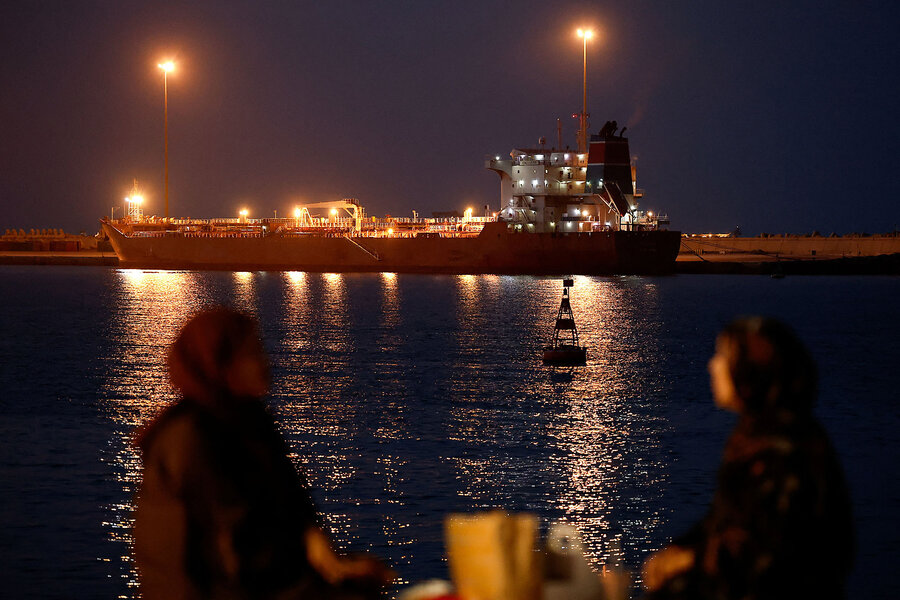
On one side, Iran has stepped up its attacks on shipping in and around the Persian Gulf, in a bid to make oil as expensive as possible for Western consumers. On Thursday, the price of Brent crude briefly topped $100 a barrel after two oil tankers were hit off the coast of Iraq and at least three cargo ships were attacked near Iran’s coast.
On the other side, while the United States and Israel pound Iranian military assets, the Trump administration and the International Energy Agency plan to release a record 400 million barrels of oil from strategic petroleum reserves to dampen the price surge. It is the IEA’s biggest-ever drawdown of strategic reserves.
Why We Wrote This
The disruption of oil-tanker traffic is becoming an increasingly urgent problem for the global economy. A key question is how quickly safe passage can be restored – either through force or by ending the war.
“The war in the Middle East is creating the largest supply disruption in the history of the global oil market,” the IEA said in a report released on Thursday.
That disruption is putting increasingly intense pressure on the U.S. military. Oil-consuming nations in the East as well as the West are asking how quickly and effectively oil shipping in the Gulf can be made safe again. If it is relatively quick, Iran loses a big lever to try to end the U.S.-Israeli bombing campaign against it. If the process is long, higher oil prices will put increasing pressure on the Trump administration to end the war.
A successful reopening of the waterway would put Iran in a difficult spot. It could try a negotiated settlement or use its biggest lever: direct attacks on Gulf oil facilities, destroying as much oil infrastructure as possible. Such attacks would send oil prices soaring, but they would almost certainly also lead to retaliatory U.S.-Israel attacks or takeovers of Iran’s oil facilities.
“Iran’s ‘use it or lose it’ dilemma could provoke a miscalculation in Tehran, resorting to … direct attacks on Arab Gulf oil facilities – as its last card to play to stave off defeat,” Clayton Seigle, senior fellow at the Center for Strategic and International Studies, wrote in an article before the war broke out.
How difficult is opening the Gulf?
It’s a thorny problem. Iran has several options to attack oil tankers in the Gulf, especially in the chokepoint known as the Strait of Hormuz. In the past, it has used swarms of fast boats, missiles, drones, and submarines to attack ships in the strait.

The U.S. military has managed to degrade several of these threats by destroying or incapacitating fast boats, missiles and submarines. But drones remain a potent weapon. “Antidrone capacity is beginning to catch up,” says Bryan Clark, a former assistant to the U.S. chief of naval operations and now a senior fellow at the Hudson Institute. “But some [drones] are always going to get through.”
So, the military will have to pair antidrone technology – such as unmanned airplanes – with military escorts to shield tankers, he adds.
There are reports that Iran has also begun to mine the strait.
Mines are a cheap but effective way to make shipping dangerous. And it could take weeks or months to clear, military experts say. But it would also make it impossible for Iran to export its own oil.
President Donald Trump floated the idea of American warships escorting oil tankers through the Gulf, which the U.S. military has done in previous engagements. The challenge is that a barrage of missiles or drones could overwhelm U.S. defenses. If even only a few get through, they could destroy an expensive tanker.
The Pentagon says it is working on solutions. U.S. Central Command said U.S. forces eliminated multiple Iranian naval vessels on Tuesday, including 16 minelayers, near the Strait of Hormuz. But after a Pentagon briefing with congressional leaders on Wednesday, Democratic Sen. Chris Murphy of Connecticut posted on X: “[On] the Strait of Hormuz, they had NO PLAN. I can’t go into more detail about how Iran gums up the Strait, but suffice [to] say, right now, they don’t know how to get it safely back open.”
How long will it take?
This is a key question, because the longer the delay, the higher oil prices could rise in the short term. Energy Secretary Chris Wright told CNBC on Thursday that the U.S. Navy isn’t ready to start escorting ships because “all of our military assets right now are focused on destroying Iran’s offensive capabilities and the manufacturing industry that supplies their offensive capabilities.” He said naval escorts in the strait might start by the end of the month.
Military experts say much depends on Iran’s moves. Tehran might be content to let most traffic through and attack select tankers, keeping the risks and insurance rates of Gulf shipping elevated.
Mining the strait would delay the process of reopening. Some of the best minesweepers are in Europe, but they go slow and are “months away from showing up at the Strait of Hormuz,” says retired Rear Adm. Mark Montgomery, who is now a senior fellow at the Foundation for Defense of Democracies. America’s more limited resources in the region could clear the strait “over significant numbers of weeks.”

One risk is that the situation escalates before it improves – such as if Iranian drone attacks on shipping prompted the U.S. to put troops on the ground near the strait or on Kharg Island, the hub for Iran’s oil exports. That could create new risks for both sides because Iran would be tempted to escalate attacks on Gulf-nation oil infrastructure as well as directly against U.S. troops.
What’s the global economic effect?
Oil prices have swung wildly, and the volatility is likely to continue as Gulf nations, oil shippers, and energy traders assess the progress in reducing Iran’s threat to the region. Eliminating it might prove impossible. But bringing the risks down to acceptable levels could be enough to get the oil flowing again.
President Trump is trying to further reduce the risks to shippers by having a U.S. federal agency step in to cover losses in the Gulf. Many maritime insurers are refusing to cover tankers operating in the Gulf. Last week, the U.S. International Development Finance Corp. announced a $20 billion reinsurance plan to reimburse maritime insurers who suffer losses as a result of attacks. Details regarding the coverage remain sketchy.
The economic effects are likely to linger. If the Gulf is reopened, production facilities shut down during the war will also have to reopen. It will take more time to fill the gap in supplies caused by the war.
“Ending the war does not mean ending the crisis,” oil analyst Anas Alhajji told E&E News on Thursday.
Average gas prices in the U.S. edged up slightly on Thursday to reach $3.60 a gallon, according to the AAA tracker. A month ago, they stood at $2.94.
Staff writer Anna Mulrine Grobe contributed reporting.