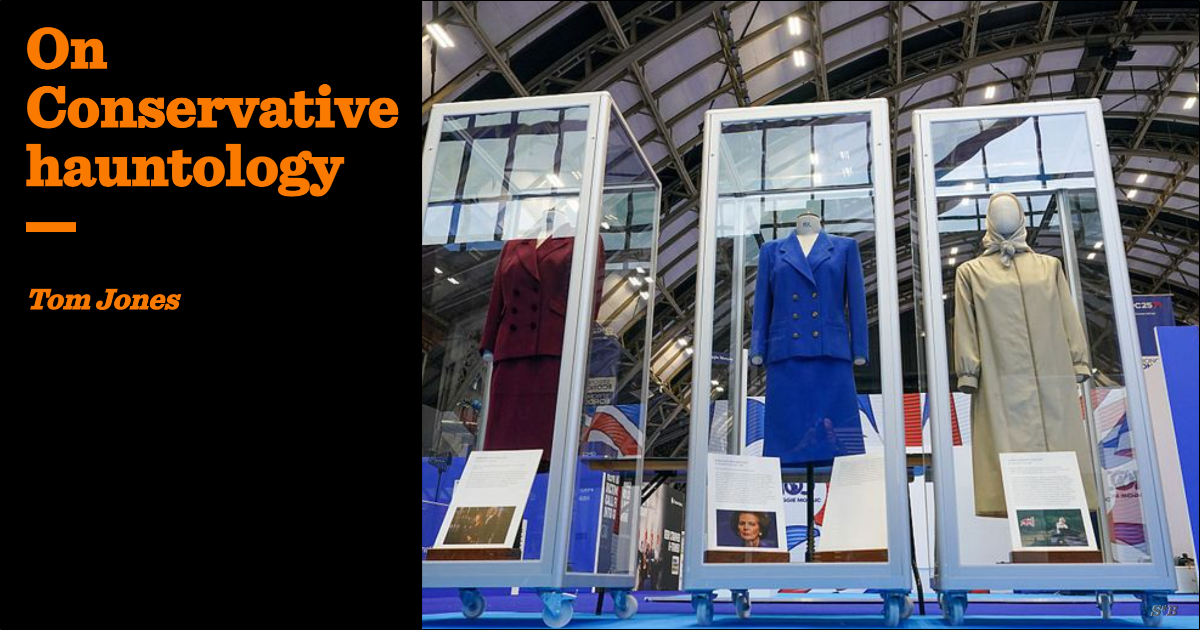
A ghost haunted the Conservative Party Conference — the ghost of what might have been
A spectre is haunting the Conservative Party.
This year is a century since her birth, and there is a memorial to that end at the Tory Party Conference — three of her dresses, worn in her most famous moments, the red velvet suit she wore leaving Downing Street for the last time, the blue suit she wore for “no, no, no!”, and the hood she wore when photographed on top of a tank.
Wisely, they have been kept in glass boxes — out of the reach of the fawning, sticky-with-we-won’t-ask-what hands of Tory Boys.
The party’s obsession with the Great Lady has no comparison in British politics; Labour politicians speak often of Clement Attlee, but their lionisation of him does not extend to the bizarre levels of worship that Margaret Thatcher seems to garner from the Tory ranks. During almost every leadership election, the candidates compulsively compare themselves to her. It has become a comfort to any embattled leader to claim they are being “written off like her”. At any one time every female MP we have is consciously either coupling or decoupling from her memory, and her audience are consciously or unconsciously doing the same. Not that this stops males from imitating her, either. I have many anecdotal examples of members voting for their preferred leader based on the fact they reminded more of Mrs Thatcher by one than the other. William Atkinson recently admitted to having a poster of her above his bed at 15, which came down when she first brought a girl home. I know of cases where it stayed up.
Thatcher’s hold over the party cannot be accurately described as a personality cult. Most states that have or have had a cult of personality around their leaders are Marxist; the Kims in North Korea, Mao in China, Tito in Yugoslavia, Lenin in Russia. But these — as did those of right wing leaders like Hitler or Mussolini — sat within a wider, and living, ideological framework. In Britain today, Thatcherism is in about as good a state as Thatcher herself. Nor can the worship of her be compared to political personality cults of individual leaders (Saddam, Franco, Peron or Stalin), which rarely lasted beyond the leader’s death or removal.
Thatcher worship, in fact, does not align with the five defining traits that historian Jan Plamper identified as distinguishing modern personality cults from earlier forms. These contemporary cults are secular and rooted in popular sovereignty; they revolve exclusively around male figures; they aim to engage the entire populace rather than just elites or the ruling class; they rely heavily on mass media; and they thrive in environments where media control is sufficient to suppress competing cults.
Maybe a better comparison would be their predecessors in pre-modern societies. Through the principle of the divine right of kings, various societies have come to see their leaders as Gods; Ancient Egypt, Imperial Japan, the Inca, the Aztecs, Tibet, Siam.
Perhaps the closest model is the Roman Empire, which not only deified the Emperor but established an Imperial Cult that associated emperors with the divinely sanctioned auctoritas of the Roman State — a wider part of a system of official Roman deities, whose cults were essential to Rome’s survival (and whose neglect was therefore treasonous).
A dead emperor deemed deserving of such reverence could be formally declared a state divinity through a Senate vote, thereby undergoing apotheosis. This elevation functioned as a potent expression of religious, political, and moral judgement. Apotheosis enabled reigning emperors to align themselves with a prestigious lineage of deified predecessors, selectively excluding those considered dishonorable or unpopular, thus reinforcing their legitimacy and authority through divine association. For a party whose leadership contests descend all-too frequently into “who is most like Mrs T”, this is a familiar trend.
Thatcher’s dethroning still brings a tear to the eye of many a Tory
But it may be more appropriate to describe the Conservatives as the first hauntological political party. Hauntology — a portmanteau of the words “haunting” and “ontology” — was introduced by French philosopher Jacques Derrida in his 1993 work Spectres of Marx. Rather than focusing on literal hauntings, Derrida argues that we are haunted by the failure of the future. He challenges the idea of linear time to posit that cultural and political ideas from the past — especially those that were never fully realized — linger in the present like ghosts. His main argument, as may be guessed by the title, is that though Marxism was declared “dead” after the Cold War, it still influences Western society. The spectre of communism Marx wrote of is still haunting Europe — even if it is only as a disappearing future.
If the future can be experienced as a haunting, then this explains her spectral hold over us. Thatcher’s dethroning still brings a tear to the eye of many a Tory — even those who were not around to witness it. I have been told by people in their 20s that “she could have gone on”. That she could have, but didn’t, is why she exerts such hauntological power over the party; we have lost an imagined future, a vision of utopia that would have been delivered — if only she had gone on.
Anthony Seldon, historian and biographer of successive British prime ministers, said the tendency to hark back to Thatcher “has always been there but is accentuated at the moment because the party doesn’t know what it is or what it wants”. We are in such a bind now. The old Tory party is dying, and the new one struggles to be born. As Will writes, Thatcher worship “prevents the party from developing a coherent response to the very different challenges Britain faces today”. Without a little exorcism, we shall remain haunted by what might have been — instead of focussing on what must be done.