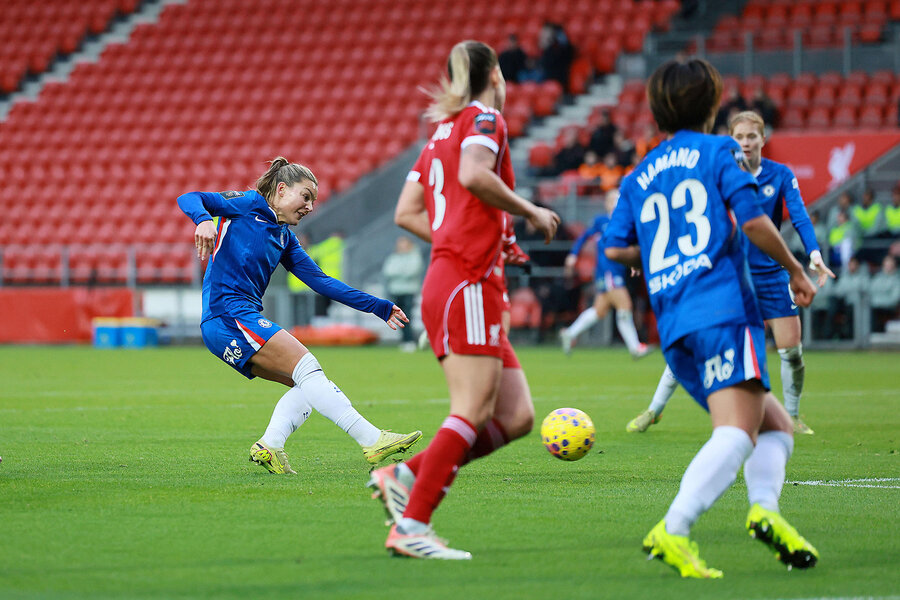
It’s a warm Sunday afternoon, and the Chelsea Women’s soccer team is playing the London City Lionesses, whose jerseys boast “Everyone Watches Women’s Sports” in large letters across the front.
And it’s true. The crowd is a perfect microcosm of London itself. There are men and women, old folks and young, sports fanatics and casual attendees enjoying a fall afternoon. Dads hold kids on their laps. A couple hoots and hollers. A young girl surrounded by giddy friends wears a glittering crown that reads, “It’s my birthday!”
Here at the stadium, the mood is energetic yet laid back – a departure from the rowdier atmosphere at men’s games. There’s no jostling or fighting. Team chants ripple through the crowd of 10,441, and when Chelsea scores its final goal for a 2-0 win, the stadium erupts in singing and high-fiving.
Why We Wrote This
English sports and the fandom around soccer, in particular, have long had a rowdy reputation. That’s ebbed in recent years, but nowhere so clearly as with the rise of women’s sports, which are proving both popular and successful.
“Everyone here can have a good time,” says Laura Daboo, a primary school teacher attending the game with her partner, Ray Lynham, who sports a Chelsea scarf and jersey with defender Ellie Carpenter’s name and number. “Quite a lot of kids come along to these games, which is really nice,” Mr. Lynham adds.
This joyful, inclusive atmosphere is one of the factors experts and fans point to when trying to parse the stunning rise of women’s sports in the United Kingdom. In the past six years, since the 2019 FIFA Women’s World Cup in France and the 2022 UEFA European Women’s Football Championship, women’s sports have started to take coveted spots on newspaper headlines, drawn massive crowds at stadiums and pubs, broken viewership records, and even increased girls’ sports participation across the country.
This past summer, that shift was on full display. England’s national soccer team, the Lionesses, became back-to-back UEFA Women’s Euro champs in July, beating Spain on penalty kicks. Two months later, the national rugby team, the Red Roses, won the Women’s Rugby World Cup. Across the U.K., people watched – and celebrated.
“The progress was really slow, but suddenly there’s been traction,” says Elizabeth Pike, a professor of sport, health, and exercise, and head of the Institute of Sport at the University of Hertfordshire.

The evidence is everywhere. It’s in viewership data, which shows 12.2 million people watched the 2025 Euros on BBC platforms, making it the most watched television moment of 2025 across all TV broadcasters. It’s in the fact that rugby match attendance has more than doubled, and yearly funding for girls’ and women’s rugby has tripled since 2021. Barbie has made a doll version of Red Roses fullback Ellie Kildunne, who incidentally was interviewed during an NFL game at Wembley Stadium.
And while soccer reigns supreme in England as the national sport, this wave is carrying other sports along with it. In their latest report, U.K.-based charity Women’s Sport Trust found cricket, netball, and tennis “are all actually doing brilliantly and all progressing,” says Tammy Parlour, the trust’s CEO and co-founder.
Changing the narrative
A clear narrative shift – which, in turn, has shaped the environment and vibe surrounding women’s sports – has been key. Specifically, there’s been a strategic attempt to set itself apart from the men’s game, Dr. Pike says. There’s no “football hooliganism” – drunken, violent, and rowdy behavior – at women’s games. “Its strength is in doing it differently,” Dr. Pike says. “That shift in thinking has been pivotal.”
The women’s game also feels more authentic for some fans who are tired of how melodramatic and overpaid the men’s game is. “It’s all just become so distorted,” says Stephanie Hilborne, CEO of the charity Women in Sport, that a lot of people actually “prefer the women’s game because it felt real, more relatable.”
It helps that the culture around women’s sports is changing, too. “Fans, especially young women, want to see people like themselves represented and are engaging more and more, particularly across digital and social channels,” says Ms. Parlour.
A major bump in women’s sports visibility has been largely the result of social media and groundbreaking broadcast deals that brought games into homes across the U.K.
It started small: The 2016 Olympics sparked excitement around gold medal-winning heptathlete Jessica Ennis-Hill, followed by a big win for England at the 2018 Netball Commonwealth Games. Then, in 2019, BBC Sport started airing select women’s football games and launched an initiative called #ChangeTheGame to, in the outlet’s words, “showcase female athletes in a way they never have been before.” And in 2021, the BBC and Sky Sports announced a landmark, three-year broadcast deal with the Women’s Super League, the top competitive tier in English women’s soccer.
“What’s actually happened, particularly in the last five years, is they’ve let us see brilliant women’s team sport,” says Ms. Hilborne. And the impact is apparent.

Women’s Sport Trust has worked hard to collect data that shows the strides women’s sports have made. “We’re seeing more people watching. We’re seeing they’re watching for longer, and we’re seeing they’re coming back as well, which is all fantastic,” says Ms. Parlour.
More spectators means more interest from companies willing to become a sponsor. That investment helps boost the level of play and visibility, which brings in more fans and money. “It becomes that virtuous circle,” says Dr. Pike.
Investing in the future
As it turns out, if you tweak the narrative and funnel money into player development, gear, facilities, and broadcast deals, you can transform an industry.
In recent years, investors like Barclays, CVC Capital Partners, and billionaire Michele Kang have started to realize there’s massive potential in the untapped market of women’s sports. In March, Deloitte predicted global revenues in women’s elite sports would reach at least $2.35 billion in 2025. “Five years ago, we were constantly having to convince people why it was important, why they should be getting involved,” says Ms. Parlour. “We don’t have to do that anymore. […] Everybody wants to be involved.”
Instead of “Why should we think about women’s sport?” the question has become, “Why aren’t we?” says Dr. Pike.
There are clear benefits to sponsoring women’s sports, too. Namely, alignment with company values. And women’s sports – seen as more wholesome – provide a unique opportunity. Plus, “If you’re going to invest in men’s sport, particularly men’s football, you’re talking about millions and millions [of pounds],” Dr. Pike points out. “You don’t need to invest that amount in women’s sport, and the return on the investment is better.”
From Dr. Pike’s point of view, the British government has “made a massive difference” in boosting women’s sports by hosting tournaments and funding programs. The U.K. is set to host the FIFA Women’s World Cup in 2035, and the government has created a task force to address barriers to equal access, ensure “best in class facilities,” and support players and audiences.
Ms. Hilborne, for her part, thinks the change everyone is seeing rides more on the shoulders of decades-long, grassroots, women-led efforts. “It was the likes of us banging the drums back in the day. … It was brilliant women writing letters to the newspapers, letters to BBC,” she says, and people who supported female players and coaches.
Next year, women’s sports have another chance to take center stage as England and Wales host cricket’s ICC Women’s T20 World Cup. Ms. Parlour’s request is quite simple. “Keep going. Keep showing up. Watch it, share, comment, attend, talk about it,” she says. “Those individual actions make such a difference. Visibility is power.”