Holding the door open for strangers and using a knife and fork correctly may have been dismissed as outdated by a generation raised on TikTok and antidepressants.
But a new study has found that young Britons still value old-fashioned manners ahead of other qualities they seek in a partner – including good looks.
Both women and men identified ‘good manners’ and ‘politeness’ as a top characteristic they look for, challenging other research suggesting old-fashioned manners are seen as outdated by Gen Z.
The study for the Marriage Foundation thinktank asked more than 2,000 British adults aged 18-35 what they look for in a partner (green flags) and what are their biggest turn-offs (red flags).
The survey found 86 per cent of women and 74 per cent of men said ‘honesty’ was the number one green flag, followed by ‘kindness’ with 80 per cent and 68 per cent respectively.

Using a mobile phone at the dinner table is considered to be a modern bad-manner (stock image)
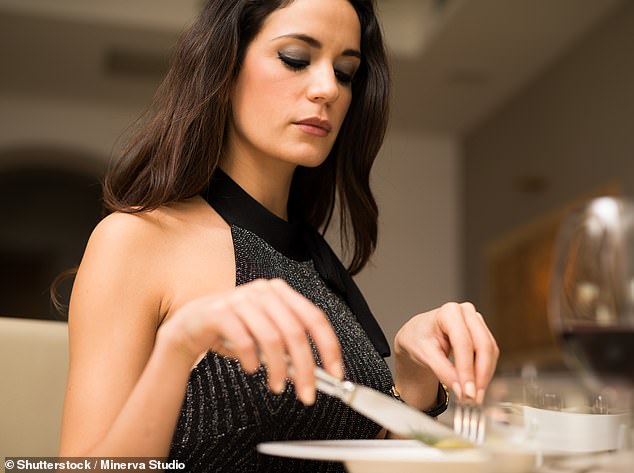
Keeping your elbows off the table and not talking with your mouth full are classic bad manners (stock image)
Politeness and good manners were also seen as key attributes by both sexes – with 67 per cent of women and 53 per cent of men saying they are qualities they seek in a partner.
By contrast, just 23 per cent of men and 35 per cent of women gave ‘looks’ as a green flag.
Demonstrating the importance of politeness and good manners, nearly six in 10 women (57 per cent) and over four in 10 men (43 per cent) said bad manners were a deal breaker for them.
The biggest ‘red flags’ for young Brits were ‘putdowns in public’, identified by 87 per cent of women and 69 per cent of men, and ‘putdowns in private’, identified by 81 per cent of women and 59 per cent of men. Next was being ‘flirty to other people’ with 69 per cent and 54 per cent respectively.
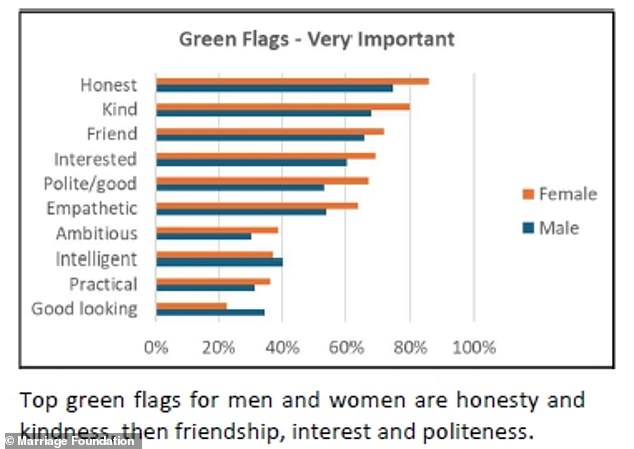
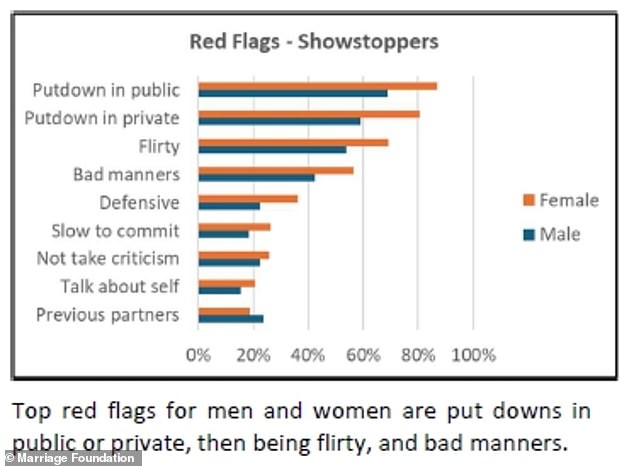
Harry Benson, Marriage Foundation’s research director, said: ‘Some surveys have suggested that traditional manners were seen as old-fashioned, even outdated, but as our data clearly shows, if you want to attract a partner, you had better be kind and watch your Ps and Qs.’
The study found that women, in almost every category, were more likely to say that a particular trait was important than men. Looks was the only quality more important to men than women, rated ‘very important’ by 35 per cent of men compared to 23 per cent of women.
However the survey of 2,008 adults by pollster Whitestone Insight found that, despite this, men and women do tend to look for the same things in relationships and avoid the same things.
Marital status also affected what people said, with significantly more married men and women saying that intelligence, ambition, being practical and looks were important than single people.
Mr Benson said: ‘The results show that overwhelmingly both men and women look for the same things in a potential partner or their spouse. They value honesty, kindness and good manners, while shunning those who are rude, flirty and bad-mannered.’
He added that the findings are ‘proof that a belief in what some might call “traditional values” and marriage remains the gold standard of relationships’ in the UK to this day.