The future of the UK’s relationship with the European Convention on Human Rights is now hotly debated in our politics. It is a source of major division amongst the main political parties. The Conservative Party and Reform UK have both pledged to withdraw from the ECHR, while the Labour Government has ruled out leaving but plans to work with other member states to reform how the Strasbourg Court deals with immigration cases. For their part, the Green Party and the Liberal Democrats are deeply committed to the status quo.
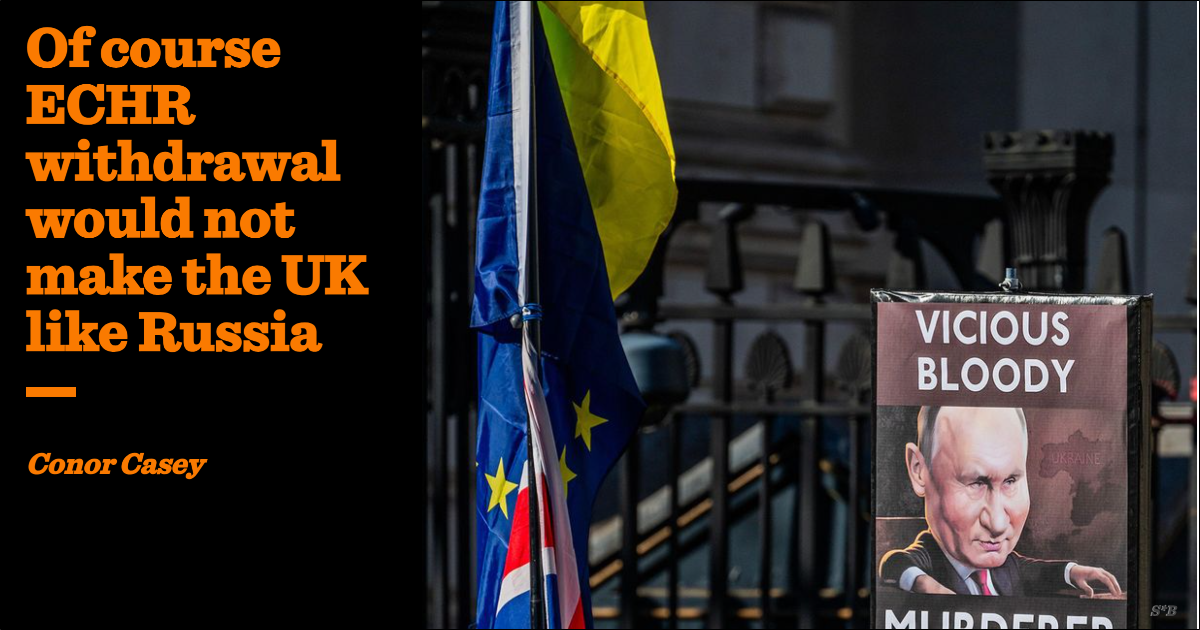
There are serious arguments to be made for and against the proposition that leaving the ECHR would be in the best interests of the UK. But there is one argument against leaving the ECHR that is patently unserious, despite its repetition at the highest levels of politics. This is the argument that ECHR withdrawal would somehow place the UK “in company” with Belarus and Russia, two other European countries that are not parties to the ECHR. These are countries whose regimes routinely violate human rights and persecute political opposition, and lack free and fair elections, judicial independence, and the rule of law.
Those that make the “Russia argument” against leaving the ECHR rarely spell out in detail what it means to say that the UK would be in the same “camp” as Belarus and Russia. But what this rhetoric sometimes implies is that leaving the ECHR would make the UK more like these authoritarian countries in some serious way, for example that it would make our political life more oppressive, intolerant of political dissent, and less protective of political freedom or human rights.
Despite the serious implausibility of comparing the politics of a stable free democracy like the UK with these highly authoritarian states, the argument is trotted out by senior politicians across the major parties. It has been made by the Prime Minister, Home Secretary, and Attorney General, as well as senior figures in the Conservative Party, Liberal Democrats, and the Scottish National Party. In a new Policy Exchange paper published yesterday, my colleagues Richard Ekins KC (Hon) and Sir Stephen Laws KC (Hon) and I dismantle their claims.
If the UK chose to leave the ECHR, it would be outside the Convention for reasons entirely distinct to Russia and Belarus. Russia did not freely choose to leave the jurisdiction of the Strasbourg Court — it was expelled from the Council of Europe for waging a war of aggression against a fellow member state. Meanwhile, because it is a dictatorship Belarus has never been accepted as a member of the Council of Europe and thus has never been eligible to be a signatory to the ECHR. While under the military rule of the Colonels, Greece did voluntarily withdraw from the ECHR in 1969, it left before it was pushed, after having engaged in mass human rights violations.
The UK is not considering leaving the ECHR in order to escape accountability for wrongdoing. Rather, as Lord Gove put it in his foreword to our Policy Exchange paper, if:
… the UK decides in the end to leave the ECHR, we will do so in order to affirm our parliamentary democracy and to defend the rule of law, bringing to an end open-ended rights adjudication and resisting the Strasbourg Court’s abuse of its jurisdiction.
Outside the ECHR, the UK would not be in the same “camp” as Belarus or Russia. More sensible and measured comparators would be Australia, Canada, and New Zealand, three countries with similar constitutional and political cultures to the UK, who manage to robustly protect political freedoms and human rights without the supervision of the Strasbourg Court. The former Lord Chancellor Jack Straw (who personally favours reform of the ECHR over withdrawal) persuasively argues in his foreword to the report that “those who want the UK to stay attached to the ECHR must do better than trot out the tired, indeed nonsensical, argument that if we were to leave we would be in the same ‘club’ as Russia or Belarus”.
The “Russia argument” hinges on the profoundly implausible notion that the ECHR is the only, or even the main, guarantor of the UK’s protection of human rights and political freedoms. In reality, the respect given to human rights and political freedoms in the UK is a product of deeply rooted constitutional, political, and cultural characteristics.
Governance in the UK has many long-standing features and traits entirely alien to authoritarian states like Russia and Belarus. These include our vibrant democratic culture, a long-standing tradition of peaceful parliamentary politics with a prominent role for an Official Opposition, a strong parliamentary committee system, a well-respected and independent judiciary, an independent criminal defence bar, a free press, an independent prosecution service, and a deep cultural commitment to law and legality. None of these features of our common life owes their existence or vibrancy to the ECHR.
Human rights are protected in the UK by ordinary law and especially by detailed legislation that adheres to the discipline of the rule of law. This law is administered by well-regulated public bodies, including independent police services and other enforcement authorities, supervised by impartial courts. The provision that our law makes for human rights remains open to political debate, but it is at least clear where the political arguments should be. If the UK leaves the ECHR, there is every reason to expect our constitutional system to continue in this form to provide strong and clear protection for human rights, political freedoms, and the rule of law.
In his foreword to our paper, Lord Sumption describes the ongoing debate as an “important issue which deserves to be taken seriously, and not trivialized by resort to cheap rhetorical slogans”. In future conversation, lazy comparisons with Russia and Belarus should be firmly rejected.