As health authorities increasingly warn against drinking, a new study has revealed which alcoholic beverages most raise the risk of death from chronic diseases.
After consuming alcohol, the body breaks it down into the toxic byproduct acetaldehyde, which attacks DNA and tissues, leading to inflammation, immune suppression and hormonal imbalances.
It’s been classified a probable carcinogen in humans, meaning it could increase the risk of several forms of cancer.
The Dietary Guidelines for Americans stress to ‘consume less alcohol for better overall health,’ while the World Health Organization‘s belief is that no amount of alcohol is ‘safe.’
A new study of over 340,000 British adults echoed those sentiments, finding less consumption overall was associated with improved health outcomes, especially for those with heart disease or other chronic conditions.
But the research team also found that based on participant questionnaires and reported alcohol intake, the risks of dying from cancer and heart disease were greater for those drinking even low to moderate amounts of certain drinks than others.
Spirits, beer and cider were associated with significantly greater risks of death overall compared to the same level of wine consumption.
Moderate wine drinkers – one to three glasses a day – were significantly less likely to die of heart disease compared to those who never or occasionally drink. However, the risk of death was nine percent higher for spirits, beer and cider drinkers, even those with a low intake – less than one to 1.5 drinks.

A new study has suggested beer, spirits and cider are more associated with cancer and heart disease than wine (stock image)
‘Our findings help clarify previously mixed evidence on low to moderate alcohol consumption,’ Dr Zhangling Chen, senior study author and professor at the Second Xiangya Hospital, Central South University in China, said.
‘These findings can help refine guidance, emphasizing that the health risks of alcohol depend not only on the amount of alcohol consumed, but also on the type of beverage.
‘Even low to moderate intake of spirits, beer or cider is linked to higher mortality, while low to moderate intake of wine may carry lower risk.’
While the exact mechanisms are unclear, experts behind the study believe wine may be more protective against chronic disease because certain types, especially red wine, contain polyphenols and antioxidants, compounds that reduce inflammation related to heart disease.
The team also noted wine is more likely to be consumed with higher quality, healthy meals, such as those that align with the Mediterranean diet, while spirits, beer and cider usually are paired with less healthy, fried foods.
‘Taken together, these factors suggest that the type of alcohol, how it is consumed and the associated lifestyle behaviors all contribute to the observed differences in mortality risk,’ Chen said.
The full analysis is due to be presented on March 28 at the American College of Cardiology (ACC) Annual Scientific Session & Expo in New Orleans.

The researchers noted wine has antioxidants and is usually consumed alongside healthier foods than beer, spirits or cider, which could make it healthier (stock image)
The researchers analyzed alcohol consumption habits and mortality outcomes among 340,924 people who participated in the UK Biobank study between 2006 and 2022.
Each participant completed a dietary questionnaire when they enrolled in the study and were put into one of four groups based on their intake, which was measured by grams of pure alcohol per week.
For reference, a 12-ounce can of beer, a five-ounce glass of wine and 1.5-ounce shot of spirits each contain about 14g of pure alcohol.
People consuming less than 20g (about 1.5 standard drinks) per week were classified as never or occasional drinkers.
Men who drank between 20g per week and 20g per day, along with women consuming between 20g per week and 10g per day, had low alcohol consumption.
Meanwhile, consuming 20g to 40g (about 1.5 to three standard drinks) for men and 10g to 20g for women per day was considered moderate. Daily consumption of more than 40g (about three drinks) for men and 20g (about 1.5 drinks) for women was deemed high.
Health outcomes were tracked for 13 years on average.
The team found that compared to never or occasional drinkers, those with high alcohol consumption were 24 percent more likely to die of any cause, 36 percent more likely to die of cancer and 14 percent more likely to die of heart disease.
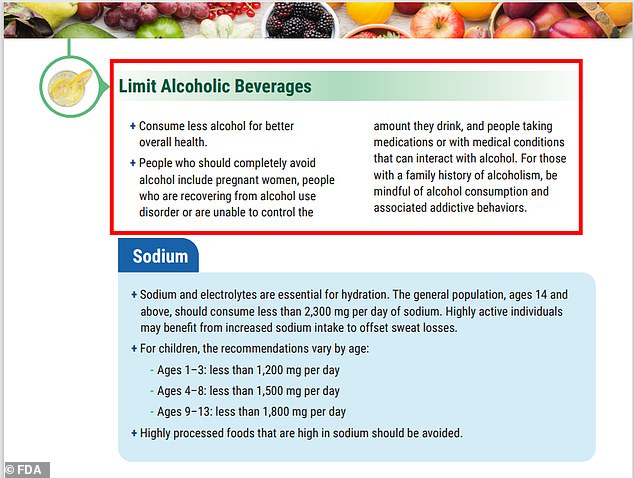
The above shows the recommendations for alcohol consumption outlined in the Dietary Guidelines for Americans
Join the debate
Would findings like this make you cut down on alcohol – or switch what you drink?
But when looking at low and moderate consumption, wine set itself apart as the potentially healthier choice.
The researchers found moderate wine drinkers were at a 21 percent lower risk of dying from heart disease compared to those who never or occasionally drank.
However, those who drank low amounts of spirits, beer or cider had a nine percent higher risk of death from heart disease than those who never drank or only did so occasionally.
The data was adjusted to account for socioeconomic status, lifestyle factors and family history of conditions such as diabetes, heart disease and cancer.
‘These results come from the general population, and in certain high-risk groups, such as people with chronic diseases or cardiovascular conditions, the risks could be even higher,’ Chen said.
In the US, previous recommendations were one drink or less per day for women and two drinks per day or less for men. However, the new 2025-2030 dietary guidelines removed the specific daily limits in favor of general moderation, advising adults to ‘consume less alcohol for better overall health.’