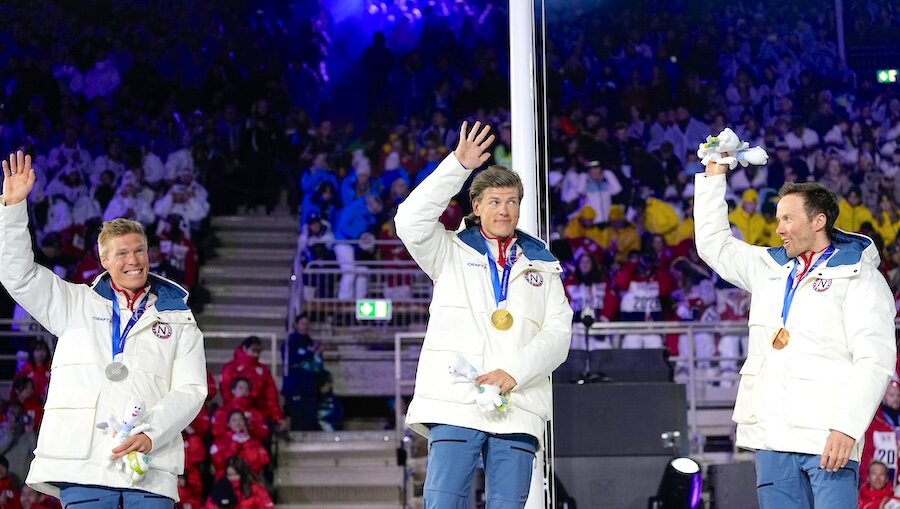
Fresh off a record 18 gold medals at the February Winter Olympics, Norway heads into the March Winter Paralympics holding the most cumulative golds in the history of those games (140).
But its international sports successes are not confined just to those performed on snow and ice, both of which are plentiful in Norway. The country of just 5.6 million people also fields winning athletes in soccer, tennis, golf – and even Olympic beach volleyball.
This record is all the more notable for Norwegians’ unconventional approach to developing high-caliber athletes: When introducing children to sports, schools, parents, and local sports clubs seek to build on their innate joy in the fun and friendship of physical activity. Youthful curiosity and interest in exploring a variety of sports are encouraged, through high school and up to college age. National guidelines forbid competitive teams, scorekeeping, or ranking for children below age 12. And they emphasize that children should help plan and execute sports activities, and determine their level of participation.
“What the Norwegians know … is that the most important thing is that children enjoy sport and come back again and again,” observed former Olympian Cath Bishop in The Guardian recently. “Norway plays the long game.” This hints at a patient trust in young people’s capacity to continually grow and develop new skills – athletic, technical, and personal.
Take Norwegian cross-country skier Johannes Klæbo, who has won the most golds of any Winter Olympian (11). As a young boy, he was an avid soccer player. It took several years of coaching and practice before he improved enough to specialize in skiing at the age of 15.
“When you try different sports … you develop the social skills to handle different kinds of people,” Tore Øvebrø, Norway’s director of elite sports, told CNN recently. When youth have that “broad learning base,” he said, it becomes “easier to build a high-performance culture; they know who they are, what they want.”
This view contrasts with the emphasis on early talent identification and specialization in other countries. In the United States, 81% of students ranked “having fun” as their biggest motivation for playing sports – well above “winning games/championships,” according to a 2021 Aspen Institute survey. Yet, 70% of youth athletes drop out of organized sports by age 13, burned out by the pressure to win or due to injury.
“This not only diminishes the pipeline of elite athletes,” according to Brad Stulberg, a University of Michigan academic and a proponent of the Norwegian model. “It also creates a hindrance for healthy habits and all the character lessons kids can learn from sport.”
As Mr. Øvebrø had commented just before the previous Winter Olympics in 2022, Norway’s approach is akin to “developing citizens and not only athletes.” That’s proving to be a winning recipe – for the competitors and their country.