Fifteen-year-old Shabaz Ali keeps one eye on his wristwatch and the other on the dirt path winding through a meadow in his highland town, Tangmarg.
“Three, two, one. It’s 5 o’clock!” he calls out. “Where’s Shabir?”
For members of the nomadic Bakarwal communities in Indian-administered Kashmir, timekeeping means survival. Children like Shabaz earn hourly wages for shepherding animals, gathering firewood, or loading trucks with goods for sale.
Why We Wrote This
Nomadic children typically lack the opportunity to gain high-tech skills. One digital initiative in Kashmir expands the children’s sense of their own possibilities.
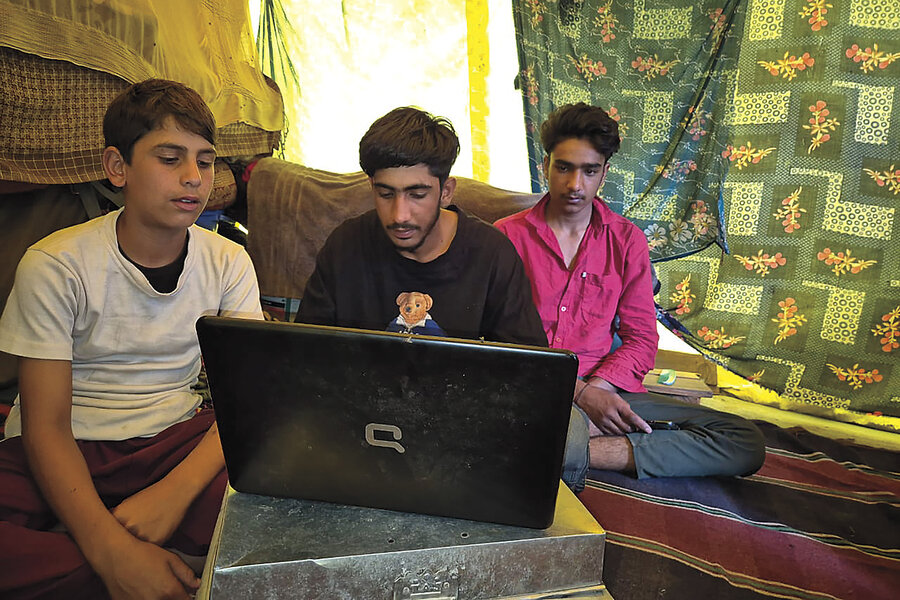
Today, Shabaz isn’t tracking time for wages. A rumble echoes through the valley, which is dotted with tents and thin wooden houses that creak with the mountain wind. Shabir Khatana, Shabaz’s friend who runs a shop in town, pulls up on an old red motorcycle. Shabaz snatches up Mr. Khatana’s cellphone – their shared lifeline – and dashes into the Ali family’s large tent.
The internet connection is strongest in the back corner, so Shabaz crouches there and opens the Zoom app. Aamir Sir, a volunteer mentor from the city of Srinagar, some 55 kilometers (35 miles) away, is waiting onscreen to teach animation and video editing to Shabaz and other students as part of a grassroots effort to open more pathways for nomadic children.
Breaking barriers
For generations, education has been a distant dream for the tribal Bakarwal families who migrate with livestock between summer pastures and winter shelters. Few families settle in one area long enough for their children to attend school. Most Bakarwal children, especially girls, grow up herding animals, working as dishwashers, or begging on streets.
But since mid-2024, an initiative led by urban young people across India has begun connecting Bakarwal children to digital training in animation, coding, and web design. It’s about more than education; it’s about fulfilling the children’s ambitions, developing their confidence, and in some cases, generating income for their families.

The transformation began when Zubair Lone, who recently graduated from college in Chandigarh, saw Bakarwal children washing dishes at his sister’s wedding.
“Little children, some no older than 7, were cleaning up the wedding venue,” he recalls. “When I spoke with them, they told me something that stunned me: This was continuous. Both boys and girls saw working in people’s homes as just life.”
Some of the children had never held a book. “It broke me,” Mr. Lone says. “That night, I called my friends and said, ‘If we don’t do this, no one will.’”
He reached out to nearly 18 people, forming a group committed to change through volunteer work.
“God has given us so much in terms of money and information,” he told them. “Our one or two hours a day can mean a lot for someone.”
The group, called Sukoon Digital, now has 14 active volunteers, stretching from Srinagar to Chennai. They include computer science students as well as graphic designers and other professionals who run digital training sessions across nomadic settlements in Baramulla, Budgam, and Kupwara districts.
From tents to tech
The first week of classes, the challenge seemed overwhelming to Mr. Lone. Most of the children didn’t know the basics about smartphones or computers, even though some already navigate YouTube and WhatsApp on their parents’ devices.
“I have to start from the very beginning,” Mr. Lone says. “Simple English words, how to hold a mouse, what the internet even means. Only then can we move on.”
The concept is straightforward: Children borrow smartphones from shops, siblings, or Sukoon’s volunteer teachers, and then join Zoom sessions in which mentors guide them through designing websites, creating digital artwork, and even setting up freelancer profiles. Classes are held on weekends and evenings, after the children’s work tasks are complete.

Seventeen-year-old Bilquees Jan used to spend her days tending sheep and decorating mud walls with floral patterns. “I thought I’d never do anything beyond making tea and applying henna,” she says.
After more than 35 Sukoon sessions on graphic design, she has begun taking freelance orders, including to create social media ads for a Srinagar-based café. Her instructor, Afifa Qadri, teaches remotely from Mumbai’s rural outskirts, sometimes on patchy networks powered by solar panels.
“There’s something incredibly powerful about watching a girl who never saw a computer start using [design tools] Canva or Figma,” says Ms. Qadri, who has a computer science degree and works at a tech startup.
Another success story is 19-year-old Zahid Ahmed, who creates short cartoons on YouTube featuring village jokes, stories about nomadic life, and videos promoting safety. In 12 months, Zahid says, he has earned more than $1,000 from freelance work and ad revenue. (A typical Bakarwal family’s annual income ranges between $600 and $800.)
“I couldn’t believe it when someone from Delhi messaged me for custom animation,” Zahid says. His father, though not understanding how YouTube works, told him, “Keep using it if it helps buy rice.”
Zahid started learning a year ago, initially traveling 2 kilometers to a friend’s house daily for electricity. After nearly 50 sessions, he created his first cartoon movie. His dream: to create his own animation studio, similar to Pixar.
While helping children earn money motivates participation, volunteers focus on the children’s sense of their own possibilities.
“The idea of a career beyond labor doesn’t exist when you live your entire life on the move,” says Mr. Sir, the volunteer in Srinagar, who makes a living teaching social media marketing. “Our goal is to change that perspective – to convey that you are important and your creativity is valuable.”
Most participating children are semi-
literate or have dropped out of school. According to Sukoon, about 60% have never touched a computer. Volunteers begin teaching basic digital literacy – typing, browsing the internet, emailing – before advancing to creative tools such as animation software or basic Python programming.
About 200 children have participated, though patchy internet and shifting grazing routes make regular attendance challenging. “Some kids attend once weekly; others only when there’s mobile data,” says Rayees Khan, a filmmaker who co-founded Sukoon with Mr. Lone.
The group, which operates without formal funding, relies on donations and income that volunteers pool from part-time work. Solar chargers, power banks, and mobile data packs are shared among students. While a Srinagar businessman recently donated three laptops, most work continues on borrowed smartphones and is frequently interrupted by inclement weather or the children’s work tasks.
Many nomadic settlements lack a reliable WiFi signal, forcing children to climb hills or hang hot-spot devices from tree branches. Volunteer Sameer Gul recalls a girl who climbed her tent’s wooden beams every Sunday for animation classes, balancing her brother’s phone on a hook while taking in the sun.
“Sukoon isn’t a replacement for formal schooling, but it’s a powerful complement,” says Kuber Ahmad, a Srinagar-based education consultant who advises the local government on tribal learning policies.
The collective is exploring offline-first tools, including preloaded tablets and solar-
powered media kits, for areas where live sessions aren’t feasible. It also plans to train older students like Bilquees and Zahid as mentors, rooting learning within the community.
Back in the meadow, Shabaz finishes his Zoom session as twilight approaches. His tent grows dim, and sheep bleat for water outside. “I want to be a video editor,” he says shyly. “Maybe work on a movie someday.”
For the first time, his dream doesn’t seem impossible.
This article was produced in collaboration with Egab, a media startup.