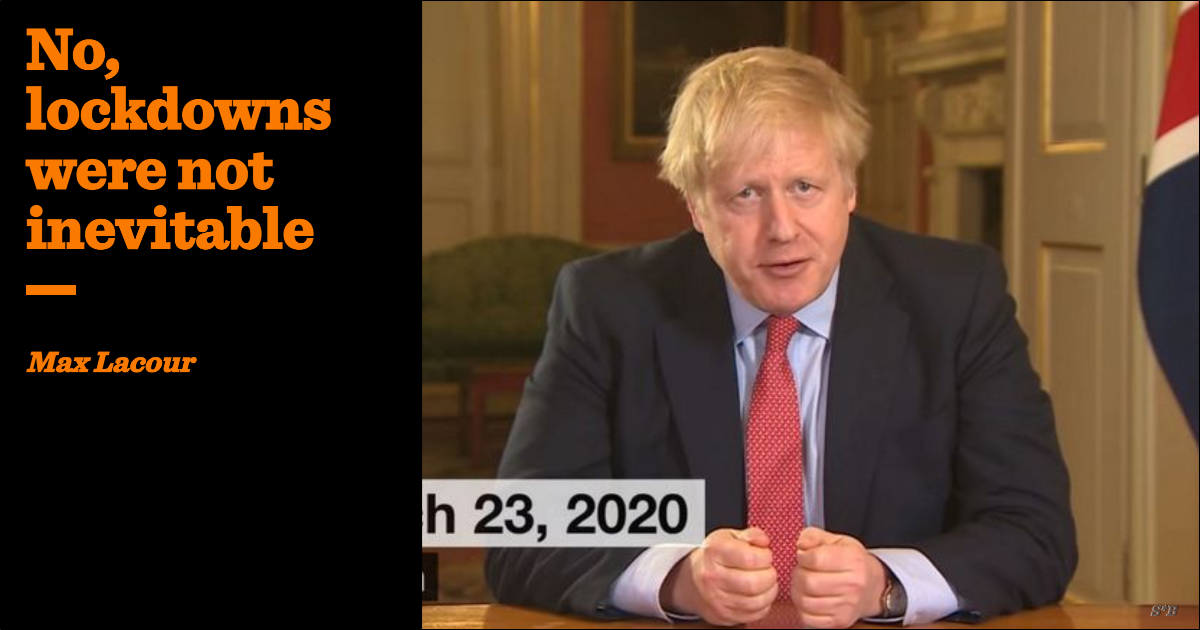
‘Tis the season again, not to be merry, but to scream impotently into a pillow over the Hallett inquiry’s latest report into the UK’s handling of the COVID-19 pandemic. Much has already been written since the second report (focussing on core decision-making and political governance) was published last Thursday, and more will inevitably follow in the coming weeks and months, as people have time to actually read and properly digest the two-volume, 800-page behemoth. For now, however, it is worth dwelling on one of its more startling conclusions, namely, that by mid-March 2020 a full lockdown was “inevitable”:
The UK government and devolved administrations had received clear and compelling advice [by the week of March 16th to 23rd] that the exponential growth in transmission, in the absence of a mandatory lockdown, would be likely to lead to loss of life on a scale that was reasonably to be regarded as unconscionable and unacceptable. No government, acting in accordance with its overarching duty to preserve life, could ignore such advice or tolerate the number of deaths envisaged. The government’s laudable aim was therefore to minimise the numbers of deaths, particularly among the elderly and vulnerable, and to prevent the healthcare systems across the UK from collapsing at all costs. In this, they acted in common with many other countries. (vol.1, p.213—emphases mine)
In my reading, this argument has two parts (both emphasised above). First, there is the claim that the government received “clear and compelling advice” that in the absence of a full lockdown, Britain would face a wave of mortality, largely driven by deaths amongst the elderly and otherwise vulnerable and by the overwhelming of NHS capacity. Second, there is the claim that this wave of mortality was “reasonably to be regarded as unconscionable and unacceptable”, with the ensuing conclusion that a full lockdown — being the only way to avoid an “unacceptable” situation, and “unacceptable” situations needing to be avoided — was inevitable. Let’s consider each of these claims and whether they justify the conclusion that a full lockdown was inevitable.
- “… clear and compelling advice…”
In a way, it is hard to deny that the British government received “clear and compelling advice”: what could be clearer or more compelling than a frightening-looking epidemiological chart, accompanied by a puce-faced Dominic Cummings shouting some variation of, “Line goes up, Boris, but it can be stopped by a lockdown. If you don’t lockdown and people die, then it will be your fault!”? So, in a literal sense, the argument’s first claim is true. Presumably, however, the Hallett report means something more than this; presumably, it is saying that the scientific advice — that Britain was facing a crushing wave of mortality, that the NHS was threatening to collapse, and that full lockdown was the only way to prevent these horrors — was a sound basis on which to act as it did. And this is hard not to scoff at.
The advice that government considered over the week of March 16th was almost entirely based on a handful of epidemiological models produced by SPI-M (the British government’s advisory group on infectious disease modelling and epidemiology) and Cummings’s team. These models were larded with so many barely-acknowledged fudges and uncertainties that I can only list a few here. Consider the most notorious of these models: Imperial College London’s (ICL) Report 9, which projected around 500,000 deaths over a two-year period in the case of an unmitigated epidemic (i.e. an epidemic against which no measures, not even voluntary behaviour change, were taken). Models like Report 9 are often subjected to analyses that test how sensitive their outputs are to small variations in parameters about whose values modellers have been forced to make educated guesses. These analyses assist modellers in making a judgement about how much confidence they should have in their model’s projections. Report 9, however, served as the basis for pro-lockdown advice without having been subjected to such an analysis and when it was finally done nearly a year later, it found that the ICL model did not justify confidence in a full lockdown’s benefits. In treating Report 9 as the basis for policy, decision-makers had been flying blind in a cockpit with windows painted to look like the sky.
Report 9’s claims about mortality and NHS collapse merited scepticism. By mid-to-late March, competing teams of modellers (not directly involved with Britain’s COVID decision-making) showed that existing data was compatible with fatality rates many times lower than the one assumed by the ICL team. A month later, another team showed that, when applied to Sweden where pandemic measures fell well short of a full lockdown, the ICL model produced a death figure sixteen times higher than the one being observed in vivo. Similarly, there was uncertainty about the model’s claims that the NHS would have been unable to adapt to increased demand, as the Hallett report itself acknowledges: “It cannot be known whether […] the health services across the UK would have collapsed if there had been no lockdown” (Nightingale hospitals were built, after all) (vol.1 p.213).
Finally, and more generally, there was much disagreement about lockdown’s efficacy in controlling a respiratory disease’s spread; simply put, there was no real-world evidence to consider, as mass quarantines of the proposed scale and duration had never been tried. And the broader literature on the efficacy of mass quarantine to manage respiratory diseases was, it is fair to say, mixed. While the government advisors largely drew on simulation studies and historical reanalyses of the patchy measures implemented by American cities during the Spanish Flu, multiple reviews found little evidence that measures like quarantine are effective in managing pandemic influenza. These included a WHO report, published in September 2019, that described the evidence for quarantining asymptomatic exposed people as being of “very low” quality. Of course, as with Report 9’s parameter values, much of this uncertainty (about looming mortality, NHS collapse, and mass quarantine’s efficacy) was simply absent from the “clear and compelling” advice that government received in mid-March 2020. Indeed, it was precisely such silences over uncertainty that made the advice particularly clear and compelling.
What was never in doubt, however, was the way that a lockdown would violate our civil liberties or the havoc that it could wreak in our lives (the former is definitional, the latter had been repeatedly warned about but was also just obvious to the non-addled), although again these clear and compelling dangers did not prominently feature in the advice. Obviously, uncertainty is a fixture of decision-making in emergency situations, and so advisors have to make value-judgements in constructing and presenting their advice to governments (starting with the questionable judgement that counterfactual models of different policy scenarios are a robust source of information in an epidemic’s early stages).
While the advice was in one sense “clear and compelling”, it was in a more substantial sense panicky and parochial
Accordingly it might be suggested that the choice to foreground catastrophic predictions about mortality and NHS collapse reflected a pessimistic value-judgement appropriate to the time; that is, that we should assume the worst, so as to be safe rather than sorry. But this justification is a terrible one. For starters, as stated above, we knew with some certainty that lockdowns were not “safe” so why should the possibility of NHS collapse have been given more weight than the certainty of lockdown harms? Next, there is no reason why such a maximally prudential approach should involve assuming that lockdowns would be effective. Surely, a true pessimist would have assumed the maximum number of COVID deaths and lockdown inefficacy, in which case advisors could only have counselled isolation and care of the sick, burying the dead, developing a vaccine, and toughing it out. A better explanation of these value-judgements would need to examine the advisors’ worldviews and account for their incentives to provide attention-grabbing advice.
In the meantime, I’ll just insist on the following: while the advice was in one sense “clear and compelling”, it was in a more substantial sense panicky and parochial. Had the advice been better — had it been more honest about the existing uncertainties and shaped by sounder value-judgements — then lockdown would not have seemed inevitable.
- “[L]oss of life on a scale that was […] unacceptable.”
Here, the Hallett report appears to be making a moral argument, so I will assess it on those terms (as opposed to, for example, assessing it as a sociological claim about what would have been politically tenable in early 2020, irrespective of its rightness or wrongness). More precisely, the report tells us that the prospective levels of death were “unacceptable” because, in tolerating them, government would have been failing in its “overarching duty to preserve life”. Lockdown, this implies, was inevitable because it was the only way to “preserve life”, an implication that, I believe, is a gross absurdity.
To see why, consider what “preserve life” means. What is “life”, this thing that our government has a duty to preserve? At one level, there is an easy answer to this: “life” is a statistical unit corresponding to a non-dead person, that can be counted, aggregated, and displayed in tables or charts of vital statistics. On these terms, the government’s duty to “preserve life” corresponds to a duty to optimise the contents of its tables and charts and to ensure that the numbers do not drop off or change in certain ways (“to minimise the number of deaths”). Crucially, this version of the duty to “preserve life” pays little attention to the particular lives being preserved, treating them instead as the fungible components of the real object of interest: the overall statistical distribution or pattern.
The problem here is that particular lives (or, better still, the people who lead them) are not fungible. On the contrary, each of us, with our distinctive constellation of needs, vulnerabilities, and priorities, is unavoidably particular. An activity that feels irrelevant or entirely frivolous to me (e.g. horse-riding), may be essential to another person (e.g. a disabled child who depends on horse-riding to maintain her mobility and mood). And to meet our needs and pursue our priorities — in short, to get on with the business of living — each of us also depends on a particular network of interpersonal connections and interactions, from our family and friends to the faceless people with specialised skills to produce the goods and services upon which we rely. Of course, neither our needs and priorities nor our networks are fixed, and each will shift in response to changes in the other and to sudden shocks like a wave of disease. But again, how our needs and priorities shift, and the new relations required to meet them, will be particular to each of us. Beyond basics like water and food, there is no way, not even in the midst of a pandemic, to make general claims about what is or is not essential to people’s lives. Lives are lived in their details; precisely those details that lives-qua-fungible-statistical-units obscure.
Lockdowns … were a direct attack on life itself
With non-fungibility duly placed back at the heart of our understanding of life, the duty to “preserve life” looks very different to the one glossed above: it stops being about optimising for a particular statistical outcome, and focuses instead on fostering the conditions under which individual people are able to negotiate their particular needs and priorities. This does not mean ignoring a sudden surge of disease, but rather favouring policies that allow people to make their own decisions about what matters to them, to form new relations as needed, and to live well, whatever that means given the circumstances. So, while the duty to “preserve life” is compatible with measures like a large-scale expansion of NHS care capacity or assisting voluntary self-isolation, it flatly precludes a lockdown. Lockdowns, in forcing a single priority (“Flatten The Curve”, “Save Our NHS”) on us all and nuking our freedom to associate and form new relations, were a direct attack on life itself (properly understood as non-fungible).
On these terms, the Hallett report’s claim that a full lockdown was the only way to “preserve life” is flatly absurd.
So no, contrary to what the Hallett inquiry’s second report says, a full lockdown was not “inevitable”. Had the scientific advice been better, and had the government had a better understanding of its duty to “preserve life”, then a lockdown might have been dismissed for what it was: an aberration and a bitter attack on what it means to live and die as a human being. Please let it never happen again.