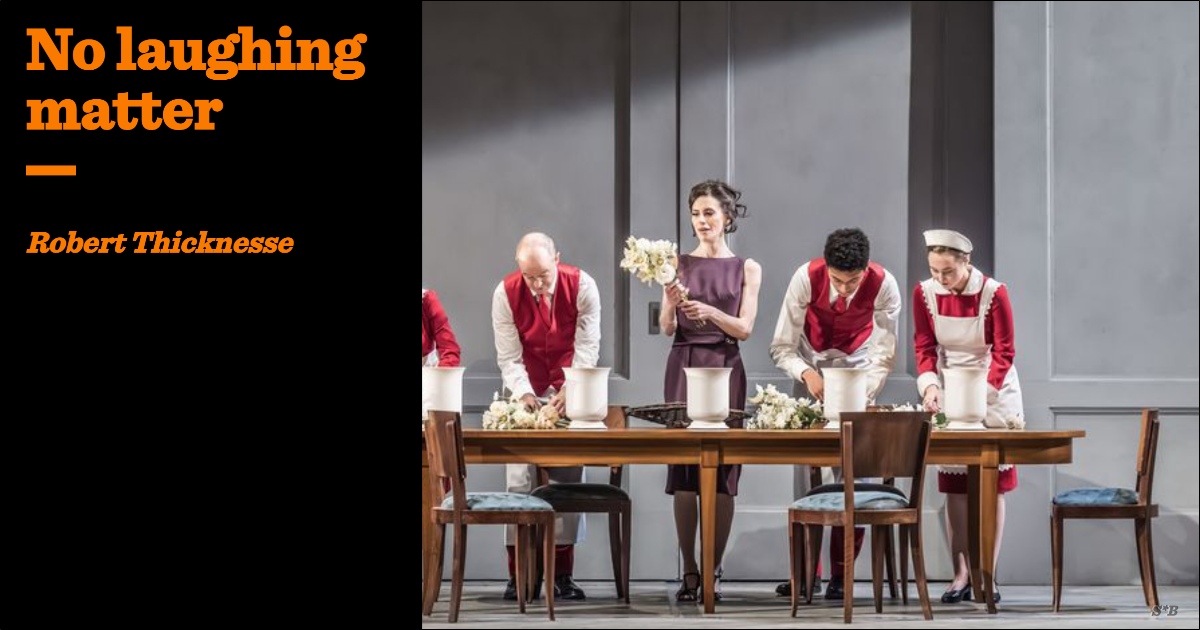

Not for the first time, a show that was extravagantly praised on its first appearance on the continent (in this case at Strasbourg) comes to Covent Garden and turns out not to be terribly good, undone by a director reducing it to a banal royal soap-opera, and a conductor with a pretty poor grasp of its proper flow and shape.
Ariodante’s a deep one — and one of Handel’s real A-Grade bangers. It’s a dark piece, frogmarching its personnel through the valley of the shadow of death, but contrives to end with his bounciest aria, “Dopo notte”, a burst of breathless joy sung by the puppyish hero after all the nastiness has been fixed. It’s very straightforward, without subplots, a strong tale of hopeful young love almost destroyed by jealousy, two little innocents pushed to the brink of suicide by a villain driven, like Iago, by the sheer love of malice.
The source text is a digression in Ariosto’s wild 16th-century romp Orlando Furioso, and the plot is the one Shakespeare nicked for Much Ado about Nothing: horrid Polinesso persuades Dalinda, languishing for love of him, that he might like her more if she dresses up as her boss (or here, sister) Ginevra, and makes sure Ginevra’s fiancé is watching when she corridor-creeps to Polinesso’s room by night; a nasty trick, all right, and the fiancé, Ariodante, duly falls for it, his personality collapsing into one of Handel’s greatest arias, “Scherza infida”, where he torments himself with a fifteen-minute imagining of his faithless girlfriend jazzing away with Polinesso. This being the old days, the blameless Ginevra is then sentenced to death for infidelity — before the plot is exposed in the nick of time.
The unhappy pair discover that the world is a much darker place, awash with motiveless evil, than they could possibly have imagined, and they are utterly without coping mechanisms: in that sense, it’s a bit like Tosca, though obviously without Puccini’s lip-smacking pervery. There are some interesting little angles, too: like the children they really are, the pair never stop banging on about how they feel, and although the happy end works in its own terms — Ginevra emerges from her death-cell horror, dusts herself down, says “Oh well, shit happens”, and gets on with it… well, that’s hardly going to play with anyone under 40, so obviously we get a mega-bust-up here instead. Most unusually, too, Handel’s Ginevra doesn’t actually lose it (à la Ophelia, Lucia, etc) when she gets hit with the baffling, awful accusation, doesn’t descend into standard mad-scene, but really lives her nightmare through, in a long musical episode that is a real, if largely unnoticed, milestone in dramatic history.
I realise this is supposed to be a review, but sometimes it’s so much more interesting to talk about the piece than what happened on stage. Jetske Mijnssen, a Dutch director who has been doing pretty low-grade Regie-style stuff around Europe for 25 years and made her debut here with a silly and superficial take on Parsifal at Glyndebourne this year, decided to base her staging on The Crown, starring the kind of dysfunctional, brattish solipsists we know and love. This isn’t particularly original — I’ve seen a Fifties-set version with Ginevra played as a monstrous Princess Margaret. This kind of piggybacking on trashy telly is an energy-saving option for directors but rarely does anything useful — how could it, actually? — and presenting Ginevra as a neurotic and spoilt flirt (leading Polinesso on) cannot really lead anywhere interesting, since we’re still going to have to feel sorry for her, and there’s not much point making her boringly unsympathetic.
Ms Mijnssen is the sort of director who paints character (actually, makes cheap gestures towards “types”) through the meanest clichés: bad Polinesso smokes and has a shiny suit, uppity Ginevra is haughty with servants, weedy Lurcanio wears a sleeveless Fair Isle jersey, and dad’s in a wheelchair. There is no depth, no hinterland, no subtlety — in fact, no evidence at all of the character that Handel explores so comprehensively through music. The physical direction is hopeless, with none of the psychology portrayed through movement and interaction that good directors do. Frantic, pointless business (usually involving folding or throwing tablecloths around the place) repeats ad nauseam — and feels completely unspontaneous, rehearsed to death.
The one character who is left unscathed is hero Ariodante himself, the guileless slave of his emotions. I was looking forward to hearing the starry Emily D’Angelo singing this fab cross-dressing role, though I’ve always found her rather a dry performer, but she was ill on the night, and understudy mezzo Grace Durham got her 42nd-Street moment. And in fact her voice is far more attractive, warm, flexible, with lovely little subtleties and grace-notes … if there were any first-night nerves (this is certainly her biggest role and Covent Garden debut), that’s pretty understandable with a conductor (Stefano Montanari) playing the early numbers as though his pants were on fire. By the time we got to the unbearably tragic “Scherza infida” she was in the zone, Montanari now holding things back to the doomiest plod — but the aria can take that, with its accompaniment of sadly vaulting violins and a mournful bassoon shepherding the poor benighted hero through his soul’s dark night.
Notably, during this long aria and the equally admirable Ginevra’s scene of torment (sung by the always dignified and cultured Jacquelyn Stucker), the singers weren’t asked to fool around arranging flowers or making tea, but allowed to centre the drama in their bodies and voices — finally. But it was a pity they cut the atmospheric dream music, half-soothing, half-nightmare, that Handel gives Ginevra when she finally sleeps, an integral part of this scene.
And with the strong cast — Christophe Dumaux as creepy Polinesso, Ed Lyon as Ariodante’s nice brother Lurcanio — this could still have been an ok-ish, student-level production (though actually most conservatoire shows are much better directed), if it wasn’t for Montanari’s odd conducting. When he wasn’t going so fast the singers could do no more than helter-skeltering through the notes, he dragged them out to an increasingly desultory plod, all momentum gone, with endless decelerating drawn-out codas that teetered towards that most anti-Handelian of affects, sentimentality. Montanari is a fine baroque violinist by training — and frequently picked up a fiddle to play a fancy turn — but there was no musical thread to this drama, things just started and stopped, repeated, started again… even “Dopo notte”, though lively enough, its fearsome roulades brilliantly dealt with by Ms Durham, felt contained, rather Mozartian in its classical neatness, no sense of Handel’s wild emotion straining against the bars of those baroque figurations.
At the end, Ginevra’s father, condemned by the director to fall over more often than Norman Wisdom as he grew ever frailer, finally pegged out during the disastrous wedding scene, to great chuckles from the audience. So at least everyone left with a smile on their face. Well, except me, of course.