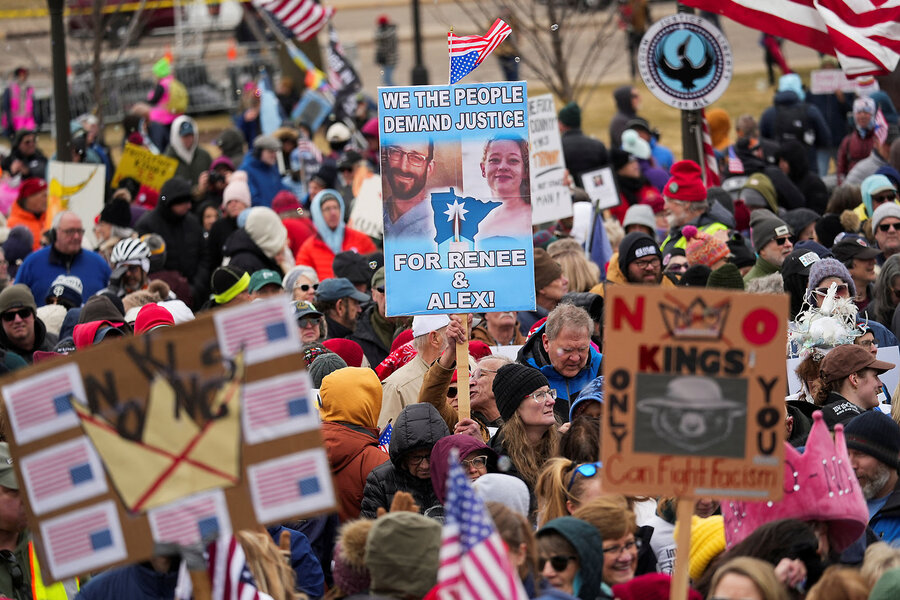
With crowd numbers estimated at several million in more than 3,000 locations, the No Kings Day protests on March 28 – animated by opposition to President Donald Trump – might turn out to be the largest combined single-day protest in U.S. history.
The movement, which bills itself as “rising against [Mr. Trump’s] authoritarian power grabs,” cites, in part, his administration’s immigration enforcement tactics and the Iran war.
Staysi and Caleb Lougheed, who commuted to Washington from Pennsylvania and joined a march from Arlington National Cemetery to the Washington Monument, say showing up matters.
Why We Wrote This
As President Trump’s approval rating hit a new low, demonstrations against his policies spanned the U.S. and might have added up to the largest event ever. The history of American protests shows that in order to achieve tangible goals, a movement must do more than have high turnout on a single day of action.
“If we get over the 3.5% for a national response, over 12 million people, the hope is that no attempt at fascism or dictatorship has succeeded in the face of that amount of local opposition before,” says Mr. Lougheed.
However, like many mass movements of America’s past – from the Civil Rights movement of the 1960s to the Tea Party movement of 2009 and 2010 – the No Kings rallies will likely be judged on whether they can turn broad opposition toward a sitting president into focused policies and sustained pressure that delivers concrete results.
This year’s No Kings protests come at a time when President Trump’s public approval ratings are hitting new lows. A March 23 poll by Reuters/IPSOS showed that 36% of respondents approved of the president’s job performance, reflecting concerns about rising fuel prices at home and the war in Iran. The latest Quinnipiac poll found similar results, with disapproval ratings of 56% overall, 58% for his handling of the economy, 59% for his handling of foreign policy, and 59% for his handling of the Iran war.

Patrik Jonsson/The Christian Science Monitor
But voicing opposition is one thing. Turning it into action is another. The long history of American protests, dating back to the original Boston Tea Party in 1773, shows that not all mass movements produce tangible or lasting results.
Susan Olzak, emerita professor of sociology at Stanford University, says that to achieve their goals, movements need sustained activity, media attention, and a stable organizational structure. They also need a clear vision and execution. “Movements with a focused and coherent message are often more effective than those appealing to a broad but heterogeneous audience,’’ she says.
In short, her work explores the trade-off between “depth” and “breadth” in social causes.
“Movements advancing focused claims tend to strengthen in-group solidarity and commitment, while those seeking broader appeal can potentially mobilize larger constituencies,’’ she says. “Yet coalition-building across diverse groups introduces the risk of internal conflict over priorities.”
That presents a challenge for No Kings, a broad progressive coalition with supporters across the country. No Kings organizers include labor unions, such as the American Federation of Teachers and the Service Employees International Union; veterans organizations, such as Common Defense; environmental groups, such as the League of Conservation Voters; and civic rights groups, such as the American Civil Liberties Union.
Wendy Bond, an activist with Free DC, which advocates for self-governance and statehood for the District of Columbia, led a mass choir in singing at a No Kings protest at Frederick Douglass Bridge in the Anacostia neighborhood of Washington, D.C. She says she’s concerned about the Trump administration’s “threats to democracy,” including the proposed Safeguard American Voter Eligibility Act, which she believes would make it “harder and harder for many citizens to vote.”

Effecting change will require sustained effort, Ms. Bond says. But she adds, “Small numbers of people who are willing to resist can make a big difference. This is a good reason to hope.”
“If you stay at home … they can do whatever they want”
At the march from Arlington cemetery into Washington, one of roughly two dozen planned for the nation’s capital and just outside it in Maryland and Virginia, a few thousand showed up on a sunny but chilly day.
About a dozen people the Monitor spoke to said they had done more than just attend a protest: volunteered to combat misinformation, organized a letter-writing campaign, or, like Jack Sobel from Maryland, canvassed and campaigned for political candidates.
Mr. Sobel, who said he has been attending protests since the Vietnam War, is going to more than ever now. Demonstrations show people they’re not alone, he says.
“And I think there’s some evidence historically that autocracies – if you get a certain percentage of the population out demonstrating, autocracies fall.”
Victor Cotto, a retired plumber and social worker, was channeling a similar thought about 600 miles away in Rincon, Georgia, just outside Savannah. Mr. Cotto, from from nearby Pooler, started protesting during the Civil Rights era in the 1960s. Marching, he says, can yield tangible results that protest movements seek.

Patrik Jonsson/The Christian Science Monitor
“There’s no other way you’re going to be in office without somebody else voting you in, and we can vote you in, and we can vote you out,” he says. “They listen. … But if you stay home and don’t do nothing, they can do whatever they want.”
Mr. Cotto was among about 80 people on a stretch of Highway 21, what used to be a dirt road that is now a busy strip of strip malls and chain restaurants. Some drivers honked in support as they drove by; others, perhaps among the 75 percent in Effingham County who voted for Mr. Trump in 2024, saluted the protesters with obscene gestures.
Rita Elliott, who lives just up the road in Springfield, said to see that many people show up in “downtown Trumplandia,” as she put it, “is incredible.”
Like Mr. Cotto, Mr. Sobel, and the Lougheeds, she said, protesting alongside others is powerful in and of itself. But she sees the need for more.
“I think that the only way that America is going to survive as a democracy is by local action,” says Ms. Elliott, a contract archaeologist. The federal government, justice system, and Supreme Court – “all of those things that our forefathers set forth to make sure democracy survived” – have been taken over, she says.
“People feel so overwhelmed and say, ‘What can I do?’ But when I see local opportunities, I want to go ahead and participate.”
Back in Washington, Hunter Gotico knows what Ms. Elliott means. As the march prepared to step off at the Arlington Cemetery Metro station, the high schooler held a sign protesting Mr. Trump.

Caitlin Babcock/The Christian Science Monitor
Asked if he plans to take action outside of protesting, he answered immediately: He’ll cast his first ballot in the November midterms.
“My singular vote is going to mean so much,” he says. “I hope that all of our voices together will be enough for people in the government to see that change needs to happen.”
Movements and meaning
No Kings organizers said they expected about 9 million people to participate in the U.S. and in major cities such as Rome, Paris, and Tokyo. Late in the day, organizers told the Los Angeles Times that at least 8 million had participated. The White House dismissed the rallies as having little public support.
Patrick Rafail, a sociologist at Tulane University, sees similarities between the modern No Kings movement and one that contributed to Mr. Trump’s rise in the Republican party: the conservative Tea Party movement that sprang up in opposition to newly elected President Barack Obama in 2009.
“People were reeling from the Great Recession after the housing crisis, and there was a new administration [that] came to power, and the atmosphere fueled a conservative pushback,” Mr. Rafail says. “Today, the Trump administration’s public approval is low and lowering, the war in Iran is not popular, gas prices are rising, and those are a big part of people’s daily expenditures.”
He says the challenge for groups like No Kings is sustaining momentum after a major event.
“What the Tea Party taught is that you have to go beyond the national stage to solid results,” he says. “If you think about the Tea Party, they went to town halls to engage with people in power.”
They did not compromise, Mr. Rafail says, and Republicans would be told, “you are going to fall in line, or we will primary you.” That Tea Party movement reshaped the Republican Party, giving it control of the House of Representatives and propelling politicians such as Ted Cruz, Rand Paul, and Donald Trump into the leadership positions they now hold.
“Having these events is important,” Mr. Rafail says, referring to the No Kings rallies. “The question is whether they can convert that sentiment into policy and action. That’s hard work.”

No Kings organizers will hold a community call on March 31 to address what comes next. They plan to roll out training sessions for protest participants to know their rights and how to de-escalate tensions with law enforcement or counterprotestors at future rallies. In the meantime, the turnout for No Kings events could build momentum for voters seeking change in congressional mid-term elections this November, especially as many members of Congress have announced their intention to retire.
Aldon Morris, an emeritus professor of sociology and African American Studies at Northwestern University, says that he sees strong parallels between the civil rights movement of the 1950s and ‘60s and the activists in Minneapolis, Chicago, and even Vermont who have been protesting for months since the Trump administration’s immigration enforcement began.
Both in the Jim Crow South and in the recent immigration law enforcement in Minneapolis, where two U.S. citizens were killed by federal personnel earlier this year, a power imbalance between the government and civic society exists, says Professor Morris. Those in power “have the resources, they have the lawyers, they have surveillance tools that average people do not have.”
Those who are not in power often turn to protests and rallies to try to shift that dynamic, he says. “People who are weak can use leverage to bring about change.”
But there’s a learning process, he adds. Just as Alabama students challenged Jim Crow segregation rules with lunch-counter sit-ins, bus boycotts, and marches, today’s activists need to develop their own effective strategies as the government shifts its tactics.
“They have to be like the great jazz musicians, and improvise,” says Professor Morris. “When things change, you have to riff in a different way. In protest movements, there are things that happen that you did not know were going to happen. You have to innovate.”