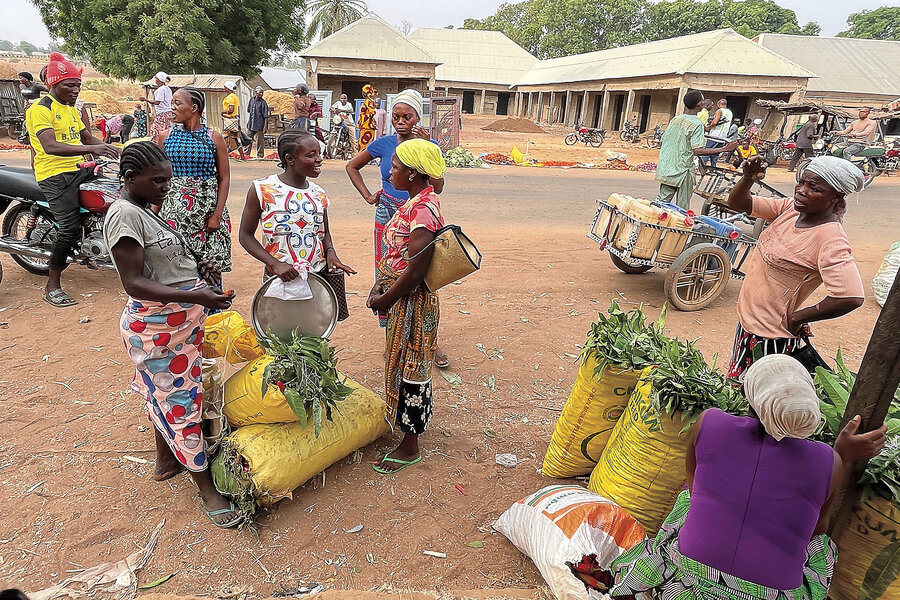
Early one morning at the Longvel market, a small crowd gathers around a motorized tricycle stacked high with sacks of peppers. Two boys hired from the market begin lowering the sacks, with each thud sending dust into the air. The seven women who brought the peppers stand watching nearby.
A man clutching a roll of cash approaches, but one of the women shakes her head. The man walks off disappointed. The women do not call him back.
“The first thing is to observe,” says Ngwan Ruda, her eyes scanning the surrounding market stalls. “If you sell too early, you risk selling at a loss.”
Why We Wrote This
Across rural Nigeria, women cultivate most of the smaller land plots but rarely own them. The Hoomsen Women Farmers Shepwan Cooperative Society is quietly changing that – and creating a blueprint for expanding women’s land access in the country.
The sacks of peppers, and the price the women will demand for them, are proof of control. Across rural Nigeria, women cultivate most of the smaller land plots but rarely own them. The Hoomsen Women Farmers Shepwan Cooperative Society, led by Mrs. Ruda, is quietly changing that – and creating a blueprint for expanding women’s land access in the country.
“Sisters looking after sisters”
The story of this group did not start at this market in Shendam in central Nigeria, but in the village of Shepwan in 1992, when Goftar Rifkatu lost her husband. In Shepwan, as in much of Nigeria, land passes through male lineage despite the country’s constitution and the 1978 Land Use Act guaranteeing equal land rights. A widow’s continued access to farmland often depends on her willingness to remain within her late husband’s family.
In Mrs. Rifkatu’s case, she was expected to marry her husband’s brother, but she refused. Soon after, the farm she and her husband had cultivated for years – land that fed her children and paid their school tuition – was taken from her. “My rights to the land died with him,” she recalls.
Mrs. Rifkatu’s experience is far from unusual. Women account for an estimated 70% to 80% of the labor force on small farms nationwide, yet only a fraction hold land titles. Without titles, it’s nearly impossible to obtain credit or expand their plots.
Mrs. Rifkatu did not go to court, as legal representation is expensive and cases can drag on for years. Instead, she formed a group with about 20 other women in a similar situation. They began as laborers, offering to cultivate plots for others and accepting payment in produce or cash. In 2000, they pooled their savings to rent their first plot, planting peppers, corn, and peanuts.
“We were sisters looking after sisters,” Mrs. Rifkatu says.

What they formed turned out to be more than a tool for daily survival. Ngizan Chahul, national president of the Nigerian Association of Women in Agriculture, says women are increasingly challenging social norms by “forming cooperatives, gathering their savings to lease or buy plots, and even going to court” to take possession of land.
“The barriers are still here, but the mindset is changing,” she adds. “More women are beginning to see land as leverage, and a lot more of us are taking ownership.”
Male allies pitch in
Even Mrs. Rifkatu did not initially imagine how far her group would go. She says some people did not like the idea of women controlling farmland.
Manasseh Komsol, a local farmer, remembers that initial skepticism.
“At first, people laughed,” he says. “They said women cannot and should not run a farm on their own. I was hesitant, too.”
The women invited him to watch them work. Mrs. Ruda calls it their strategy of “Show, don’t argue.” After seeing how disciplined the women were, Mr. Komsol rented them the plot of land.
“They were better organized than many men,” he recalls.
In 2019, the women submitted a grant application to the Dutch Ministry of Foreign Affairs through Voice Global, a project implemented by the nonprofit Oxfam. They won €25,000 (about $29,000).
With the money, and mediation from male allies such as Mr. Komsol, the women bought nearly 25 acres of land, plus fertilizer and seedlings. When others in the community saw this, they began helping to prepare the land for cultivation and providing additional labor during planting and harvest.
Rebecca Naa’npoe, an agricultural officer with Shendam’s local government, says the women’s cooperative offers a model that she hopes other communities will replicate.
“The fact that they have been able to do this for more than a decade, starting from zero with only each other, demonstrates what is possible,” she says. “It strengthens women’s economic independence.”
The group also advocated for female representation within Shepwan’s traditional leadership, a space long reserved for men. In 2023, for the first time in the community’s history, a woman was appointed Magajiya, the formally recognized leader within the kinship structure. She represents women in council meetings and helps mediate disputes.
The appointment has not dismantled entrenched gender hierarchies or cultural restrictions on women owning land, but gave women a seat at the table.
How the cooperative operates
Now numbering more than 50 members, the group meets weekly. Conversation topics range from family concerns to farm logistics, but reviewing record books listing contributions, savings, and needs is always part of the agenda.
At the start of planting season, responsibilities are assigned, including who coordinates fertilizer purchases and who arranges tractor rentals. At the end of the season, profits are distributed, with a portion reinvested into the farm and a small fund reserved for emergency loans that could otherwise be difficult to obtain.
When Mrs. Ruda’s daughter fell ill, the emergency fund covered the hospital bills. Another member needed school fees, so she secured a loan from the cooperative and repaid the money when the farming season ended.
Back at the market, Mrs. Ruda checks her watch and nods. A potential buyer who has been circling for more than an hour finally approaches. The negotiation is brief. The man attempts to get the peppers at a low price, but Mrs. Ruda counters. Though the man winces, cash changes hands. The boys start lifting the sacks.
As the buyer receives the last sack, Mrs. Ruda counts the money and hands it to another member of the cooperative. “This goes to our purse,” Mrs. Ruda says, smiling.
A younger member stands beside her. “Next season,” the woman says quietly, “we should plant more peppers.” Mrs. Ruda agrees.
The tricycle engine then sputters to life. A few of the women climb aboard and head back under the bright noontime sun to their plot of land.