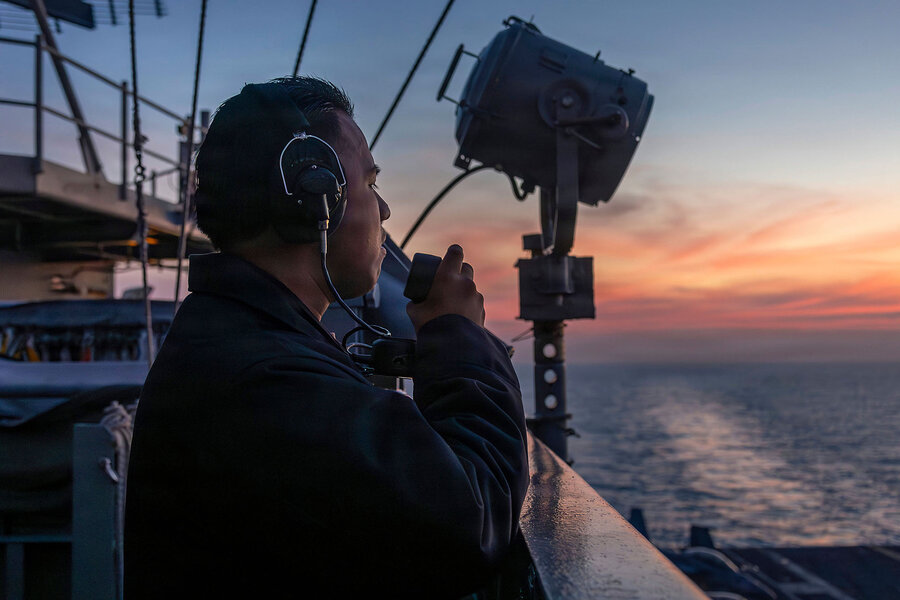
The arrival this week of a U.S. aircraft carrier in the Middle East, within striking distance of Iran, came as allies reacted to the release of a new report offering a blueprint for how America plans to flex its military might around the world.
Released late on Friday – the traditional “news dump” window for potentially contentious administration announcements – the National Defense Strategy (NDS) puts the nation’s home hemisphere first, calls on longtime U.S. allies to shoulder more of the burden in deterring threats from Russia and North Korea, and lays out the goal of reducing tensions with China.
It also explains why the Trump administration is keeping a close watch on Iran.
Why We Wrote This
The newest National Defense Strategy is attracting global attention for pledging “more limited” U.S. support to friendly nations. It envisions deterring China “through strength, not confrontation.”
Defense analysts are alternately calling the new strategy, revised and published by the Pentagon every four years, a “marked” and “unprecedented” turnabout in policy.
It “signals arguably the single greatest shift in American defense priorities since the end of World War II” articulating “a significantly smaller role for the United States in global affairs, writes Carrie Lee, a senior fellow with the German Marshall Fund of the United States, in an analysis published on Monday.
In Washington and in Europe, the NDS also had allies mulling its implications and privately grumbling about the scolding tone.
That tone was likely no accident. Defense Secretary Pete Hegseth writes in the strategy’s introduction that it will no longer be “America’s duty … to act everywhere on our own, nor will we make up for allied security shortfalls from their leaders’ own irresponsible choices.”

Instead, the United States will offer “more limited” support to friendly nations and deter China “through strength, not confrontation.”
In the Middle East, the NDS says, the U.S. government says the Iranian regime is “weaker and more vulnerable than it has been in decades.” What that portends for possible U.S. strikes against Tehran, as the USS Abraham Lincoln’s carrier strike group arrived in the region this week, remains to be seen.
The report also points to plans to “supercharge” America’s defense industry.
Here are some of the strategy’s key takeaways:
Defending the U.S. homeland
Prior administrations, including President Donald Trump’s first, rated competition with China and Russia as the nation’s top security threats. The current emphasis on America’s military supremacy in the region was expected but still striking.
It cites the “wisdom” of the Monroe Doctrine as the U.S seeks to “restore American military dominance” in the Western Hemisphere.
To this end, the Defense Department will work to “guarantee U.S. military and commercial access to key terrain.” The Panama Canal, Gulf of Mexico, and Greenland fall into that category, it asserts.

The Pentagon will now focus on developing Mr. Trump’s plan for a “Golden Dome” – a conceptual space-based missile defense system meant to block long-range and hypersonic missile threats – for the U.S. and on less expensive ways to defeat large missile barrages.
It also emphasizes finding new ways to counter drones, which the NDS describes as a growing “threat.”
Deterring China through strength, not confrontation
The Pentagon, the report says, is trying to cultivate “respectful relations with China,” which the NDS calls the “second most powerful country in the world.”
This week, at a policy discussion in South Korea, Undersecretary of Defense for Policy Elbridge Colby said the strategy document’s point is to end “needless confrontation” with Beijing.
In that pursuit, the Pentagon will seek to communicate with leaders in the People’s Liberation Army in more and different ways.
There is no mention of Taiwan in the document, analysts point out, even though a potential Chinese invasion of the island has long been a concern.

Still, the U.S. must be clear-eyed about the “speed, scale, and quality of China’s historic military buildup,” the NDS strategy advises.
The point, it adds, “is not to dominate China” nor “to humiliate them” but to keep the country from “being able to dominate us or our allies.”
“More limited” support to allies
Russia will remain “a persistent but manageable threat to NATO’s eastern members for the foreseeable future,” the NDS says.
The Pentagon will also make sure U.S. forces are prepared to defend against Russian threats to the homeland – especially since Russia has, as the document notes, the world’s largest nuclear arsenal.
But the new strategy makes it clear that the U.S. expects European allies to take primary responsibility for their own defense against Russia.
Until now, the strategy argues, allies have been “too often content to allow the United States to defend them, while they cut defense spending and invested instead in things like public welfare.” Even without the U.S., NATO countries collectively have ample resources to defend against aggression, including from Russia, says the report. It points out, using a bar graph, that “non-US NATO” nations have $26 trillion in total gross domestic product, compared with Russia’s $2 trillion.

Serhii Korovainyi/Reuters
“European NATO dwarfs Russia in economic scale, population, and, thus, latent military power,” the NDS says. “Our allies are substantially more powerful than Russia – it is not even close.”
On this idea, however, there has been pushback. “If anyone thinks here again that the European Union, or Europe as a whole, can defend itself without the U.S., keep on dreaming,” NATO Secretary-General Mark Rutte told members of the European Parliament on Monday in Brussels. “You can’t. We can’t. We need each other.” It was a response to growing calls by some European leaders, too, for more strategic autonomy.
Iran and North Korea: still threats
North Korean nuclear forces, “growing in size and sophistication,” are a danger to the American homeland, the report says. It also contends that South Korea is “capable of taking primary responsibility” for its defense, “with critical but more limited U.S. support.”
But in the Middle East, the report issues a warning.
Though Iran has experienced “severe setbacks” as a result of military strikes on its territory over recent months, “it appears intent on reconstituting its conventional military forces,” the NDS says.
Leaders in Tehran “have also left open the possibility that they will again try to obtain a nuclear weapon,” it adds. “Nor can we ignore the facts that the Iranian regime has the blood of Americans on its hands, that it remains intent on destroying our close ally Israel, and that Iran and its proxies routinely instigate regional crises that not only threaten the lives of American servicemembers in the region but also prevent the region itself from pursuing the kind of peaceful and prosperous future that so many of its leaders and peoples clearly wish for.”
For this, along with concerns about Iran’s violent crackdown on protests there, Mr. Trump has frequently mentioned the ongoing threat of U.S. military force.
The aircraft carrier strike group is now in the region, “just in case,” Mr. Trump said last week. “Maybe we won’t have to use it.”