Benjamin Netanyahu has ordered Israel to widen its invasion of Lebanon as he claimed Hezbollah still has the ability to ‘fire rockets at us’.
Israel has sent troops into the south of Lebanon as it seeks to destroy the Iranian-backed terror group, who dragged the country into the war by sending a barrage of missiles at Israel in revenge for the killing of Ayatollah Ali Khamenei.
In response Israel began ‘limited and targeted ground operations’ which it claimed have been targeting ‘key Hezbollah strongholds’ to remove their threat for border communities.
On Sunday, the Israeli prime minister said he had told the military to expand the ‘existing security buffer zone’.
On a visit to northern Israel, he said: ‘I have just instructed to further expand the existing security buffer zone.
‘We are determined to fundamentally change the situation in the north.
‘We eliminated thousands of Hezbollah terrorists, and above all, we eliminated the immense threat of 150,000 missiles and rockets that were intended to destroy the cities of Israel.’
He added: ‘Hezbollah still has a residual capability to launch rockets at us.’
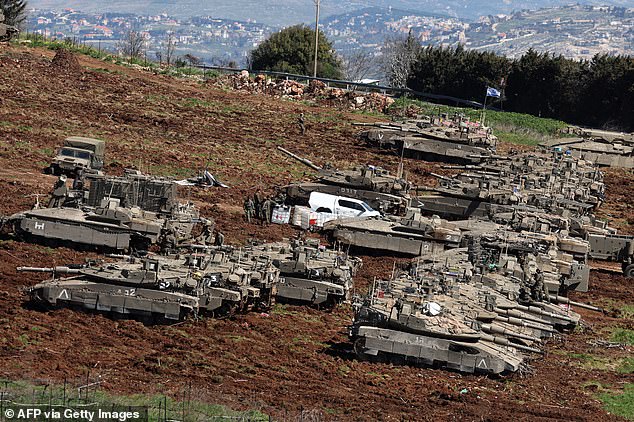
Israel has sent troops into the south of Lebanon as it seeks to destroy Hezbollah. (Pictured: Israeli tanks massing at its northern border with Lebanon)
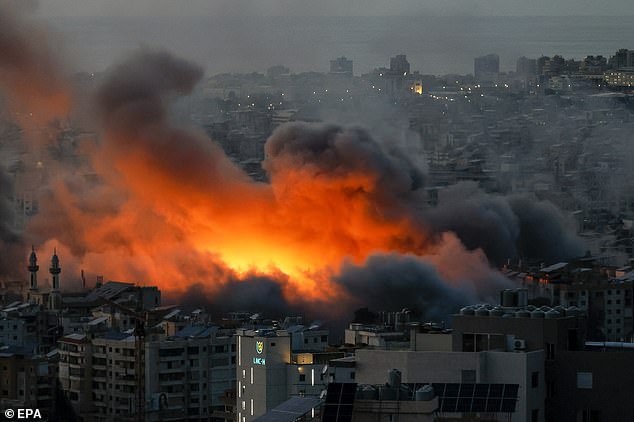
Smoke and flames rise following an Israeli airstrike on Dahieh, a Hezbollah stronghold in the south of Beirut
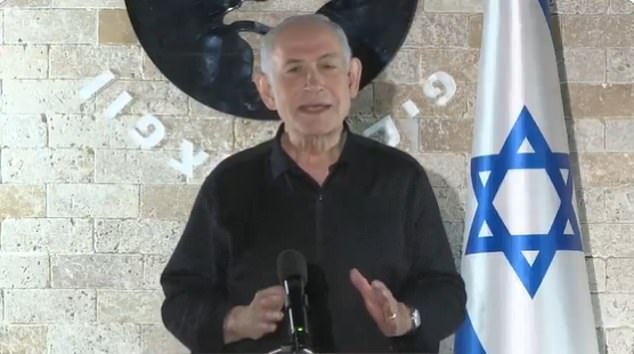
Benjamin Netanyahu has ordered Israel to widen its invasion of Lebanon as he claimed Hezbollah still has the ability to ‘fire rockets at us’
Netanyahu also said Israel has created ‘visible cracks in the terror regime in Tehran’.
‘Iran is not the same Iran,’ he said. ‘Hezbollah is not the same Hezbollah, and Hamas is not the same Hamas.’
The three are ‘battered enemies fighting for their very existence,’ he claimed.
‘Instead of them surprising us, we are surprising them. We are the side that is acting, we are the side that is attacking, we are the side that is initiating, and we are deep in their territory.’
The Israeli premier boasted that Israel has created ‘three security zones deep in enemy territory.’
Hezbollah, an Iranian proxy which maintains significant control in Lebanon’s politics, and Israel are long-time enemies and fought a 13-month conflict that ended in November 2024.
Hezbollah was created in response to Israel’s occupation of Lebanon during the 1980s.
It was massively weakened in the last conflict and in the last month Israel has battered its stronghold in Dahieh, a Shia heartland in the southern suburbs of Beirut.
The terror group’s decision to fire rockets at Israel last month drew fury from the Lebanese government who accused them of pulling the country into war.
The government ordered Hezbollah to give up its weapons and issued arrest warrants against members for smuggling weapons.
But Israel has demanded stronger action and intensified strikes on its neighbour.
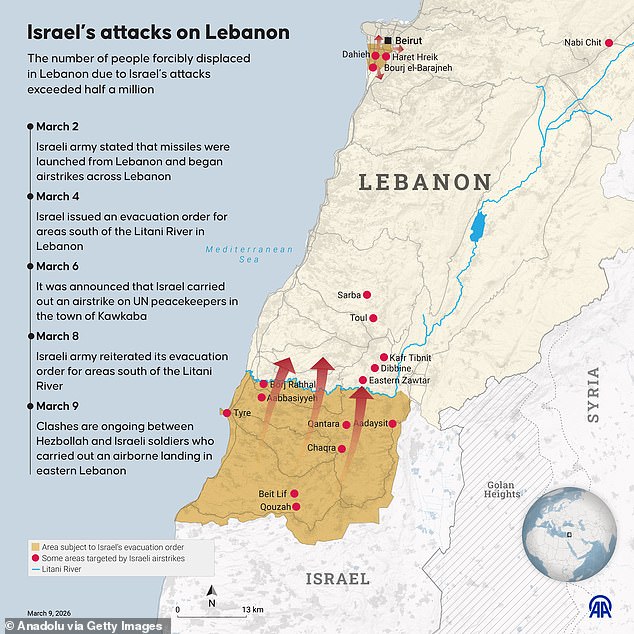
A graphic displaying Israel’s attacks on Lebanon in the first week of the latest conflict
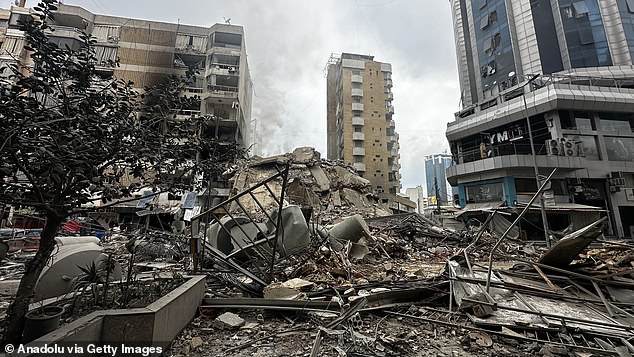
Israel has pounded Lebanon since Hezbollah sent missiles over the border in retaliation for the killing of Ayatollah Ali Khamenei (Pictured: The aftermath of Israeli airstrikes in Dahieh)
Last week, military chief Lt Gen Eyal Zamir said they had advanced ‘the targeted ground operations and strikes’ against Hezbollah, and that this would be a ‘prolonged operation’.
That came after a statement from defence minister, Israel Katz, who said Israeli forces had destroyed crossings over the crucial Litani river, which it claimed was being used by Hezbollah to transport reinforcements.
Lebanon’s President Joseph Aoun said the strikes were a ‘prelude to a ground invasion’ amounting to a ‘policy of collective punishment against civilians’.
More than 1,100 people have killed in Lebanon since the beginning of the war, with over 3,500 people injured, according to the Lebanese health ministry.
More than one million people have been displaced.
Missiles fired from Iran and Lebanon have killed 19 people in Israel, according to the Israeli ambulance service.
Earlier this month, the UK, France, Germany, Italy and Canada released a statement which warned a significant Israeli ground invasion would have ‘devastating humanitarian consequences’ and it ‘must be averted’.
Meanwhile, Israel is also facing threats from the Houthis, who have claimed they will choke off a second major oil shipping route.
In a significant escalation to the month-long war, Iran’s proxy group in Yemen yesterday issued a warning over the waterway which is known as the ‘Gate of Tears’ in Arabic.
The Bab al-Mandeb Strait connects the Red Sea with the Gulf of Aden and is used as an alternative to the Strait of Hormuz, which Iran has effectively shut down.
If both routes are compromised, the impact would extend far beyond the region, hitting supply chains, energy markets and shipping costs worldwide.
Ten per cent of global seaborne trade passes through the Red Sea, including a fifth of the world’s container traffic and car shipments and 10 per cent of crude oil.
The 1,400-mile-long body of water links the Indian Ocean to the Mediterranean via the Suez Canal.
Yesterday, the Houthi rebel group fired missiles at Israel and vowed to carry out more attacks.
The Houthis have held Yemen’s capital Sanaa since 2014 and, so far, have stayed out of the US-Israeli war on Iran.
The group’s attacks on ships during the Israel-Hamas war caused chaos in the Red Sea, through which billions of pounds of goods pass each year.
Between 2023 and 2025, Houthi rebels attacked more than 100 merchant vessels with missiles and drones, sinking two ships and killing four sailors.