Strong societies, industries and economies win wars — but does Britain have them?
Al Carns, the UK Armed Forces Minister, has said that Britain is preparing for war. Speaking to Sky News, he warned: “The shadow of war is knocking on Europe’s door once more. That’s the reality. We’ve got to be prepared to deter it.”
Carns is a former Colonel in the Royal Marines. He should be taken deadly seriously. His remarks follow a warning from NATO’s Secretary General, Mark Rutte, that Europe must prepare for a confrontation with Russia on a scale “our grandparents and great-grandparents endured”.
Two developments explain the shift in tone. The first is the protracted US–Russia peace talks conducted largely over Europe’s head. The second is the publication of Donald Trump’s National Security Strategy, which makes explicit that Europeans must now assume far greater responsibility for their own defence. None of this should surprise anyone who has been paying attention. The Trump administration has been saying the same thing, bluntly and repeatedly, since its inauguration.
Speaking at the NATO Defence Ministers’ meeting in February 2025, the US War Secretary, Pete Hegseth, put it plainly: “To endure for the future, our partners must do far more for Europe’s defence. We must make NATO great again. It begins with defence spending, but must also include reviving the transatlantic defence industrial base, prioritising readiness and lethality, and establishing real deterrence.”
After nearly eighty years of relying on American power to underwrite their security, European leaders are being forced to relearn the fundamentals of hard power and grand strategy. It is difficult to overstate how profound a challenge this represents for both Europe and the UK. It demands a rethink across policy areas that, for decades, have been treated as marginal to national security.
Since the 1990s, Britain’s political and intellectual elite has operated within a fundamentally different paradigm. The “end of history” has become a cliché, but it is worth recalling just how deeply it shaped elite thinking. In the aftermath of the Soviet Union’s collapse, Anthony Giddens — one of the intellectual architects of New Labour — argued in The Third Way that the West no longer faced “clear-cut enemies”. Cosmopolitanism, he claimed, would be both the “cause and condition” of the disappearance of large-scale war between nation-states. The “strong state”, once defined by preparedness for war, “must mean something different today”. They believed that post-material and post-traditional values, including ecological modernisation, human rights and sexual freedom, would come to dominate politics.
For realists, this utopian worldview was always naïve. In her final book, Statecraft (2003), Margaret Thatcher warned that the post-Cold War world was far more likely to vindicate Samuel Huntington’s “clash of civilisations” than Francis Fukuyama’s progressive vision of an “end of history”, in which liberal democracy emerged as the inevitable global victor.
Clearly, the liberal internationalist illusion should finally have been shattered by Russia’s annexation of Crimea in 2014. Alas, it was not. Instead of prompting a fundamental strategic reset, Britain’s governing class doubled down on the same post-material, cosmopolitan assumptions that had shaped the 1990s and 2000s. In 2015, Europe and the UK embraced the Paris Climate Agreement. In 2019 — a year after the attempted murder of Sergei Skripal on British soil with a chemical weapon — ministers enshrined Net Zero in law and banned fracking. Each decision reflected the same belief: that geopolitics could remain subordinate to “climate leadership”, and that the material foundations of security could continue to be dismantled.
That worldview is now colliding with reality.
The US National Security Strategy contains a series of blunt truths about Europe’s condition. British commentary has focused on its remarks about culture, migration and defence spending. But one critical area has been largely overlooked: energy and industry.
The document begins from a hard material premise: that dominance in dense and reliable sources of energy — oil, gas, coal and nuclear — is essential to the ability of the United States, and its allies, to project power. From that foundation it draws a sharper conclusion, rejecting what it describes as the “disastrous ‘climate change’ and ‘Net Zero’ ideologies” that have hollowed out Europe’s industrial base while subsidising its adversaries. The result, it argues, is a defence problem that runs far deeper than military budgets. Alongside cultural weaknesses, myopic energy policy and de-industrialisation — exemplified by Germany’s recent offshoring of its chemical industry to China — are identified as anti-civilisational forces that directly erode Western hard power.
This makes Carns’s most important observation all the more sobering. While armies, navies and air forces respond to crises, he said, it is “societies, industries and economies [that] win wars”. He is unequivocally right.
In The Rise and Fall of the Great Powers (1987), the British historian Paul Kennedy showed that prolonged wars of attrition ultimately become tests of productive capacity. “A lengthy, grinding war,” he wrote, “eventually turns into a test of the relative capacities of each coalition.” Victory flows to those with deeper reservoirs of industrial capacity, organisational resilience and energy abundance. Defeat comes to those who exhaust their productive base faster than they can replenish it. As John Bew — the respected historian, grand strategist and former advisor to four Prime Ministers — warned last Christmas, we are entering a new era of “Machinepolitik”, ultimately determined by “productive force”. Bew also contributed to the UK’s recently published National Security Strategy.
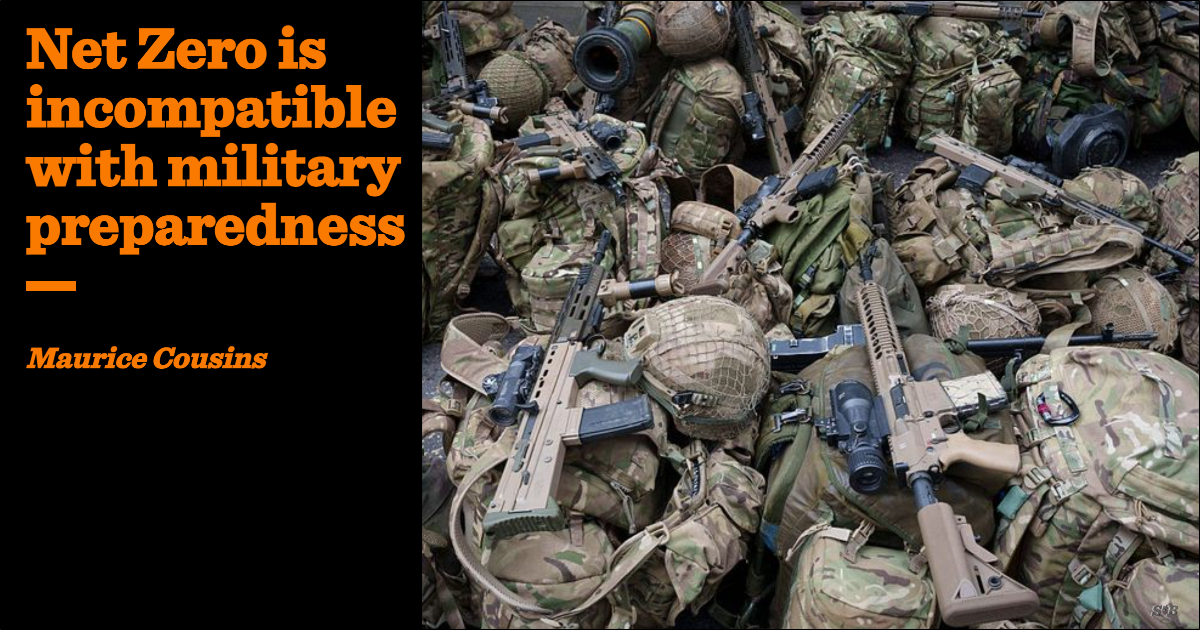
Taken together, this raises an unavoidable question: can Net Zero and Ed Miliband’s Clean Power 2030 mission survive this Parliament if the government is serious about deterrence?
Both deterrence and war-fighting are deeply energy-intensive. The war in Ukraine has shown how war remains heavily dependent on hydrocarbons, which still provide more than 70 percent of the country’s primary energy and up to 60 percent of its electricity during wartime, while supplying virtually all military fuel needs. As the BBC’s Frank Gardner has observed, drones are now integral to modern warfare — but “mass” still matters. Russia can replace its losses because its factories churn out drones, missiles and artillery shells at scale. Britain cannot. Sir Anthony Beevor, the military historian, has warned that the UK would run out of ammunition within ten days.
These warnings are reinforced this week by Rian Whitton’s excellent new report, Destroying the Foundations, which is published by the Prosperity Institute. Whitton argues that Britain has spent two decades attempting to sustain a modern industrial economy with an energy system misaligned with the requirements of efficient production. UK electricity prices are now among the highest in the developed world, driven by self-imposed policy costs and the unavoidable system costs associated with renewables. Gas prices are inflated by, and domestic production constrained by, punitive policy. The result is an accelerating collapse across the foundational industries: the North Sea, refineries, chemical plants, steelworks, fertiliser producers, ceramics, glass and advanced materials manufacturing.
These are not peripheral sectors. Our strategic autonomy and hard power capabilities directly flow from them. Lose them, and you do not “move up” the value chain; you lose the capacity to build it at all. Advanced sectors — from precision engineering to drones — depend on cheap energy, metals, chemicals, composites and explosives produced at scale. Ukraine is estimated to be using around 10,000 drones a day. That level of output is impossible without a deep domestic industrial base.
During the Cold War, it was said that the Soviet Union feared “Detroit” far more than NATO’s divisions or its Strategic Air Command. Nuclear weapons mattered, but they were instruments of deterrence. If deterrence failed, industrial capacity would decide the outcome — just as it had in the Second World War.
Strong societies, industries and economies do win wars. The question is whether Britain’s leaders are prepared to act as if that is true
The same logic applies today. Britain, and Europe, will not deter Vladimir Putin with tough rhetoric or the confiscation of Russian assets. It will only do so by rebuilding its productive base — in the Midlands, the North and beyond — and by abandoning the fantasy that a de-industrialised, high-cost energy economy can sustain either peace or war.
If this government is serious about re-arming and deterring Putin, it must therefore be serious about choices it has so far treated as unthinkable. In this Parliament, that means scrapping the Climate Change Act and Net Zero, ending the ban on fracking, re-densifying the grid, and bringing the two decade experiment with renewables to an end.
Carns is right. Strong societies, industries and economies do win wars. The question is whether Britain’s leaders are prepared to act as if that is true.