A couple who forked out £40,000 to make their house energy-efficient are fuming after being slapped with an F energy rating.
Tori McKillen and husband Mhinder Mehta want to sell their home, but can’t because most mortgage providers won’t lend to buyers for properties with an F-rated energy performance certificate (EPC).
Ms McKillen, 54, and Mr Mehta, 57, are furious after they followed Government advice and schemes to increase their home’s energy efficiency with a raft of green home improvements – only to be scuppered by what consumer campaigners argue is a flawed system.
The couple put their 1936 ex-local authority, three-bed semi in Horseheath, Cambridgeshire – worth £400,000 – on the market so they could downsize, but were shocked to receive the near-rock bottom energy rating.
Ms McKillen said: ‘You try to do the right thing and then you regret it. We feel like we’ve been jinxed – after all we’ve done, an F feels like a failure.’
She added: ‘We feel there is a need to expose the ineffectiveness and impact of a very poor EPC system that penalises clean electric energy options.
‘We have undertaken all energy-efficiency steps possible.’
The couple did away with the property’s polluting oil heating system and installed an energy-efficient electric boiler, double-glazed windows, cavity wall insulation, an economy 11 meter, and zoned heating – a system that saves energy by allowing householders to set different temperatures for different parts of the home.

Tori McKillen, 53, and husband Mhinder Mehta, 57, are trying to sell their Cambridgeshire home

The couple had to remove spray foam loft insulation that they had fitted under another scheme

They were shocked to receive the near-rock bottom energy rating on the £400,000 home
Ms McKillen said it made no sense that they were punished for using electricity while ministers pushed Britons towards using electric vehicles, which need home electric charging points, as part the Government’s Net Zero drive.
She and Mr Mehta say they were also ‘stung’ after being forced to remove spray foam loft insulation that they had fitted under another Government-recommended scheme, because the form of insulation is also refused by some of the UK’s biggest mortgage lenders.
The couple then had to splurge thousands to re-roof the property to remove the spray foam insulation.
And in another slap in the face for Ms McKillen, who works in medical communications, and Mr Mehta, an analyst at Cambridge University, their EPC report recommends they splurge tens of thousands of pounds on solar panels and a wind turbine, which would bump them up to the E rating they need to sell the house.
Consumer campaigners Which? have branded EPCs ‘unreliable and in desperate need of reform’.
Ms McKillen said: ‘Some lenders won’t lend on an F rating and we wouldn’t be able to rent it with an F rating.
‘There are significant flaws with the methodology used for the EPCs, as electric is deemed expensive, so scores badly.
‘Heat pumps don’t fair well either apparently as they run on electricity.’
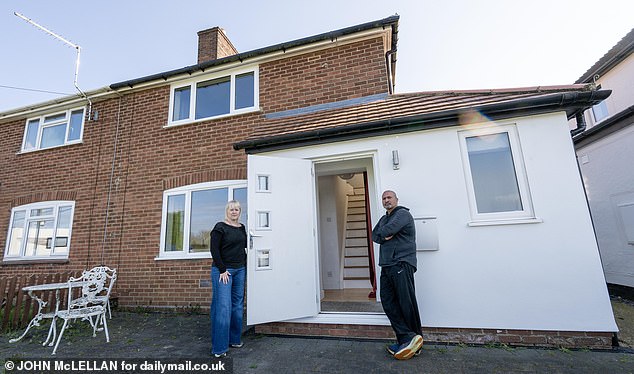
The couple forked out tens of thousands of pounds to make their house energy-efficient
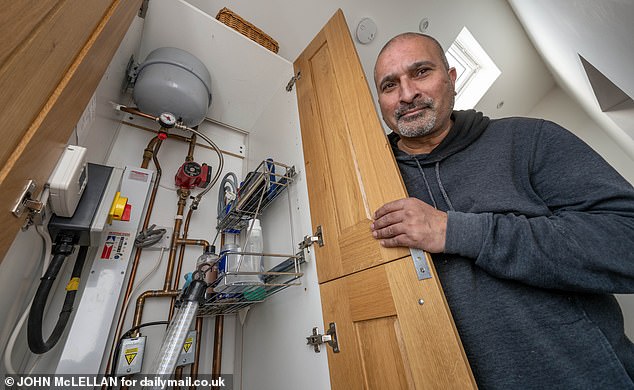
They did away with the oil heating system and installed an energy-efficient electric boiler
Ms McKillen added: ‘Our local MP was horrified to hear about this, given it flouts the Government’s whole green energy policy.’
The couple’s MP Pippa Heylings tabled a written question to Steve Reed, Secretary of State for Housing, Communities and Local Government, demanding to know his plans for reform of EPCs.
Samantha Dixon, Mr Reed’s Parliamentary Under-Secretary, said the Government was analysing feedback from a consultation on the certificates.
The Government said last year that landlords will have to meet decent energy efficiency standards in homes they rent out by 2030.
All private landlords in England and Wales will be required to meet EPC C or above by the end of the decade, up from the lower EPC E level currently required.
Under the plans, landlords will have the choice of how to meet energy efficiency standards, with options such as loft insulation, cavity wall insulation and double glazing.
They will also then have further options such as solar panels, batteries and smart meters, or low carbon heating such as heat pumps.
The Government has been proposing a maximum £15,000 cap beyond which landlords will not have to spend to meet the EPC C rating, with potential for a lower £10,000 cap if renters are charged lower rents or homes are in a lower council tax band.
In 2021, the Climate Change Committee, which is advising the UK government on how to achieve its net zero carbon emissions target by 2050, recommended that all homes should have an EPC rating of at least C.
But at the time there were 19million UK homes with an EPC lower than C, according to the CCC’s figures – raising concerns that owners of these properties would find they were unsellable and unlettable when the new rules come in.