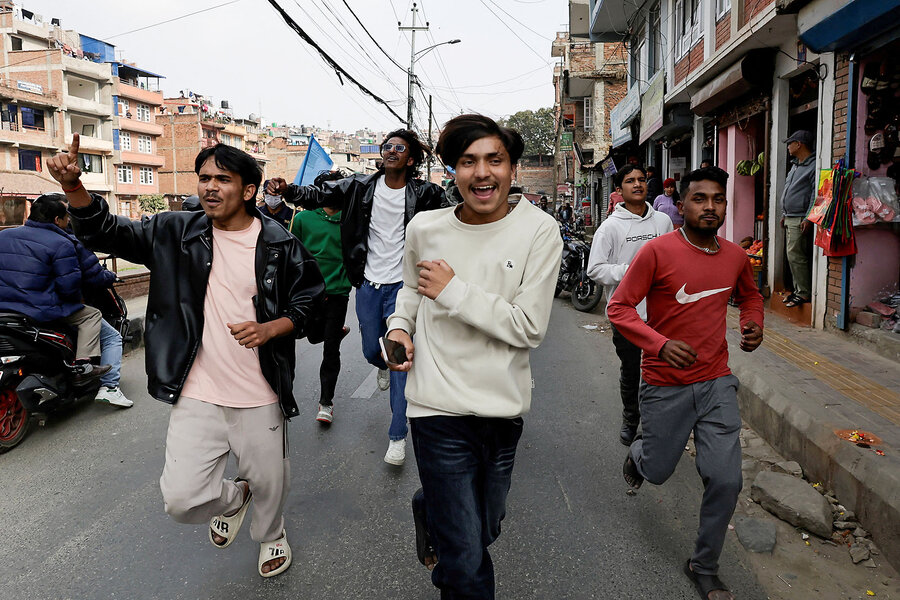
When young Nepalis flooded the streets in the capital this past September, Santosh Jaiswal followed the unrest from thousands of miles away.
After working long shifts at a Dubai oilfield, he’d return to his cramped dorm room and watch viral videos of Gen Z protestors clashing with security forces and setting fire to the parliament building. Under mounting pressure, the communist-led government resigned.
Within weeks, he quit his job and booked a flight home.
Why We Wrote This
Every year, hundreds of thousands of young people leave Nepal in search of work. These elections – the country’s first since youth-led protests overthrew the government – are giving some a reason to stay.
“It felt like an extraordinary moment,” says Mr. Jaiswal, who comes from a dusty hamlet in Nepal’s Lumbini province. “For the first time, it looked like ordinary young people could push out the old corrupt politicians. I wanted to be part of that change.”
Now, as Nepal holds its first elections since protests that some have dubbed the “Gen Z uprising,” young Nepalis are emerging as a powerful and engaged political force. Young candidates make up about one-third of those contesting the election, and around 1 million newly registered voters – most of them also young people – have been added to the rolls. It’s a striking shift in a country that has struggled with mass youth migration; 40% of Nepal’s population is under 25, yet hundreds of thousands of frustrated young people leave every year in search of opportunity abroad, including Mr. Jaiswal.

“This election has given some young people the confidence that change is possible,” says Jeevan Sharma, a professor of South Asia and international development at the University of Edinburgh in Scotland. “But that hope will need to be matched with deeper economic reforms that create viable livelihoods.”
Young Nepalis forced to leave
Labor migration has shaped Nepali households for generations, reinforced by slow job creation and an economy that largely skipped industrialization. Today, Nepal’s economy relies heavily on remittances from migrant workers, which make up nearly a quarter of its gross domestic product, according to the World Bank. Youth unemployment stands above 20%, and roughly 2,300 Nepalis leave the country each day for jobs abroad, mostly in the Gulf region and Southeast Asia.
“I always wanted to live and work in Nepal,” Mr. Jaiswal says. “But there are hardly any jobs. That’s why I went to Dubai, working long hours in extreme heat, like most people in my village.”
Thursday’s election offers a chance to shake up a political system long dominated by the same leaders rotating through power since the country abolished its monarchy in 2008. Last year’s protests were fueled by long-simmering frustrations over corruption, rising unemployment, and economic inequality.
“There is huge potential in our country, but the same leaders have been in power for decades and have failed to move it forward,” says Yujan Rajbhandari, one of the activists who helped lead the demonstrations.

Mr. Rajbhandari had hoped to contest the election himself. But Nepal’s law requires candidates for parliamentary seats to be at least 25 years old, so, at 23, he is instead campaigning for several friends who are running. Dozens of first-time candidates in their 20s and early 30s have entered the race, and newer, anti-establishment political parties such as the Rastriya Swatantra Party, or RSP, are seeing a surge in popularity. That party’s pick for prime minister is rapper-turned-politician Balendra “Balen” Shah, who’s built a large following among young voters with his outsider image and blunt criticism of traditional politicians.
“Our only real hope is democracy in the true sense,” says Mr. Rajbhandari. “Nepal is a young country, and the old leadership needs to make space for younger voices.”
A need for deeper change
Many argue that making space for a new generation is not enough to deliver the jobs and accountability needed to stem youth migration.
Outside Nepal’s Parliament, in Kathmandu, some of the people involved in last year’s protests have been staging a sit-in. The building’s walls bear posters of those killed during the government’s crackdown on protests, as well as blackened patches from fires set when young people stormed the complex.

“Just bringing young people into the same old system won’t change things,” says 22-year-old Aryan Adhikari, who was shot by police during the protests. “There has to be deeper structural change.”
Many protesters say that would require reforms to key institutions – including the judiciary and the election commission – to ensure stronger checks and balances when future crises emerge.
But, for Mr. Jaiswal, these elections inspire hope that deeper change is coming.
Back in his village in Lumbini, he sits outside a roadside shop with several friends – all unemployed, all watching campaign vehicles rumble past on the dusty road. Their loudspeakers echo promises of jobs and prosperity as young volunteers hand out pamphlets.
For now, Mr. Jaiswal supports his family of five by farming a small patch of land.
“If nothing changes,” he says, “I’ll have to leave again.”
He pauses, watching the campaign convoy disappear down the road.
“But this time,” he says quietly, “I want to see if my country gives me a reason to stay.”