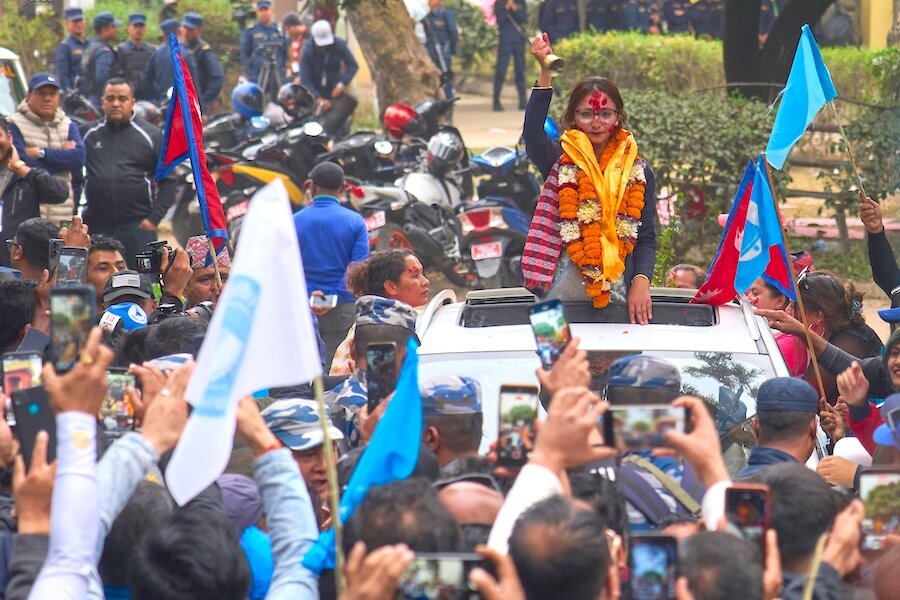
In the thin Himalayan mountain air of Nepal, the unambiguous results of the March 5 national elections are breathing new vitality into hopes for clean and effective governance in one of the world’s least-developed nations.
The relatively new Rastriya Swatantra Party (RSP) has so far won about 74% of the 165 directly elected seats in the legislature. Its sweeping success positions Balendra Shah, the capital city’s youthful, antiestablishment mayor (and ex-rap star), to become prime minister.
Nepal is the third South Asian country in recent years – after Sri Lanka and Bangladesh – to demand both democratic and generational change in political systems characterized by entrenched leadership, nepotism, and inefficiency. In all three nations, youth-led street protests resoundingly called for honesty and accountability, and ousted longtime political leaders, including – last September – Nepal’s four-term Prime Minister K.P. Sharma Oli.
Until the RSP came along, the same major parties had dominated politics for nearly three decades.
“People want change very badly,” as one political activist told Monitor contributor Aakash Hassan. “But transforming the system will be much harder than winning an election,” he noted.
An engineer by training, Mr. Shah has often indicated – largely through social media – that he wants to overhaul, if not overturn, “the system.” As a teenage rapper, his songs such as “Sadak Balak” (street child) and “Balidan” (sacrifice) called out corruption, pervasive poverty, and lack of services in this landlocked nation sandwiched between India and China. The country ranks in the bottom 25% of the United Nations Human Development Index. And more than 10% of its nearly 30 million people have sought employment in foreign countries.
Last month, Mr. Shah’s party issued a “Citizen Contract,” tying itself to a “100 Days, 100 Works” list of rapid actions to be taken on assuming office.
This “binding pact,” noted the Nepal News portal, differs from typical election manifestos that lack “robust ways to ensure compliance or continuation.” The contract, the outlet said, outlines public updates and progress assessments, putting a “spotlight on openness and verifiable accomplishments.”
Even as some critics are concerned about Mr. Shah’s go-it-alone style, his direct approach and focus on transparency – along with the relatively peaceful election process – inspire hope among many young Nepalis that deeper change is possible.
“I would love to be remembered as an honest guy, rather than a musician, an engineer, or a mayor,” Mr. Shah said in an online interview in 2024.
“There is huge potential in our country,” youth activist Yujan Rajbhandari told the Monitor just before last week’s vote. “Our only real hope is democracy in the true sense.”