There’s been a sharp increase in the number of drivers feeling nervous driving on ‘smart’ motorways, new research has found.
A huge 46 per cent of drivers told the AA they feel nerves or anxiety on ‘smart’ motorways – motorways with no hard shoulder – which is double the number who reported the same feeling last year.
One of the 12,705 drivers surveyed admitted she feels ‘terrified’ when driving on these roads and said they ‘fill me with fear’.
When driving on ‘smart’ motorways motorists are forced to rely on emergency refuge areas spaced around three-quarters of a mile apart because the hard shoulder has been permanently removed or it is converted into a running lane at peak times.
Increased ‘smart’ motorway fear comes even though these type of high speed roads only make up a fifth of the nation’s total motorway network and there have been no new installations in the last two-plus years after the Government cancelled construction of new stretches on safety fears.
In April 2023, the former Prime Minister Rishi Sunak officially called off the building of new ‘smart’ motorways – including 11 schemes that were already on pause and three earmarked for construction – due to a lack of public confidence.
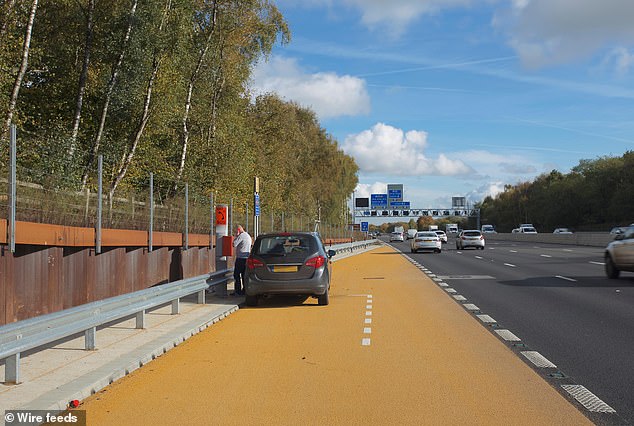
In April 2023, the former Prime Minister Rishi Sunak officially called off the building of new ‘smart’ motorways due to low public confidence and financial reasons
Motorways where the hard shoulder is only opened to traffic during busy periods also saw a significant increase in anxiety, with the number of drivers feeling nervous or anxious rising from 30 per cent to 47 per cent in the space of the last 12 months.
Contrastingly, confidence remains highest on conventional motorways that retain a continuous hard shoulder.
Levels of anxiety are still low on these roads but the AA’s survey shows a small increase compared with last year, suggesting that overall concerns about motorway safety may be rising more generally, even beyond smart motorways.
Looked at cohesively a clear and growing confidence gap between traditional motorways and smart motorway layouts is laid bare, underlining ongoing public concern about safety, breakdown provision and emergency access on the strategic road network.
One driver told the AA ‘it can be a bit anxious…there’s no safe spot, it can be quite dangerous’.
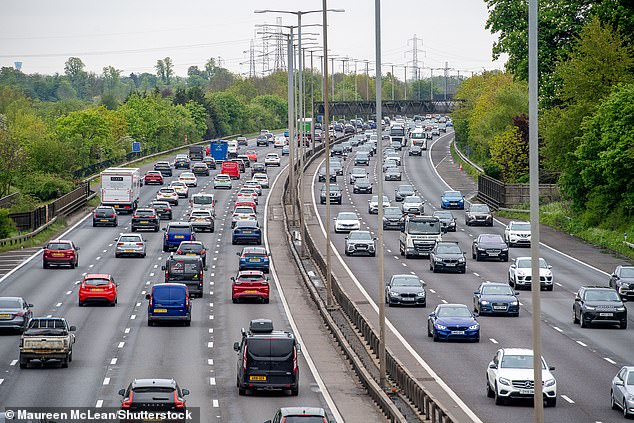
One driver told the AA ‘it can be a bit anxious…there’s no safe spot, it can be quite dangerous’
Edmund King, AA president said: ‘It’s not surprising that our members are more anxious about using ‘smart’ motorways. If you break down in a live lane, in effect, you are a sitting duck.
‘The failure of ‘smart’ motorway technology over the last few years has, no doubt, added to the levels of anxiety.
‘What the AA and our members would like to see is the return of the hard shoulder in a controlled motorway environment. Until that concern is properly addressed, it’s hard to see confidence in ‘smart’ motorways recovering.’
What types of motorway are there? And what’s the (brief) history of ‘smart’ motorways?
Twenty years ago the first trial of a ‘smart’ motorway started on the M42 in the West Midlands between junctions 3A and 7 as a Dynamic Hard Shoulder scheme.
The trial evolved into a permanent conversion of the hard shoulder, with the ‘smart’ motorway schemes extended to roughly 17 per cent of the motorway network between 2010 and the cancellation of the programme in 2023.
There are four major types of motorway – conventional motorways have a continuous hard shoulder.
‘All Lanes Running’ have no hard shoulder but emergency laybys at varying intervals. This is the most common type of ‘smart’ motorway.
‘Dynamic Hard Shoulder’ have a hard shoulder but it is only used as a running lane during peak hours or high levels of congestion.
‘Controlled Motorways’ have a permanent hard shoulder, but gantries which enforce lower speed limits.
What are the three types of ‘smart’ motorways and how do they work?
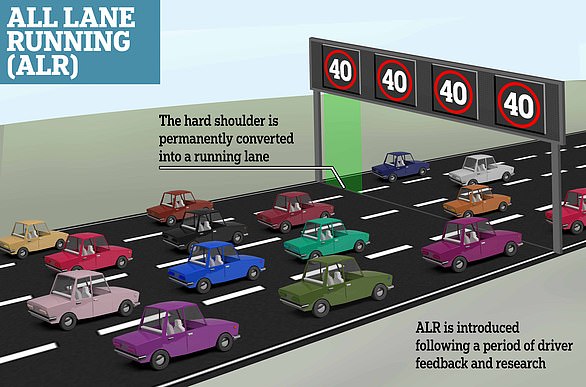
ALL LANE RUNNING (ALR)
All lane running schemes permanently remove the hard shoulder and convert it into a running lane.
On these types of motorway, lane one (formerly the hard shoulder) is only closed to traffic in the event of an incident.
In this case a lane closure will be signalled by a red X on the gantry above, meaning you must exit the lane as soon as possible.
All running lane motorways also have overhead gantry signs that display the mandatory speed limit.
Should drivers break down or be involved in an accident there are emergency refuge areas at the side of the carriageway for them to use.
Miles in total: 249.5 miles
Percentage of smart motorways in England: 55.1%
Percentage of all motorways in England: 13%
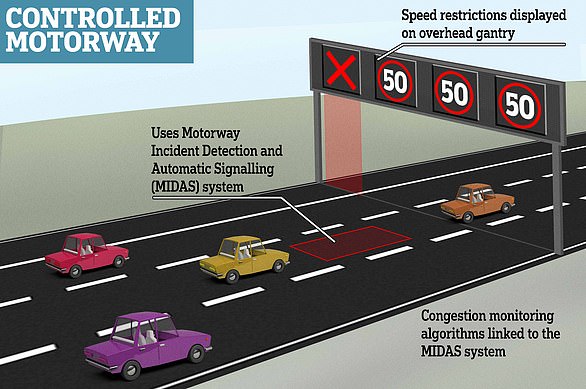
CONTROLLED MOTORWAY
Controlled motorways have three or more lanes with variable speed limits, but retains a hard shoulder. The hard shoulder should only be used in a genuine emergency.
These variable speed limits are displayed on overhead gantry signs – if no speed limit is displayed the national speed limit is in place. Speed cameras are used to enforce these.
Miles in total: 140.2 miles
Percentage of smart motorways in England: 31.0%
Percentage of all motorways in England: 7.3%
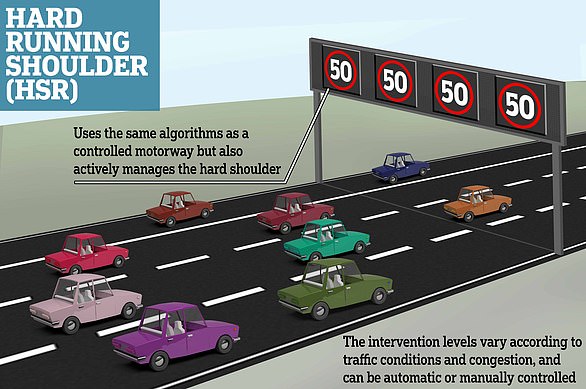
DYNAMIC HARD SHOULDER (DHS)
Originally referred to as Hard Shoulder Running smart motorways, dynamic hard shoulder running involves open the hard shoulder as a running lane to traffic at busy periods to ease congestion.
On these stretches a solid white line differentiates the hard shoulder from the normal carriageway. Overhead signs on gantries indicate whether or not the hard shoulder is open to traffic.
The hard shoulder must not be used if the signs over it are blank or display a red X, except in the case of an emergency.
A red X on the gantry above means you must exit the lane as soon as possible.
Overhead gantries on these types of motorway also display the mandatory speed limit which varies depending on the traffic conditions. Speed cameras are used to enforce these – no speed limit displayed indicates the national speed limit is in place.
Miles in total: 62.6 miles
Percentage of smart motorways in England: 13.8%
Percentage of all motorways in England: 3.3%