Marco Rubio, the poor man’s Kissinger of our era, drew standing applause in Munich this month — an odd reception for a speech that offered explicit Christian (trans)nationalism. A year before, his colleague and rival J.D. Vance had said similar things, albeit in harsher words. As U.S. missiles pounded Iran this week, German Chancellor Friedrich Merz was muted in his criticism of the latest American military adventure, abjuring any idea of “lecturing our partners.”
After twelve months of both European gestation and American reiteration, in the form of National Security and National Defense Strategies anchored on a pivot to the Western Hemisphere, the dust has started to settle in Europe, even as it rises again in the Middle East. Despite the praise lavished on Rubio by Eurocrats, the continent is finally, fitfully, stumbling towards something like an independent path. Nowhere is that truer than in the land of his German hosts.
As even a casual student of postwar Europe might remember, the Atlantic alliance came into being in 1949 with a triple mission. In the pithy words of its first secretary general, Sir Hastings “Pug” Ismay, NATO was created “to keep the Americans in, the Russians out, and the Germans down.” Three quarters of a century on, all three planks look very wobbly.
The Americans are still in, with a congressionally-mandated 76,000 troops in Europe. But the Trump administration’s turn west and south have induced a mix of fear, bluster, and sycophancy on the eastern shores of the Atlantic. A year into the Trump restoration, the administration’s revealed preferences match its espoused aims: America is abducting caudillos, bombing Iranians, and putting active duty troops on its southern border while driving its northern neighbor (and NATO member) toward China.
Should Donald Trump, despite his recent assurances, ultimately choose to annex frigid Greenland, the Americans will be decidedly out. Naked, utterly irrational aggression by one member state against another would break the alliance, whether or not a shot is fired in anger. Even absent such a massive blunder, the drive of American policy in Europe is toward burden shifting, not burden sharing. Despite the lingering hopes of some observers, future Democratic administration may have minimal enthusiasm to take up responsibilities shed. Joe Biden’s ardent Atlanticism is far more likely to be a relic than an aspiration for his party.
The Russians are still out, in some ways more than ever, with Finnish and Swedish NATO accession turning the Baltic into a NATO lake. The pace of Putin’s conquest of Ukraine has been glacial after the initial advances and counter-offensives of 2022. But Russia has reverted to historical type — slugging forward even at the cost of perhaps a million casualties and tens of thousands of vehicles and weapons systems. Western sanctions may eventually precipitate an economic crisis in Russia, but Ukraine’s stalwart but strained forces may break before that moment arrives.
Should Russia achieve something approaching its initial war aims — the Donbas conquered, Ukraine’s army limited and its allies fenced out, Ukrainian integration into Europe halted — it will be positioned to regenerate its strength and threaten at least the Baltic salient on its border.
The scale of Russian losses in Ukraine dwarfs anything Europe has seen since 1945. But Russia, now running a war economy hot, is still able to reconstitute. Ukraine’s new defence minister, Mykhailo Fedorov, has just announced that Ukraine aims to kill 50,000 invaders a month, exceeding Russia’s recruitment rate and winning the war through attrition. But there are reasons to doubt the viability of such a strategy. Russian casualties have risen sharply in recent months, but this could be as much a testament to season and terrain — bare trees hide few troops — as technology.
European intelligence services give various unclassified estimates of the timeline for a renewed Russian threat to Europe, with many settling on 2029 as the earliest plausible period. But in a new, high profile wargame conducted by Germany’s Die Welt newspaper in partnership with the German Wargaming Center of the Helmut-Schmidt University of the German Armed Forces, a simulated October 2026 Russian invasion of a strategic Lithuanian city succeeded, in large part due to German tactical and strategic hesitance.
It is that third leg of Ismay’s stool that has collapsed. Despite his axiom, after 1949 the West German military was quickly resurrected and rearmed. The Bundeswehr, manned by conscripts and equipped by the defence arm of the Wirtschaftswunder, could summon more than a million men in wartime. Even at the Cold War’s final peak in the early Eighties, some NATO comrades rated it the most tactically adept army in Europe.
When the Berlin Wall came down, the Bundeswehr slid into military irrelevance and even farce. The force shrunk to a scant 180,000, despite having the additional men and women of a reunified Germany to draw from. Conscription was hollowed out and eventually suspended altogether in 2011. After the (halting) provision of munitions to Ukraine in 2022, some weapons systems may only have had sufficient force-wide ammunition for a few hours of high-intensity combat.
Then-Chancellor Olaf Scholz’s heralded Zeitenwende pumped 100 billion Euros into a special fund to rejuvenate German defence. Four years later, this has sufficed to pull Germany over the old NATO red line, spending 2 percent of GDP on defence, but the heavy lifting is still ahead. The real turning point came only last year, when the inveterately frugal Bundestag narrowly passed a constitutional amendment that removed a debt brake to enable far greater borrowing for defence and infrastructure.
Germany now boasts the world’s fourth largest defence budget in nominal terms. The increased demand signal is driving both capacity and capability in the German defence industry. By this December, Germany plans to complete 154 major defence purchases: new frigates, fighter planes, armored vehicles, missiles, and much else. Most new procurement will come from European sources.
Rheinmetall, the sector’s juggernaut, singlehandedly produces more 155mm artillery ammunition than the entire United States. With 2025 revenues likely to have been double what they were just four years earlier, the firm has ambitions that go far beyond tank barrels and high explosives. The Financial Times reported that Rheinmetall is in talks to co-produce a replacement for Elon Musk’s Starlink in Europe. Rheinmetall aims to be a national champion on the scale of America’s vaunted and reviled “primes,” a one-stop shop for what ails German defense.
German leaders have also touched the ultimate defence third rail: nuclear weapons. With American extended deterrence increasingly questionable, Chancellor Friedrich Merz has openly invoked the idea of a shared European nuclear umbrella, through British and French weapons.
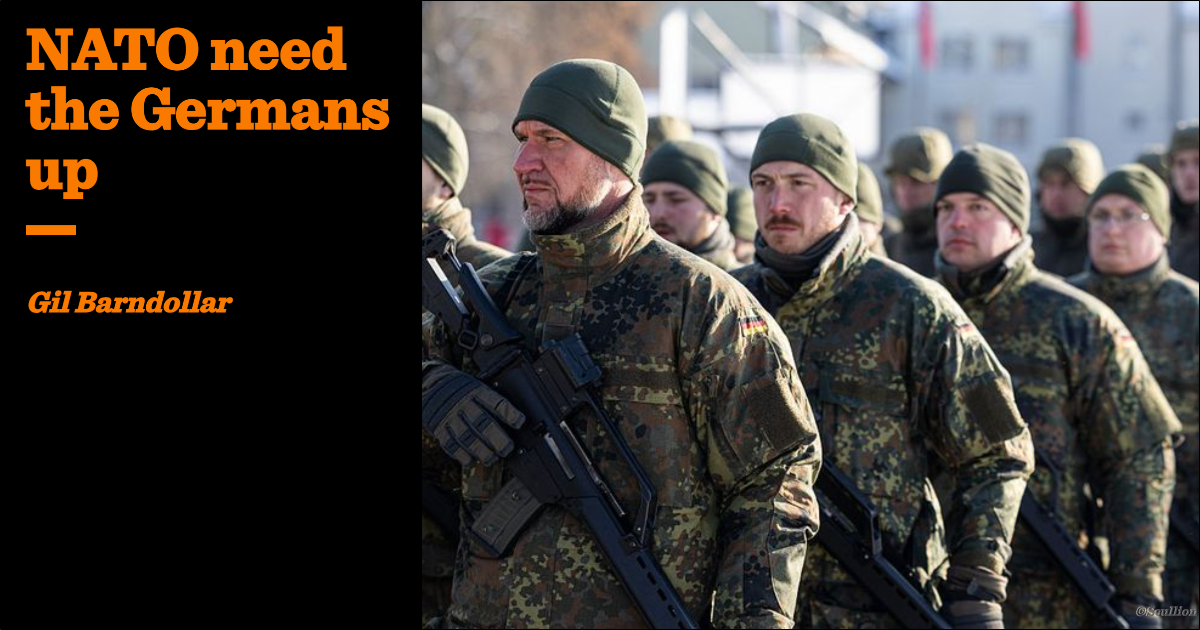
There is even cause for optimism on the thorniest issue: who will wield these piles of new weapons. After steadily shrinking for decades, in 2025 the Bundeswehr had its best recruiting year since the end of conscription in 2011. The Bundestag has decided against a return to conscription for now but men will now undergo mandatory military screening at 18, while incentives for voluntary service will be enhanced.
Germany, like all European countries, will find its military hamstrung by demographic realities. A new report finds that Germans are getting older faster than previously forecast. As in all of the West, the skyrocketing cost of housing, rising income inequality, and dimming prospects for personal prosperity dampen patriotism and willingness to sacrifice among the young. As a 26 year-old German influencer and podcaster told the Wall Street Journal in January: “Now we’re told we should defend democracy, but whose interests are we asked to defend here?”
Still, with more than 20 million Germans between the ages of 20 and 40, there are more than enough potential soldiers. The question is whether they should be incentivised or compelled to serve.
The real threat to Germany assuming its proper share of European defence is political: the rising right in the form of the Alternativ für Deutschland (AfD) party. In an odd inversion of European politics of a century ago, the AfD joins most of the European far right in a newfound Russophilia. In November, the AfD’s co-leader told German public television that Putin “hasn’t done anything to me.” Poland, he opined, could be more of a threat. The AfD fought the repeal of the debt brake.
When it comes to Europe’s defence after Ukraine, Germany is the key
With more than 20 percent of the vote in last year’s election, the AfD is Germany’s second-largest party. The centre-right CDU and centre-left SPD have drawn a cordon sanitaire around the AfD, making it earn an outright victory and an actual majority of parliamentary seats to govern. But this fall, it may achieve that for the first time in the eastern German state of Saxony-Anhalt, thanks to the telegenic Ulrich Siegmund. Squint and you can make out a younger facsimile of Le Carre’s Karfeld, excusing the past and embracing the East.
The AfD’s ascent is troubling. A sudden rug-pull, a retreat of Germany from rearmament and collective defence remains a political possibility. But without a German contribution commensurate with its size and wealth, who can provide credible conventional deterrence in the possible future of an absent America and a bloodied but ascendant Russia? Britain and France, the continent’s traditional heavyweights, are mired in political crisis, budgetary ceilings, and shrinking force structures. NATO’s frontline states — the Balts, the Finns, and the Poles — are all in, with new weapons, growing reserves, and natural and manmade obstacles to Russian invasion. Yet they lack the heft, the population, and the depth to deter Russia. When it comes to Europe’s defence after Ukraine, Germany is the key. As a European leader proclaimed in a very different context: TINA — there is no alternative.