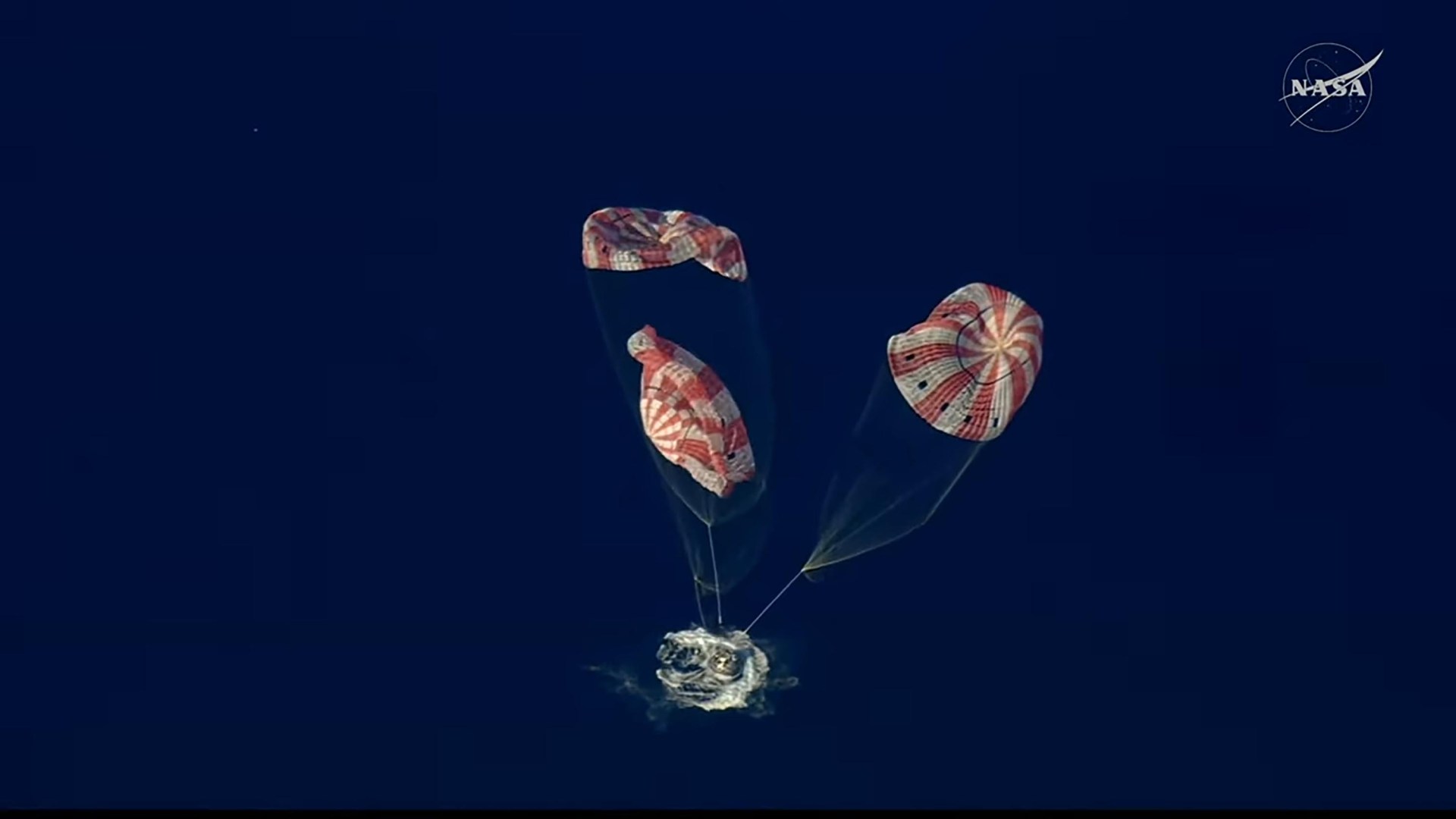
ASTRONAUTS on the Artemis II capsule have splashed down on Earth after their historic 10 day journey into space.
The crew are now floating off the coast of San Diego after an incredible 25,000mph decent after what Nasa called a “bullseye splashdown”.
All four crew members are in good condition. Reid Wiseman said: “Reid Wiseman reporting four green crew members, that is not their complexion, that is their condition.”
It took just 42 minutes for the splashdown sequence, which began with the separation of the European Service Module, to complete.
But it was considered the most dangerous part of the £3billion ($4bn) mission, with the Orion capsule heating up to nearly 2,760C — about half as hot as the Sun.
Watch The Sun’s livestream of the Artemis II mission here

The crew also faced a tense six-minute communication blackout before the capsule parachuted into the sea.
The planned six-minute silence was caused by a build-up of plasma that stops communications, during which NASA showed a fiery visual but there was no footage of the craft burning through the atmosphere.
Recovery teams are now working to retrieve the crew using helicopters before they will be transported to the USS John P. Murtha.
Once aboard, the astronauts will undergo post-mission medical evaluations in the ship’s medical bay before traveling back to shore to meet with an aircraft bound for NASA’s Johnson Space Center in Houston.
History was made when the Artemis II mission thundered out of Earth’s orbit on April 1.
The four daring astronauts lifted off from Kennedy Space Center on April 1 for a journey to pave the way for a permanent base on Earth’s closest neighbour.
Although the crew did not land on the lunar surface, they travelled farther from Earth than any other human in history.
Reaching a whopping 252,756 miles, Artemis II broke the previous record set by Apollo 13 in 1970 – which travelled 248,655 miles from Earth.
The Orion spacecraft left the Moon’s “sphere of influence” – the area where the Moon’s gravitational pull is stronger than Earth‘s – on Tuesday.
Key moments from the historic Artemis II mission
After a 10-day lunar mission that has reignited global interest in space exploration, the astronauts of Artemis II have returned home. Here are some of the key moments from their record-breaking mission.
- Artemis II thundered out of the Earth’s orbit on April 1.
- The four astronauts travelled further from earth than any human in history, smashing the previous record set by the 1970 Apollo 13 mission.
- The crew experienced a communication blackout which lasted almost an hour after setting their distance record and passing across the far side of the moon.
- The first ever pictures of earth as seen from the mysterious far side of the moon were taken.
- New craters were discovered on the lunar surface, which have now been named by astronauts.
- A fault put the spacecraft’s £17.4 million toilet out of action for six hours.
- Artemis II left the Moon’s “sphere of influence” on Tuesday to begin their journey home.
The crew briefly lost contact and were left completely alone for nearly an hour.
In their final words before the unavoidable blackout, pilot Victor Glover said: “To all of you down there, we love you from the Moon.”
The crew revealed a newly-discovered lunar crater would be named after Commander Wiseman’s wife Carroll, who died of cancer, aged 46, in 2020.
In another record breaking feat, astronauts snapped the first ever pictures of Earth from the mysterious far side of the moon.
Another astonishing snap shows a solar eclipse from space showing “totality, beyond Earth”.
But the high-stakes mission has not been without tense moments.
Engineers ran into issues on launch day, facing two technical scares and a one-hour delay before liftoff.
A faulty loo also meant crew could not boldly go for six hours after a blinking light alert put the £17.4million toilet out of action.
Hansen, 50, revealed the “tense” moment in the crew’s first live interview from space.
He said: “We did get a warning message for ‘cabin leak suspected’”.
Cabin leaks can be deadly – they could lead to the structure of the spacecraft being compromised, risking exposing the crew to space’s powerful vacuum.
Fortunately, the crew investigated and found the alert was a mistake, and onboard cabin pressure remained at normal levels.
Ahead of the crews decent all eyes were on the capsules heat shield – a special coating applied on the bottom to protect astronauts from the 2800C temperatures on re-entry.
During a test flight on the first uncrewed Artemis mission in 2022, the heat shield cracked and chunks came off.
The spacecraft was still able to return to Earth intact and a subsequent investigation found that people would have been safe, so Nasa bosses decided it could still be used for the Artemis II mission.
Instead, experts made some alterations to the flight path.
Several other critical factors, including achieving the spacecraft’s precise descent path and re-entry angle through a series of guidance blasts, all went to plan.
The huge mission follows nearly three years of training for the group, who are the first selection of astronauts to fly in Nasa’s Artemis program.
Nasa is already preparing its next Artemis mission for 2027 which will be another crewed test.
After that it’s the most talked about Artemis IV mission in 2028, where astronauts will walk on the Moon.