How old were you when you bought your first house? That’s the question my youngest daughter asked me a few days ago.
The answer made me cringe: I was just 21.
‘Here we go,’ I thought, expecting a lecture on how my Boomer generation (born between 1946 and 1964) got rich simply because jobs were plentiful and property cheap when we arrived in the world.
I’ve heard it before, of course. I’ve spent years telling my children to stop complaining, to realise how lucky they are with all their material advantages.
My children didn’t wear second-hand clothes or wake up with ice on the inside of their bedroom windows. Yet the truth is that Britain’s young adults do have real grievances, and none greater than when it comes to jobs and housing.
My daughter, now in her early 30s, belongs to a generation of young adults who know they are unlikely to be able to buy property until the age of 40 – if at all – and perhaps only then with generous help from the Bank of Mum and Dad.

My daughter, now in her early 30s, belongs to a generation of young adults who are unlikely to be able to buy property until the age of 40 – if at all (Picture posed by models)
The relentless increase in house prices and rents combined with a flatlining economy ensures that millions of young people struggle to put a roof over their own heads, let alone to think about starting a family.
Figures released by the respected Institute for Fiscal Studies suggest that the number of people aged between 25 and 34 still living with their parents has increased by as much as a third since 2006.
It’s not a lifestyle choice: they simply can’t afford to leave.
No wonder the birth rate for England and Wales has slumped to a record low of just 1.4 children per woman (well below the ‘replacement’ level of 2.1 which would keep the population stable). Who will pay the taxes to run the public services of tomorrow?
Life for today’s young is so much harder than in the past, when flying the nest was a rite of passage.
Millions of us expected to walk into a job and buy property as soon as we were earning a steady salary. With good reason.
Jobs abounded. Houses were being built. Despite the strife of the post-war decades, we felt the world really was changing for the better.
If you had ambitions, the chances were that you could – and would – achieve them provided you put the effort in. With or without a degree, the economy was open to all.
There were maintenance grants for those who won a place at university.

That’s why, like many of my ‘Boomer’ friends, I know I’ll be working until the day I drop. We fear for the future of our children and grandchildren (Picture posed by models)
When I trained as a nurse in the 1970s, I didn’t have to borrow huge amounts of money like today’s nursing students, who are left thousands of pounds in debt. I was paid a wage while training and studying.
That was before Tony Blair decided to funnel 50 per cent of school leavers into higher education and then made them foot the bill by charging tuition fees – and saddling them with student loans.
Half a century on, my children have emerged into a bleaker, frankly unrecognisable world. European economies are stagnant. British manufacturing is a shadow of itself. Technology is destroying jobs more quickly than it’s replacing them – and that’s before AI really gets going.
The employment market is awash with graduates, mostly saddled with vast debts, yet the opportunities to build a career are dwindling fast and the competition is fierce.
Who wants to hire 21-year-olds to learn the ropes when the tech is so much faster?
It’s as if the world has turned its back on Britain’s young adults, yet still we brand them ‘lazy and entitled’. Who would want to be young today? Not I.
That’s why, like many of my ‘Boomer’ friends, I know I’ll be working until the day I drop. We fear for the future of our children and grandchildren. We want to do everything we can to support them.
Back to my daughter’s question: I bought my first home in 1978 as a newly qualified nurse on a salary of £13,000.
It took me only a year to save up the deposit and my reward was a three-bedroom semi with a garden – not a one-bedroom studio flat an hour’s commute from work.
I find it embarrassing to explain all this to the younger generation. People like my daughter feel resentful and quite rightly so.
For the lucky ones, like me, who emerged into adulthood in the 1960s and 1970s, the world was pretty much our oyster. It was a golden age – and we didn’t even know it.
Princesses must stick together
Princess Eugenie has cut off all contact with her father, Andrew Mountbatten-Windsor, according to The Mail on Sunday.
This contrasts with the attitude of elder sister Princess Beatrice, 37, who is said to be treading a careful diplomatic line, keeping both her father and a very twitchy Royal Family happy. It is a mission worthy of the United Nations.
It’s only natural that Beatrice should take this path. She’s the elder daughter, after all. The serious sibling, the one expected to shoulder responsibility and look out for others.
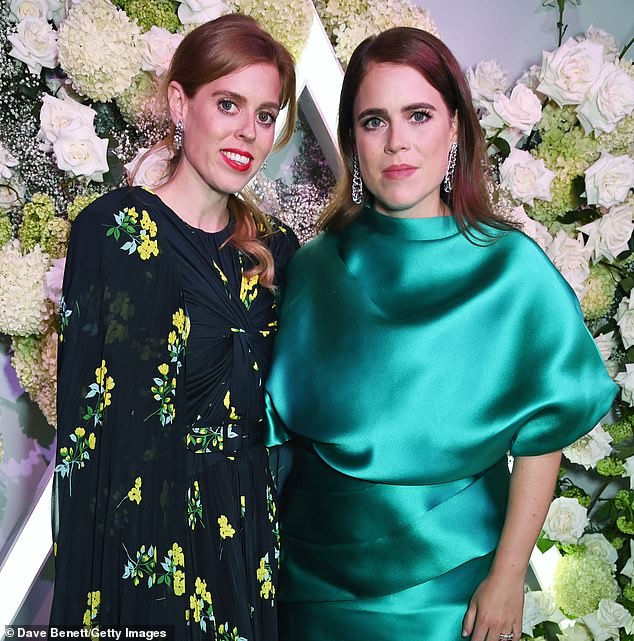
Princess Beatrice of York and Princess Eugenie of York ‘must stick together’, says Nadine (Pictured in 2023)
And one imagines it’s not the first time Beatrice has taken on the role of peacemaker in this family. I wholly understand why she has put discretion before confrontation.
Both princesses are known to be lovely young women. But Eugenie, 35, has the luxury of being the second-born, which means she has more freedom to do as she wishes.
I understand her position, too. What young woman wouldn’t feel revulsion at her father’s association with the late paedophile financier Jeffrey Epstein?
The most important thing, however, is that the sisters refuse to let the sins of the father contaminate their own close relationship, and that they remain supportive of each other.
My Hamnet dilemma…
The film of the moment is Hamnet, starring Irish actors Jessie Buckley and Paul Mescal. It tells the story of William Shakespeare’s son and his death at the tragically young age of 11.
The movie is tipped to sweep the board at the Oscars.
Yet I have to confess I’m filled with trepidation at the prospect of seeing it, so heartbreaking are the reports.
It carries a ‘grief warning’, after all. Am I strong enough to hold it together and not leave the cinema a bawling, wrung-out wreck? I’m sure the answer to that is ‘no’.
Tickets are booked. To go or not to go? That is the question…