A suicide note impaled with a red pen into the soil of a potted plant was long believed to be Kurt Cobain’s final message to the world.
The Nirvana frontman died on April 5, 1994, at age 27 from a shotgun wound at his Seattle home. The King County Medical Examiner ruled his death a suicide.
Written in red pen on a restaurant placemat, the note was one of the key pieces of evidence cited by Seattle Police in their conclusion that Cobain took his own life.
Now, a private forensic team has claimed that the final lines of the note, where Cobain appears to bid farewell to his wife and daughter, may have been written by someone else.
Those lines read: ‘Please keep going Courtney,’ ‘for Frances,’ ‘for her life which will be so much happier,’ ‘without me,’ followed by ‘I LOVE YOU. I LOVE YOU.’
Independent researcher Michelle Wilkins, who worked with the team, told Daily Mail: ‘If you look closely, the handwriting in the last four lines is different, larger and more scrawled. We don’t believe Kurt wrote those lines.’
By contrast, the top of the note, addressed to Cobain’s imaginary childhood friend ‘Boddah,’ reads like a farewell to the music world rather than a personal message to his family: ‘I’ve tried everything… I’ve tried to get what I wanted out of life, and it just hasn’t worked.’
Handwriting analyst Mozelle Martin claimed that the last lines were written by someone else, citing changes in letter formation and rhythm, though her findings have not been peer-reviewed.
Martin said she conducted her analysis to see the Kurt Cobain case officially reopened by Seattle Police as a homicide investigation, not a suicide.
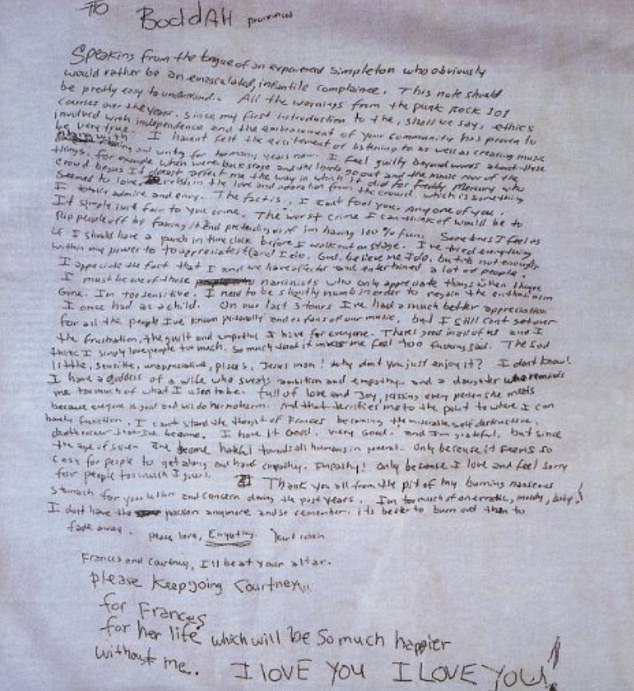
A private forensic team has claimed that the final lines of the note, where Cobain appears to bid farewell to his wife and daughter, may have been written by someone else
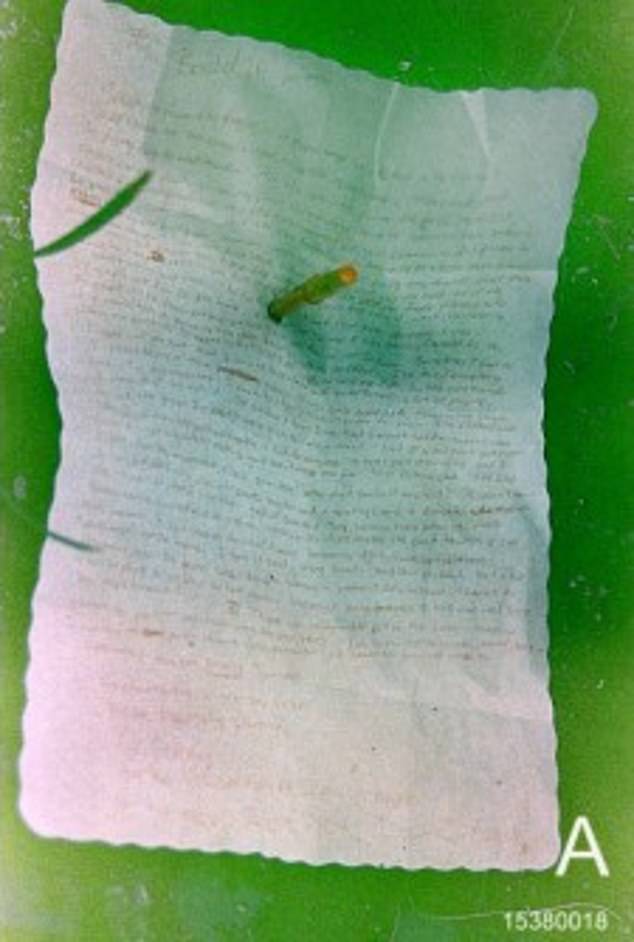
A suicide note impaled with a red pen into the soil of a potted plant was long believed to be Kurt Cobain’s final message to the world
A spokesman from the Seattle Police Department previously told Daily Mail that they are not reopening the case.
‘Our detective concluded that he died by suicide, and this continues to be the position held by this department,’ the spokesperson added.
At the bottom of the note was a signature reading ‘Kurt Cobain,’ but experts have pointed out that using his full legal name rather than a more personal sign-off like ‘Kurt’ or ‘Love you,’ is highly unusual for a farewell to a spouse and child.
Combined with the dramatic presentation of the letter, pinned to a placemat and stabbed into the soil of a potted plant, these details have fueled speculation that the note may have been staged or crafted for effect.
Observers have long noted the theatricality of the display, and it was also highlighted in an episode of Unsolved Mysteries, drawing national attention to the unusual circumstances surrounding Cobain’s final message.
Martin conducted a meticulous examination of two sets of handwriting: known samples of Cobain’s writing and the alleged suicide note, including its final four lines.
Using both digital and manual forensic tools, she analyzed everything from i-dot placement and vowel shapes to stroke pressure and letter proportions.
Her findings confirmed that the main body of the suicide note aligns closely with Cobain’s known handwriting. But the final four lines told a different story.
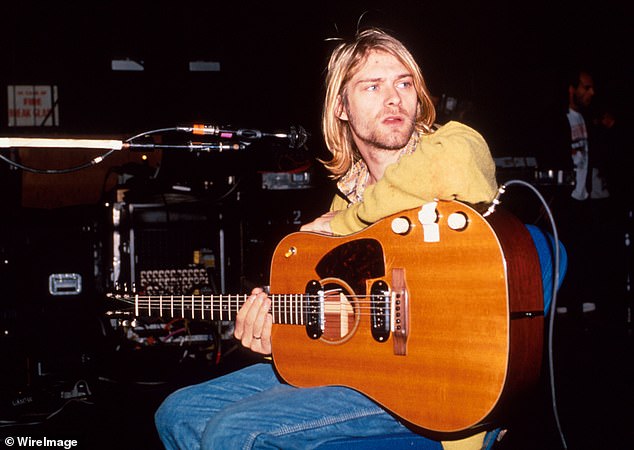
The Nirvana frontman died on April 5, 1994, at age 27, from a shotgun wound at his Seattle home. The King County Medical Examiner ruled his death a suicide
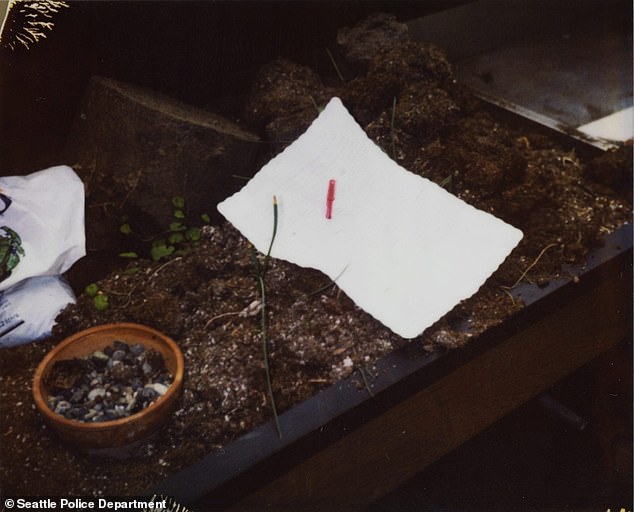
Written in red pen on a restaurant placemat, the note was one of the key pieces of evidence cited by Seattle Police in their conclusion that Cobain took his own life
‘When analyzing the contested Kurt Cobain suicide note, forensic handwriting comparison revealed a distinct behavioral fracture: the body of the note aligned with Cobain’s known writing, while the final four lines displayed significant anomalies,’ she told the Daily Mail.
On a five-point comparison scale, the likelihood that Cobain authored the final lines was rated 4.75, with five meaning ‘definitely not.’
According to Martin, this indicates the evidence strongly suggests he did not write them.
‘While the data strongly supports that the final lines were not authored by Cobain, I cannot say with 100 percent certainty that he did not write them, because I was not there,’ she explained.
‘Ethical forensic examination is about probability, not absolute certainty.’
Certified document examiner James Green also compared the main body of the note with the final four lines using standard forensic methods, including the ACE process, Analyze, Compare, and Evaluate, consistent with the Academy Standards Board.
While Green did not definitively identify a second author, he noted several ‘significant’ differences.
The final lines are larger than the rest of the note, suggesting they may have been added later.
One theory is that Cobain wrote the main body in a single sitting and returned to add the final words. Another possibility, Green concluded, is that the last lines were added by someone else entirely.
Letters throughout the four lines show similarities to Cobain’s handwriting, capital letters like ‘P,’ ‘K,’ and ‘C,’ and lowercase letters such as ‘a,’ ‘s,’ ‘p,’ and ‘g’ were generally consistent with his known forms.
But subtle variations in slant, size and shape leave room for doubt.
Green said that while the handwriting could plausibly have been produced by Cobain, a skilled imitator could have replicated many of these features.