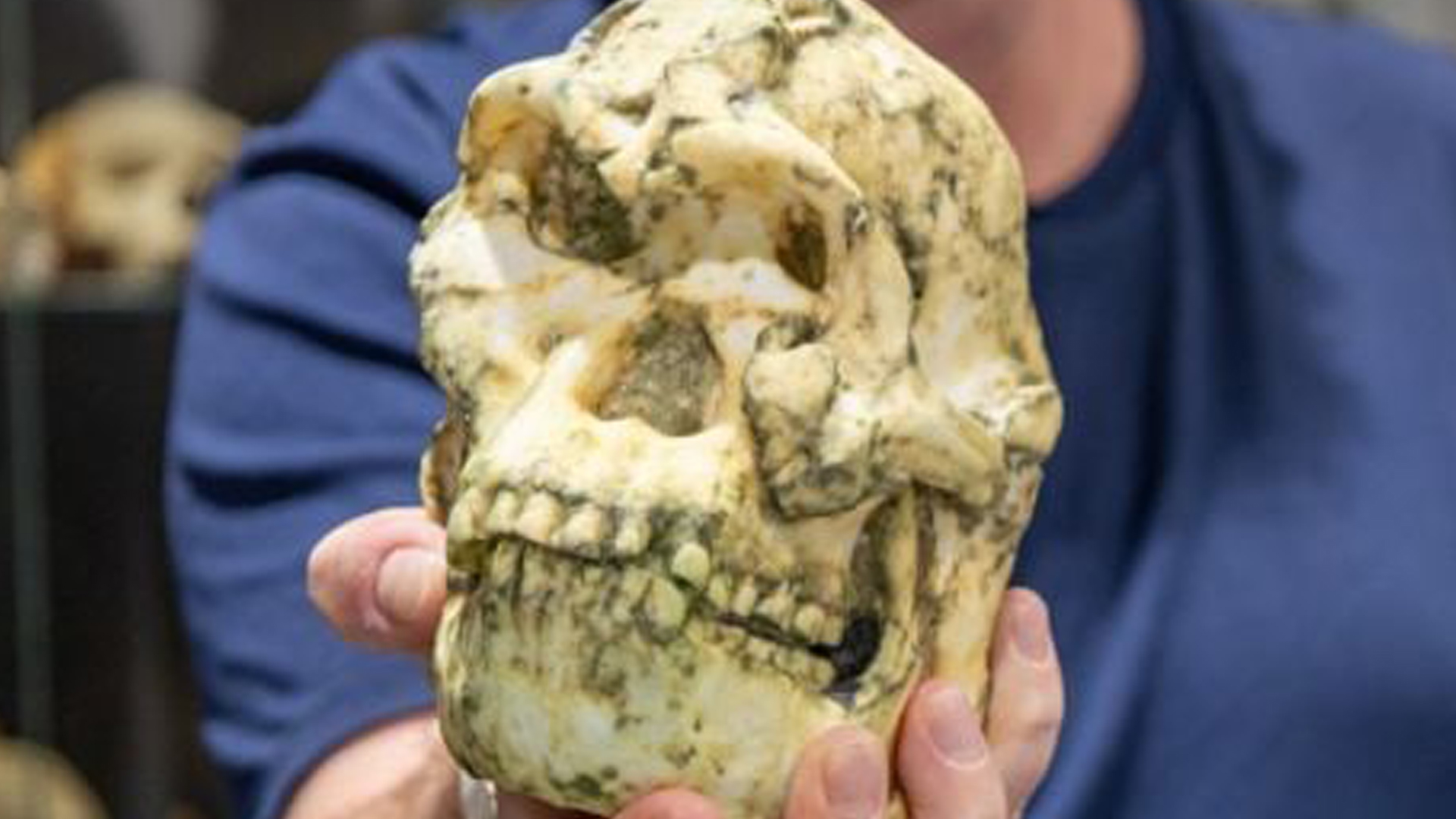
A WORLD-FAMOUS fossil nicknamed “Little Foot” may actually belong to a new humanlike species.
The fossil was previously thought to be a member of a genus called Australopithecus – but a fresh probe tells a very different story.
Little Foot is the name for a nearly complete fossil skeleton that was found in the mid-to-late 1990s. Its name comes from the four ankle bones that showed the individual was able to walk upright.
The skeleton was discovered in the Sterkfontein cave system in South Africa.
And it was thought by paleoanthropologist Ronald Clark, who led the original excavations and analysis, to be a member of Australopithecus prometheus.
Others thought that it was Australopithecus africanus, a species first described in 1925.

Now new research by La Trobe University and the University of Cambridge say that Little Foot doesn’t share a unique set of traits with either species.
And that might mean it’s an entirely new species.
“This fossil remains one of the most important discoveries in the hominin record and its true identity is key to understanding our evolutionary past,” said Dr Jesse Martin, of La Trobe University.
“We think it’s demonstrably not the case that it’s A.prometheusor A. africanus. This is more likely a previously unidentified, human relative.
“Dr Clarke deserves credit for the discovery of Little Foot, and being one of the only people to maintain there were two species of hominin at Sterkfontein.
“Little Foot demonstrates in all likelihood he’s right about that. There are two species.”
Little Foot is notable for being the most complete ancient hominin in the fossil record to date.
Dating of the specimen has ranged from between 2.2 million and 3.67 million years old.
Officially known as Stw 573, the skeleton was partially uncovered – with just four ankle bones – in 1980.
But it wasn’t until 1992 that a large rock was blown up in the cave, revealing a treasure trove of fossils.
Then in the mid-1990s, Dr. Clarke identified fragments that could be pieced together.
And in the late 1990s, further bones were discovered, allowing experts to piece together a relatively complete skeleton.
Investigations over the years led to debate over the species that the skeleton belonged to – and the latest research suggests it’s actually very unique.
“It is clearly different from the type specimen of Australopithecus prometheus,” said Professor Andy Herries, of La Trobe.
A timeline of life on Earth
Here’s a brief history of life on our planet
- 4.6billion years ago – the origin of Earth
- 3.8billion years ago – first life appears on Earth
- 2.1billion years ago – lifeforms made up of multiple cells evolve
- 1.5billion years ago – eukaryotes, which are cells that contain a nucleus inside of their membranes, emerge
- 550million years ago – first arthropods evolve
- 530million years ago – first fish appear
- 470million years ago – first land plants appear
- 380million years ago – forests emerge on Earth
- 370million years ago – first amphibians emerge from the water onto land
- 320million years ago – earliest reptiles evolve
- 230million years ago – dinosaurs evolve
- 200million years ago – mammals appear
- 150million years ago – earliest birds evolve
- 130million years ago – first flowering plants
- 100million years ago – earliest bees
- 55million years ago – hares and rabbits appear
- 30million years ago – first cats evolve
- 20million years ago – great apes evolve
- 7million years ago –first human ancestors appear
- 2million years ago – Homo erectus appears
- 300,000 years ago – Homo sapiens evolves
- 50,000 years ago – Eurasia and Oceania colonised
- 40,000 years ago – Neandethal extinction
“Which was a name defined on the idea these early humans made fire, which we now know they didn’t.
“Its importance and difference to other contemporary fossils clearly show the need for defining it as its own unique species.”
Dr Martin added: “Our findings challenge the current classification of Little Foot and highlight the need for further careful, evidence-based taxonomy in human evolution.”
This research was published in the American Journal of Biological Anthropology.