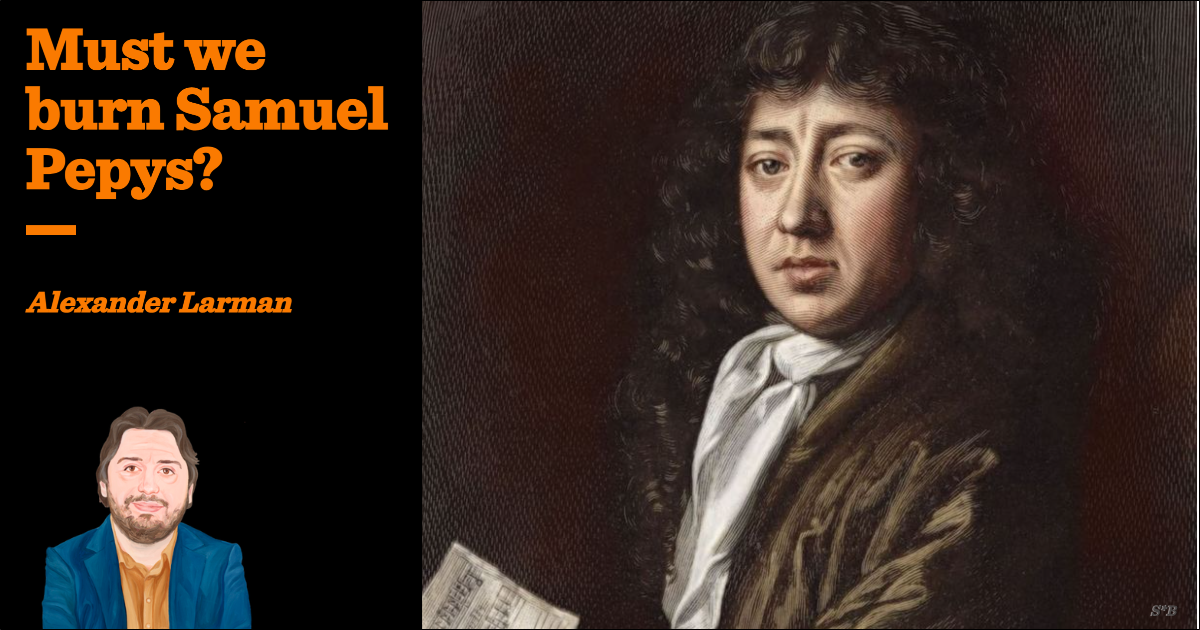
The news that pupils — pupils! — at the diarist Samuel Pepys’s alma mater Hinchingbrooke School in Huntingdon, Cambridgeshire have voted to rename one of the school houses, Pepys House, in protest at the old boy’s abhorrent behaviour is both depressing and predictable. It is depressing because of the historical revisionism that it demonstrates — egged on by the staff, who huffily declared that the activities alluded to in Pepys’s diaries do “not align with the values we hold as a school – respect, equality, kindness and high standards” — and it is predictable because, in this new censorious age that we reluctantly inhabit, standards of behaviour are constantly reassessed and, more often than not, found wanting. 1760 votes were cast, of which 1054 were for the name of the sinful Pepys to be stripped from the building. Notably, Oliver Cromwell — who wrought incomparably more change upon Britain for good or ill, generally the latter — continues to have one of the houses named after him.
You might decry this kind of censorship, which is of a piece with tearing statues down and renaming libraries and concert halls because of their perceived associations with slave owners, but there is little point in shouting about it. It is here to stay, alas. Yet as someone who has written extensively about the Restoration era and Pepys himself, I cannot help thinking that the new vogue for piling into the diarist — begun last year by the scholar and critic Guy de la Bédoyère’s new research into his diaries — is based on an essential misunderstanding of the literary culture of the day.
Traditionally, Pepys has been seen as a jolly, slightly ramshackle character, whose diaries are the key to understanding everyday literate upper-middle-class life in 1660s Britain. Pepys began writing his account on 1 January 1660 and kept it until 1669, when, fearful that the effort of his daily toil would result in his losing his sight, he stopped his diary, depriving future generations of his unique and detailed insight into the Restoration court. However, for the near-decade that he wrote his account of life in Britain, he offered a fascinating perspective on everything from what it was like to have been present at the Great Fire of London (ever-prudent, Pepys buried an expensive parmesan cheese to save it from destruction) to eyewitness accounts of everyone from the “merry monarch” Charles II to wars, plague and the affairs of actresses such as Elizabeth Knepp and the king’s mistress Nell Gwynn.
The diaries have been invaluable for historians and literary critics alike, and in their cameos of such figures as the decadent poet Lord Rochester, who Pepys decries as “so idle a rogue”, there is an immediacy and vitality that brings the gilded, gaudy era to life, in a way that no dry academic ever could. Yet de la Bédoyère’s new investigation of Pepys’s writing, which was written in shorthand, discovered that, rather than being the amicable duffer that he has traditionally been regarded as, forever chasing after women and being a bit of a nuisance with them but never getting very far, he was a sex pest par le diable, who was either assaulting his maidservants, fantasising about participating in gang rapes or simply groping women in the street as he passed by them on his way to work at the Navy Board.
As de la Bédoyère sadly observes in his book The Confessions of Samuel Pepys, the diarist may have lived in a “hierarchical, patriarchal, deferential society”, but he took full and unseemly advantage of the opportunities that his enhanced status offered him: literally, in the case of a woman who was coerced into sex with the official in exchange for a guarantee that her husband would not be pressganged into serving in the Second Anglo-Dutch War.
Taken at face value, then, Pepys was no less of a rogue than Rochester, and thoroughly deserving of the cancellation that he has faced. Yet I was surprised, amidst last year’s uproar at these new revelations — occasioned by de la Bédoyère uncracking Pepys’s far from subtle code in a way that previous scholars had somehow failed to — that there was not more discussion of the literary world that he was, albeit inadvertently, a member of.
If taken literally, the poetry of Rochester, and other court poets, would be an endless litany of what he calls, in “A Ramble in St James’s Park”, “buggeries, rapes and incests made”. It is because of the sexual permissiveness brought about by Charles II’s Restoration, after the dour days of Puritan rule during the Commonwealth, that such things became acceptable even to write about, let alone enact. If, of course, they were enacted at all.
It is hard not to feel that the entries veer closer to being wish-fulfilment and fantasy … than to being a documentary account
My first book, Blazing Star, was a biography of Rochester, and while researching it, my major discovery was that the one-time servant of Sodom was nowhere near as wicked or licentious as posterity has painted him. Instead, a vast amount of the poetry — unquestioningly regarded by many as confessional autobiography — was simply performative fancy, designed to amuse and titillate his friends and masters at court, including, naturally, the king. He was undoubtedly no saint, but he was far from the notorious rake who is a byword for immorality. And I suspect that much the same would be true of Pepys, too. While one might suggest that a private diary, written in code, was necessarily more candid than poems passed from hand to hand, it is hard not to feel that the entries veer closer to being wish-fulfilment and fantasy — perhaps written to act as a form of masturbatory relief — than to being a documentary account of his activities during this period.
To describe Pepys as flawless would be ridiculous. He clearly misbehaved, in thought and word if not necessarily in deed, and, like most men of his class and background, he was an opportunist who had what can only be described as “traditional” views about the role of women in society. Yet if one was to cancel him for these failings, virtually every single major historical or literary figure would face similar censure and consequent expungement. I hope that the pupils of Hinchingbrooke School had as many facts, and the context of those facts, to hand as they could.