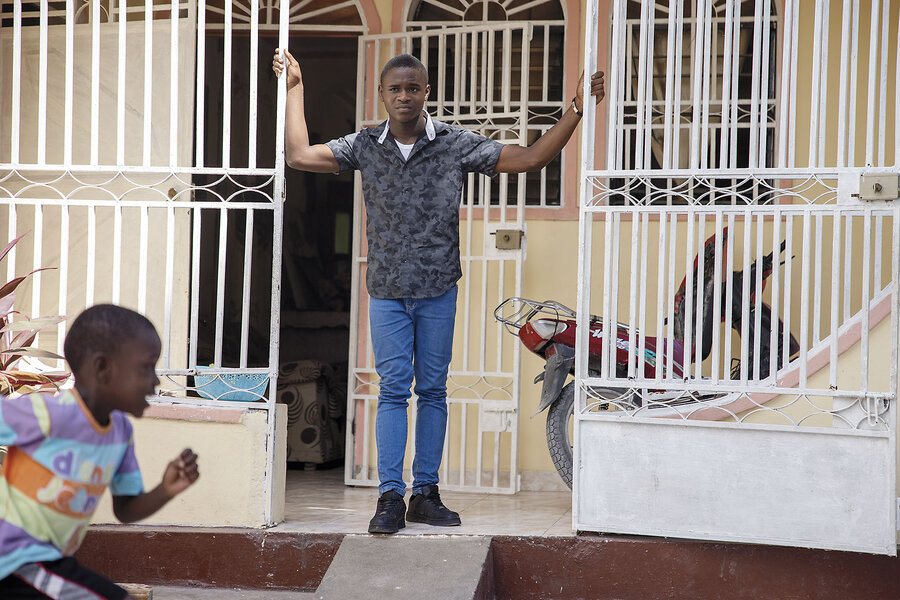
Émile Bejin says he always dreamed of living in “a real house” with a “real family.” And after spending the first 14 years of his life in an orphanage outside Port-au-Prince, last year, he finally moved into a foster home in the cassava-growing plains of southern Haiti.
“We don’t watch as much television,” he says of some of the biggest changes since moving in with his three-person foster family.
Haiti is sometimes referred to as the “Republic of Orphanages,” because of the hundreds of private institutions that opened following its historic 2010 earthquake. Upward of 200,000 people were killed in the temblor, and the number of orphanages operating in the country more than doubled in the aftermath – many run by U.S.-based churches.
Why We Wrote This
The number of orphanages in Haiti exploded following a 2010 earthquake. Today, amid growing international research – and violence in Haiti – there’s a push to place children with relatives or in foster care.
Émile’s new foster family is part of a broader shift in child welfare services in Haiti today, where there’s a growing emphasis on keeping children with relatives or in their community over sending them to an orphanage. It’s in line with a broader international push, led by organizations such as the United Nations, to end institutional care because of the long-term risks it can pose to a child’s development.
Across Haiti, social workers and their foreign partners are leading the charge, climbing hills searching for relatives and holding meetings in remote villages to ask who might take in a child whose family can’t be found. They sit with priests, teachers, and community leaders, and host information sessions about “the importance of keeping children in a family environment,” says Haitian Enel Andre, social and community development manager at Overture International, a nonprofit working to help strengthen the foster care system in southern Haiti.
In a nation struggling with soaring poverty, violence, and displacement – alongside a lack of governance and a complicated reliance on international aid – the transition won’t be quick.
But, “Haiti has a long tradition of solidarity,” Mr. Andre says. “Even in hardship, families will help children who aren’t their own.”

Clarens Siffroy/Special to the Christian Science Monitor
A growing international consensus
Before joining Overture, Mr. Andre worked in southern Haiti for the country’s national child protection agency, Institut du Bien-Être Social et de la Recherche, where he received troubling reports of abuse and neglect inside the region’s orphanages. In a 2018 national audit, the most recent published, IBESR found that of the 754 orphanages they surveyed across Haiti (housing nearly 26,000 children), only 35 met minimum standards, such as providing regular meals and basic education.
Close to 400 of the surveyed orphanages – nearly 70% – were deemed unfit and marked for immediate closure. In more than three-quarters, inspectors documented physical or sexual abuse.
That same year, the government banned the opening of new orphanages, and a campaign to reunite children with their families gained momentum.
Mr. Andre was already deep in this work. In 2011, he helped found a pilot foster care program through IBESR, as thousands of children were left without caregivers at the height of the postquake cholera epidemic. In 2016, after Hurricane Matthew tore through the region, the program grew and Overture International was officially founded.
“We said, ‘We are not going to place a single child in an orphanage,’” Mr. Andre recalls of getting Overture off the ground.
Internationally, there is growing consensus that institutionalizing children is harmful on an individual and societal level. For each year a young child spends in an institution, he or she loses four months of development, according to 2017 research from the University of Pittsburgh. Children are six times more likely to be victims of violence when living in an orphanage than in family-based care, and those raised in institutions are often physically smaller than peers, according to The Lancet.
Still, donations keep flowing into Haitian orphanages.
Of the roughly 750 orphanages operating nationwide in 2017, all but two were privately run, receiving an estimated $100 million a year from abroad, according to a report by the Lumos Foundation. It makes running an orphanage a lucrative business, creating incentives for some to keep these institutions going.
Bertrand Meridien, regional director at IBESR in Les Cayes, says his team has successfully shuttered only a handful of orphanages in the southern region. Some staff members have received threats for trying to close others.
Persuading international donors to shift their focus toward family-based care is not straightforward, says anthropologist Mackynzie Archer. “Donors often assume a Western-funded orphanage will care for children better than a Haitian family can.”
Dr. Archer first came to Haiti with her Tennessee-based church to volunteer at an orphanage when she was 16 years old. She returned annually, increasingly troubled by the “way kids were made to perform a sense of gratitude” during her group’s visits. She went on to write her 2024 Ph.D. dissertation on orphanhood in Haiti, and now advocates against the system she once served.

Clarens Siffroy/Special to the Christian Science Monitor
Orphanages are closing – due to violence
Armed gangs now control about 90% of Port-au-Prince and are spreading across the country. Violence has displaced nearly 1.5 million people, more than half of them children, according to the United Nations.
In April 2023, gangs attacked the neighborhood where Émile’s orphanage – La Maison L’Arc-en-Ciel, or The Rainbow House – was perched on a hillside overlooking the valley north of Port-au-Prince. The children were evacuated and flown to Les Cayes. There, Overture took custody of them, in collaboration with Haiti’s social services.
Eventually, Émile came to the home of Marie Rosemond, whom Émile calls “Grandma.” She found out about Overture’s search for foster families through her local pastor.
“At first, I wasn’t sure what to expect,” says Mrs. Rosemond, who lives with her adult son and one of her grandchildren. She imagined a foster child would struggle in school or have behavioral problems. “Émile is very polite and helpful,” she says.
As gangs tighten their grip on Port-au-Prince, some child welfare workers see it as an opportunity to double down on placing children with relatives or foster parents – or, in the best-case scenarios, a biological parent.
Most of the children in Haiti’s orphanages are, in fact, not orphaned. According to the government, 4 in 5 have at least one living parent. Many of these children are what nongovernmental organizations call “poverty orphans”: children temporarily placed in institutions by parents who cannot afford to feed or educate them, hoping they will receive better care.
“Reuniting them is always the priority,” says Overture social worker Wijems Sainval.
But orphanages often lack detailed family records. And in a country of more than 11 million people, where there are no residential phone books and where many families have neither a street address nor a digital footprint, tracing relatives is a herculean task.
When entire communities are displaced by violence, it becomes nearly impossible.
Given the rising levels of violence, children are at a growing risk of gang coercion – or abduction. Child recruitment by organized criminals surged by an estimated 200% over the past year. Some fear that an orphanage’s closure could benefit these groups.
“If the center closes, the children will go to the gangs,” says Henry Bernard, a supervisor at Carrefour Care Center, one of the country’s two state-run orphanages, southwest of Port-au-Prince.
This orphanage was founded 80 years ago to give vulnerable boys a future through education and vocational training, with the ultimate goal of reuniting them with their families. Today, it’s on the verge of collapse. In the kitchen, the staff dug a pit in the cement floor to cook over wood fires during the nation’s prolonged fuel shortages.
The more than 200 boys here sleep on bare metal bed frames, using scraps of clothing to shield themselves from the sharp wires. Allegations of sexual abuse have led to at least one court case.
Outside the gates, armed men linger, offering weapons and promises of brotherhood to the boys.
“The state has abandoned these kids,” says Marie Laurent, a teacher at the center.

What should child protection look like?
While foster care might be preferable under international guidelines, some Haitians believe it’s too risky to lean on individual families for care.
Haiti has a long history of child exploitation masked as social support. For generations, children were sent to live with wealthier families in exchange for food and shelter, often working in slavelike conditions. These children were called restavek, and although the system has been outlawed since 2003, the practice persists. There are concerns that a poorly monitored foster system could look like a new version of child exploitation.
Foster care has not been approved as a government-supported system. With no elected officials in office since January 2023, “Haiti doesn’t have a functioning Senate to pass the necessary laws,” Mr. Meridien from IBESR says. He and his staff sometimes go months without pay.
“There are so many crises; the government is not prioritizing child protection,” he says.
After welcoming Émile into her home, Mrs. Rosemond convinced her neighbor to foster a child as well. He sometimes plays with Émile at the soccer pitch down the road.
Émile has overcome his initial shyness, Mrs. Rosemond says, and he’s started to “join in, sharing meals, helping around the house.” After school, he works at Mrs. Rosemond’s small street-vending business, hawking prepared food. He doesn’t really enjoy the work, he says, but he’s happy to be learning new skills, such as managing money.
Émile often thinks about the couple who ran the orphanage where he grew up. “I miss Mum and Dad,” he says of the caregivers, who a security guard at the former orphanage building says have moved to Canada.
Mr. Sainval, the Overture social worker monitoring Émile’s case, says that’s not unusual. Children often miss the caregivers they grew up with, despite the research backing the need to move away from institutionalization. “It’s good,” he says, “that they keep the memory of those who, in their eyes, did them well.”