This article is taken from the February 2026 issue of The Critic. To get the full magazine why not subscribe? Get five issues for just £25.
It had been, until that point, an almost perfect morning. The late December sun was bright, frost covered the fields, and skeins of pink-footed geese were threaded across the Norfolk sky. We had started early, only five of us, walking the hedgerows and rootling around in damp stands of willow trees where the woodcock lay. We’d been at it for about four hours when I rounded the final hedge to find my dog laying motionless on her side, slumped in the cold grass.
It’s hard to say quite how it feels to see a dog you’ve grown to love and have spent countless hours training, lying there still. I put my gun down and went to her. And then she started screaming, very much a scream rather than a howl.
My father-in-law, who was 50 yards down the hedge, later said he assumed somebody had mistakenly shot her. It’s rare but I suppose every once in a whilst, when people are out shooting who probably shouldn’t be, it does happen.
As she screamed, a look of panic came over her. Her brown spaniel eyes were sunken and it was though she was drifting away. It was as if she wasn’t there.
I crouched to lift her and as I reached out she bit me. She was so tired she only just broke the surface of my skin (the same dog who I have seen crunch through half a raw chicken in thirty odd seconds). In that moment, she didn’t know me.
It seemed to go on and on, and then she started to come to. Steadily, she emerged from her torment and then we walked back over the fields to my cottage, on the edge of the village, where she drank two bowls of water, ate six sausages, and slept all afternoon.
That evening a good friend of mine from Devon, who has had a long and very successful career as a vet, explained that what Jessie had almost certainly experienced was hunting dog hypoglycemia. “Quite common in spaniels,” he said, “particularly 100-mile-per-hour ones. Bring a source of sugar along when you’re out shooting in case they start to show symptoms. Or feed the dog little and often during the day.”
It’s heartbreaking, really, but she collapsed because she was trying so hard
Poor Jessie had collapsed after running out of blood sugar and had then had a small fit, which is apparently not unusual in severe cases of so-called “HDH”.
The trouble with Jessie and countless other working spaniels like her is that she will simply go and go until she’s done. She has no sense of conserving energy or taking a break. It’s heartbreaking, really, but she collapsed because she was trying so hard. Every bit of thorn and every patch of briar had to be explored fully and as quickly as she possibly could.
About a week later, I was out shooting ducks with my neighbour on a new pond I’ve dug. We had no plans to harvest any more than two or three mallard. It’s always a great mistake, when hunting wild game, to overdo it. Go steady on those ducks and there’ll be plenty more next season.
It was a full moon, and the flatlands were illumined all the way down to the river. We stood in a ditch, some 40 yards apart and I had no real confidence that any duck would come but then they did, that sibillant whistle of wings high in the night. They circled three or four times, then committed to the water. As they set their wings to land, I shot them both. One fell into the ice and the other tumbled amongst the brambles.
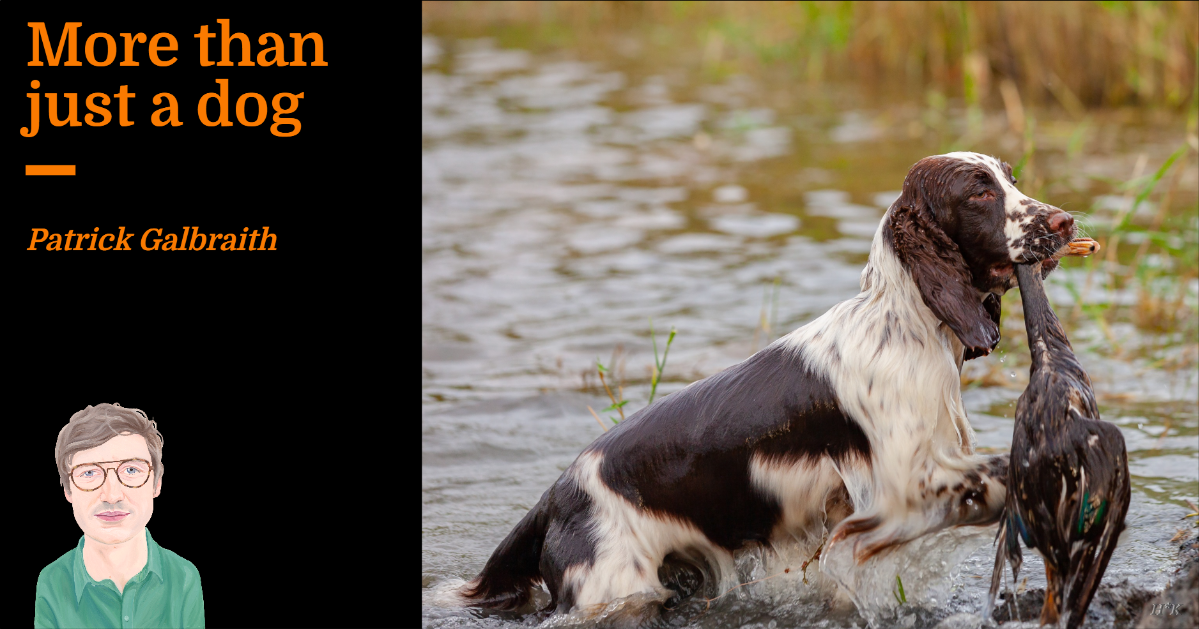
A dog is essential when flighting ducks. The first retrieve was easy enough for Jessie. She leapt in, swam out, plucked it from the ice, and then returned. But the second was trickier. I could tell from the way she was questing amongst the brambles that she knew it was there, but it took two or three minutes before she emerged out onto the moonlit winter wheat, holding the drake softly in her mouth.
As she trotted back to me, I remembered standing there those few days previously whilst she lay screaming, and I said again and again, “I don’t know what to do.” Because I didn’t at that very moment know what. But what I think I meant was, “I don’t know what I will do.” They are, after all, only dogs but they are so much more than that. They are forever forgiving, and they will, to their last, give you all they have.