My father was a world-class dickerer. As a young boy, I remember looking on as he bargained with the owner of a sporting goods store over a fishing rod he wanted to buy for my birthday. The clerk engaged patiently with my father as the two went at it. In the end, my dad prevailed and garnered a 25% discount. (His argument was that the metal fishing-line guides were poorly angled.) He also got the clerk to throw in an extra spool of fishing line.
For my part, I was embarrassed. Bargaining for something that has a plainly marked price seemed somehow wrong. As we walked along the street, I asked my dad if the man was mad at us. He looked down at me and smiled. “Of course not. If he didn’t want to sell this rod at the price I had bargained for, he would have said no.” Then he chuckled. “That man enjoyed the back-and-forth as much as I did.”
With the benefit of hindsight, I realize that my dad was right. There are those who love the art of bargaining. There are even countries where it is built into the culture. Over the years, I tried my best to emulate my father, and I concluded that dickering ability is not hereditary. I stink at it.
Why We Wrote This
From friendly negotiation to fierce haggling, there are those who love the art of bargaining. And then, there are those, like our essayist – who has overpaid for everything from wallets to cheap sunglasses – who just plain stink at it.
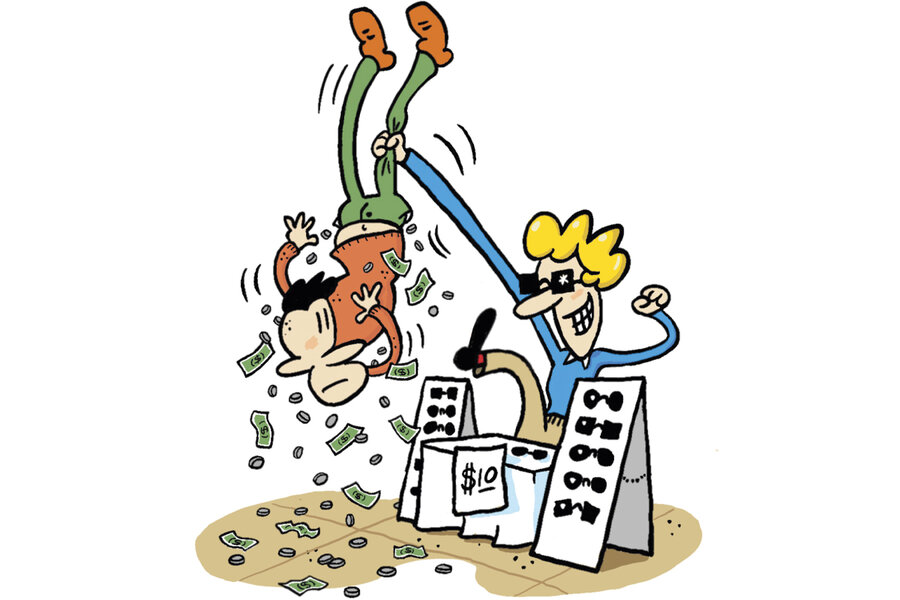
I was 17 years old when I made my first independent attempt to haggle, on a class trip to Spain. “The street vendors expect you to bargain with them,” our teacher, Mr. Gurske, told us. And so, on a brilliant Madrid day, I decided to make my father proud. I spotted a street vendor with a brimming display of sunglasses. In my halting high school Spanish, I approached him and picked out an attractive pair. In an offhand manner, he quoted me the American equivalent of the local currency – $5.
Mr. Gurske had told us to commence the dickering by offering half the stated price. Being an attentive student, I offered the man $2.50. I was taken completely by surprise when he flew off the handle and began to wave at me and berate me. I upped my offer to $3, then $3.50, then $4.50. The man told me I was insulting him. “The price is now $6,” he said, holding up six fingers for emphasis. I don’t know what possessed me, but I forked over the $6.
When I got back to the hotel, Mr. Gurske listened to my story. “You’re supposed to bargain down,” he said, agreeing not to tell my classmates about my embarrassing dickering gambit.
Over the years, I made further attempts to bargain, almost always with negative results. Regardless of where I travel, my efforts rarely bear fruit. On a recent trip to El Salvador, I was looking for a leather wallet for my son. I found the perfect item, embossed with a Salvadoran theme. The man quoted me a price of $10. I offered him $6. Looking pained, he placed his hand on his heart and then called his little boy out of the back room. The child emerged, sucking on his fist as he sniffed back tears from some scrape. The upshot: I gave the man $10. And I threw in an extra buck for some candy for the little boy.
I recall my dad once confiding the secret of successful bargaining: “You’ve got to convince the vendor that you don’t need whatever it is they’re selling. Get the stars out of your eyes. Learn to walk away.”
Again, my dad was right. It was my mother who once told me, “You have soulful, trusting eyes.”
As it turns out, my eyes have worked wonders for building relationships, but as for commerce, I’ve wound up paying top dollar for everything.
A couple of years back, I had a delightful student from Turkey in my university class where I teach. “You must go to Istanbul,” she gushed. “You can bargain your heart out in the Grand Bazaar. What great deals!”
Yes, for anyone else. But once the Turks see my soulful eyes, I wouldn’t stand a chance.