This is the moment the BBC’s science editor was left in tears during NASA’s Artemis II lift-off.
The spacecraft will take four astronauts on the first manned mission to reach the moon since 1972.
It officially launched yesterday evening on its mammoth 285,000-mile (1.1 million km) round trip to the dark side of the moon before returning to Earth on April 6.
The BBC‘s Science Editor, Rebecca Morelle joined hundreds of other spectators in Florida to witness the historic launch.
As Artemis II’s booster ignitions are activated, sending large plumes of smoke billowing across the launch pad, the excitable reporter can be heard saying ‘oh my goodness’ and repeatedly clapping.
The rocket then blasts off into the sky to thunderous cheers from crowds gathered at the Kennedy Space Centre.
‘Oh my goodness that is spectacular,’ a visibly emotional Ms Morelle said.
‘It’s not just want you see and you hear as the rocket lifts off. You can feel the force of it through your body. This is the most powerful rocket that NASA has ever built.’

The BBC’s Science Editor, Rebecca Morelle (pictured) joined hundreds of other spectators in Florida to witness the historic launch
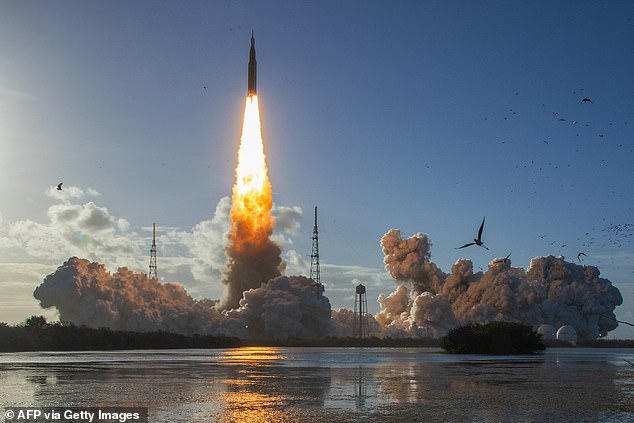
Artemis II officially launched yesterday evening on its mammoth round trip to the dark side of the moon before returning to Earth on April 6
The roaring engines of the massive spacecraft then interrupt Ms Morelle as it commences its journey towards the stars.
She can be seen struggling to be heard over the thunderous noise as she looks over her shoulder at the rocket in wonder.
Artemis II will take American astronauts Reid Wiseman, Victor Glover and Christina Koch, and Canadian astronaut Jeremy Hansen farther into space than any human has ever gone before, breaking the previous record set by Apollo 13 in 1970.
Four minutes into the historic journey, Artemis II crossed the boundary into space with no issues with the flight reported and a clear view of their target destination. Mr Wiseman, the mission commander, said: ‘We have a beautiful moonrise. We’re headed right at it!’
NASA Administrator Jared Isaacman reported that Artemis II suffered a temporary communications problem after launch and was still dealing with a ‘controller issue’ with the toilet on board the Orion capsule.
However, all major systems were still functioning and the crew was busy preparing for the next stages of their orbital burn over Earth before the space agency declared the spacecraft ready for its trip to the moon.
Just after 6pm in the US, Mr Wiseman declared ‘Full send,’ as he and his crewmates sat atop NASA’s towering rocket, confirming they were ready for launch.
From mission control, launch director Charlie Blackwell-Thompson delivered an emotional message to the crew, telling them they carried ‘the heart of this Artemis team, the daring spirit of the American people and our partners across the globe, and the hopes and dreams of this generation.’
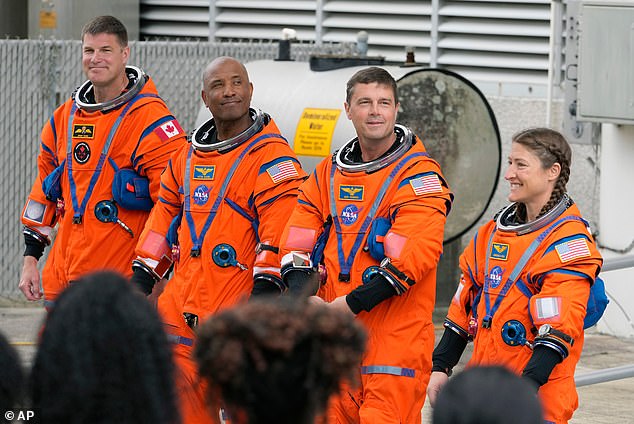
From left to right: Canadian astronaut Jeremy Hansen, NASA astronauts Victor Glover, Reid Wiseman and Christina Koch
‘Good luck. Godspeed, Artemis II. Let’s go,’ she said, following the final launch checks.
The crew will spend the first one to two days conducting extensive systems checks.
These include testing Orion’s life-support, propulsion, navigation and communications systems to ensure the spacecraft is ready to head into deep space.
Once checkouts are complete, Orion’s propulsion system will perform a critical engine burn known as translunar injection, sending the spacecraft out of Earth orbit and onto a trajectory toward the moon.
It will take three to four days for the Artemis II crew to reach the moon, with the Orion spacecraft projected to enter what NASA calls the moon’s sphere of influence on day five.
This is the point at which lunar gravity overtakes Earth’s pull and begins guiding the spacecraft toward its destination.
Day six is likely to be historic for NASA and the rest of humanity, as Artemis II conducts its lunar flyby and travels to the dark side of the moon.
The spacecraft will not only reach a point farther from Earth than any previous crewed mission, but NASA confirmed that the astronauts will be able to see a lunar eclipse – when the moon blocks out the sun.
After looping around the moon, the Orion craft will begin its return journey, leaving the moon’s gravitational influence and heading back toward Earth.
It will take another four days to return, which the astronauts will fill by conducting key safety demonstrations, including testing procedures designed to shield the crew from dangerous solar radiation from solar flares. The crew will also practice manually steering the spacecraft.
As Orion approaches Earth, it will separate key components before plunging into the atmosphere at speeds of about 25,000 miles per hour (40,233 kph).
Testing the capsule’s heat shield during high-energy re-entry is one of the mission’s primary objectives.
The spacecraft is expected to splash down in the Pacific Ocean, where recovery teams will retrieve the crew.
Parachutes will deploy to slow the spacecraft before it splashes down in the Pacific Ocean, bringing the landmark mission to an end.
Artemis III, NASA’s next space mission, is set to launch in 2027 and will see two astronauts land on the surface of the moon and stay there for about a week.
This will be the first time man has set foot on the moon since Apollo 17 in December 1972.