During the 32 years he spent locked within its walls, Ian Brady never missed an opportunity to denigrate Ashworth High Secure Hospital.
Dubbing it Trashworth, the serial killer disparaged the food – ‘pigswill’ – his accommodation – ‘freezing in the winter and boiling in the summer’ – and in particular his fellow ‘half-wit’ patients and the staff.
All he wanted, he said in one of the letters he wrote from the facility, was a ‘coffin’ – a wish that was finally granted when he died there aged 79 in 2017.
Today, it’s another paranoid schizophrenic who has become the most high-profile patient to be treated in the Merseyside institution, one of just three high-security psychiatric hospitals in England.
Valdo Calocane has been held there since stabbing to death University of Nottingham undergraduates Barnaby Webber and Grace O’Malley-Kumar, both 19. The friends were walking home from a night out in the early hours of June 13 2023 when they were brutally attacked by the killer, who had travelled to the Midlands from London carrying a rucksack packed with three knives and a metal scaffold pole.
Soon after, he also killed grandfather Ian Coates, 65, stealing his van then using it to run over pedestrians in Nottingham city centre.
Unlike Brady, there has been no word from Calocane since his detention began. But if the 34-year-old is really set to spend the rest of his life at Ashworth – something the families of his victims hope will be the case but fear may not – then these are early days.
One of 200-odd male patients treated at the hospital, sources have told the Daily Mail that he is among a small minority held in what is known as long-term segregation (LTS) due to the danger he poses.
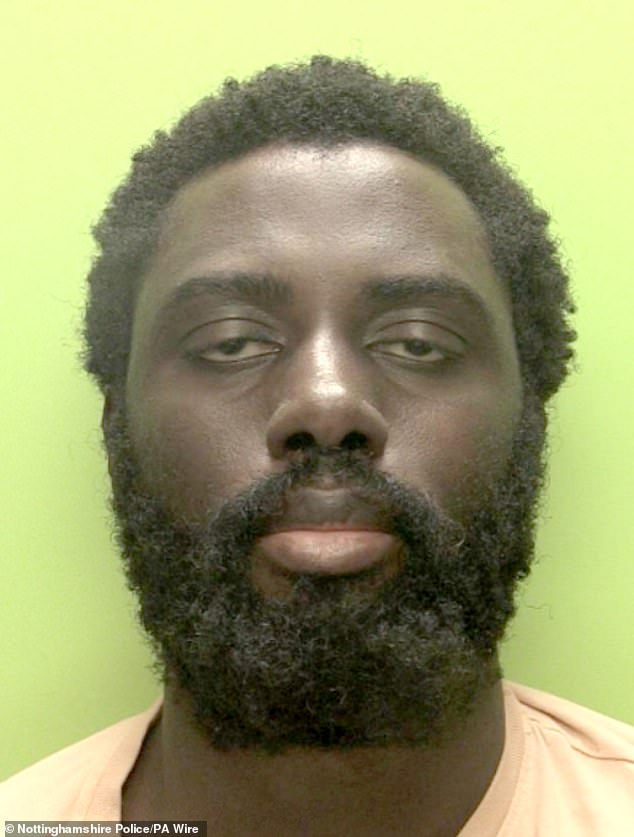
Valdo Calocane is among a small minority held in what is known as long-term segregation (LTS) due to the danger he poses

Psychiatrists who interviewed Calocane in Ashworth observed that even when taking the maximum dose of anti-psychotic medication he could still hear a mixture of female and male voices in his head
I’m Tom Rawstorne, and nearly 30 years ago a 12-year-old murderer, with a gold crucifix hanging round her neck, gave me a moment I’ll never forget.

Sharon Carr is to this day Britain’s youngest-ever female murderer, having killed an 18-year-old hairdresser in an unprovoked act of gruesome violence. I watched her up close in court for three weeks and it is something I’l never forget. I’ve written about it in The Crime Desk newsletter – sign up to read it for free.
Placed in a secure room with a hatch in the door, he is under supervision around the clock and has almost no contact with other patients.
‘When he arrived he was distressed and extremely unpredictable which meant he had to be contained under the most secure of regimes,’ said an insider who worked at the hospital.
‘We were briefed that we were dealing with an individual who was very ill and potentially extremely dangerous. With patients as sick as him you just never know when he might react and become violent – there were no clues as to how he might behave or what his triggers might be because none of us had a relationship with him.
‘It was extremely stressful for everyone. Protocols were developed for dealing with him quite quickly which meant that you always had a team who had the capability to restrain him if necessary. There were a few occasions where he became violent but fortunately no one was hurt and he was restrained before he could either damage himself or anyone else.
‘I’d say that in all the years that I’ve worked at Ashworth he is probably the most dangerous patient I have worked with, because he was so unpredictable.’
Psychiatrists who interviewed Calocane in Ashworth observed that even when taking the maximum dose of anti-psychotic medication he could still hear a mixture of female and male voices in his head.
On occasion these voices would instruct him to attack hospital staff. At other times they were ‘gloating’ about the trouble they had got him into.
Visitors, such as his lawyers, had to speak with him through a glass screen, such was the potential danger he posed.
Holding him in LTS has further ensured the safety of staff and other inpatients. ‘They are placed in a bare cell with little more than a fixed plastic bed, a mattress they cannot tear, a blanket and a pillow,’ said a second former senior staff member.
‘If their segregation goes on for months or years, the room may have a few more basic comforts, such as a television, but it is still an intensely restricted existence.
‘In a typical day in LTS, a patient might get three half-hour periods out of the room, heavily supervised by several staff, and the rest of the time they are back inside the cell. Meals are usually taken in the room. Even something as simple as cutlery becomes a security issue, so everything has to be carefully controlled, counted in and counted out.
‘If it’s deemed too dangerous for staff, food or medication is passed through a hatch simply to remove any risk. Even showers have to be tightly managed. They would often be taken only after other patients have gone off the ward, so the area could be locked down and staffed safely.’
Despite the terrible crimes he committed and the threat he undoubtedly poses, the concern is that Calocane could one day enjoy very different living conditions – or even be freed altogether.
Join the debate
Should violent killers with mental illness ever be released back into society?
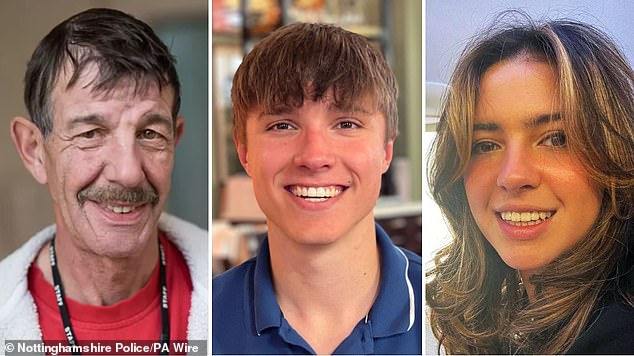
Calocane murdered three people during the horrific attack in June 2023. From left to right: Ian Coates, 65, Barnaby Webber, 19, and Grace O’Malley-Kumar, 19

Police forensic officers during the aftermath of the attack in Nottingham in June 2023
This is because in December 2023 prosecutors accepted his guilty pleas to manslaughter on the grounds of diminished responsibility, rather than prosecute him for murder. It led to him being handed an indefinite hospital order rather than being jailed for life and means he will be held until either the Secretary of State for Justice or a mental health tribunal assesses that he no longer poses a risk to the public.
While the sentencing judge said he believed that Calocane would be detained in a secure hospital ‘very probably for the rest of your life’, the decision not to try him for murder was heavily criticised by the families of his victims.
They claim the evidence suggested that while Calocane was mentally unwell, the attacks were premeditated and that he knew what he was doing was wrong, ‘but did it anyway’.
This week, a retired detective involved in the case told the public inquiry into the tragic events of that day that he shared the families’ belief that Calocane had ‘murdered in cold blood’ – but that the views of psychiatrists stood in the way of a murder trial.
After the Court of Appeal subsequently rejected a challenge to the ‘unduly lenient’ sentence, the families warned that it would now fall on their shoulders to keep the pressure up to ensure Calocane would never be freed.
As Barnaby’s mother Emma Webber observed: ‘The fact remains, despite the words of the judge, that almost 90 per cent of people serving hospital orders are out within 10 years and 98 per cent within 20 years.
‘In effect, the families now face their own life sentence of ensuring the monster that is Valdo Calocane becomes the next Ian Brady… and is never released.’
That we now know the full extent of the threat posed by Calocane is largely down to the persistence of Mrs Webber and the other bereaved families.
Refusing to accept the excuses and apologies of the authorities with whom he had crossed paths in the years leading up to the attacks, they demanded a public inquiry. Over the past month the Nottingham Inquiry has laid bare, in shocking detail, how police and mental health services missed opportunity after opportunity to intervene.
Born in Guinea-Bissau, Calocane’s family first settled in Portugal before moving to Britain when he was 16.
Having worked as a cleaner and labourer after leaving school, he enrolled at the University of Nottingham to study mechanical engineering. It was while there that his mental health rapidly disintegrated and he was diagnosed with paranoid schizophrenia in 2020.
In the years that followed he was sectioned on four occasions and had stopped taking his medication. He had also attacked former housemates and colleagues, yet no action was taken.
No wonder the families watch proceedings with mounting disbelief and anger. Because even as the scale of these failures comes into focus, they are expected to trust the very same authorities who failed their loved ones to keep their killer behind bars.
Even if Calocane remains at Ashworth, any improvement in his condition could see him enjoy much more favourable circumstances than he would in prison. The former senior staff member told the Daily Mail: ‘Officially, nobody says a patient is going to LTS for years. But in reality, some of them do remain there for years.
‘Every case is reviewed and on paper the aim is always to reduce the restrictions. But if someone remains dangerously unpredictable, there is only so much you can realistically do.’
The second insider said that the aim with all of those held in LTS was to move them into less restricted accommodation in the hospital. Reviews are carried out on a three-monthly basis.
‘He is on a pathway which will see him moving to a less secure and restrictive regimen, but that will take time,’ he said. ‘We work with him every day and explain the situation. You have to remember he is a deeply disturbed individual and there are days when he appears to be making progress then he can become very unpredictable. We are all trained to recognise the signs and triggers for unpredictable behaviour.
‘If his mental state improved and the risk reduced, then in theory he could move into more normal conditions. That does happen. What we have to do is make sure that he is treated with dignity and his human and legal rights are respected.
‘I know his crimes were appalling, but we do not see him just as a violent criminal but as someone who is a very disturbed patient who needs care.
‘To work here or other secure hospitals you have to be able to deal with that distinction.’
A spokesman for Mersey Care NHS Foundation Trust, which runs Ashworth, said: ‘We are unable to comment about individual patients because of rules governing patient confidentiality.’
The conditions that lower-risk patients are held in are considerably more benign than those found in a Category A prison. And while a normal prison place costs the state about £55,000 a year, a bed in a secure hospital is in excess of £350,000, more with round-the-clock supervision.
Ashworth boasts a swimming pool, gym and vegetable gardens as well as opportunities to undertake arts, crafts and woodwork.
Patients can make their own drinks and snacks, order ‘world foods’ from an in-house takeaway service and make phone calls in private. ‘The biggest difference is that in normal conditions there is structure, movement and contact with other people,’ said the former senior staff member.
‘They are usually up in the morning, showered and moved out to activities, then back to the ward for lunch, and some return to work or education again in the afternoon.
‘There are also evening socials during the week – football on the television, film nights, or visiting entertainers. It is still a high-security hospital, but it is not the same as being segregated.
‘In normal conditions, patients can usually keep their own clothes and personal belongings, and they can personalise their rooms to a certain degree.’
Indeed, the hospital has its own shopping catalogue from which relatives can order items up to a value of £300. These include 24in TVs, guitars, flags, jewellery, house plants, snooker cues and even Lego sets.
At what point, if ever, Calocane recovers enough to enjoy such perks remains to be seen.
In 2013 Ian Brady took legal action in an attempt to move out of Ashworth and back to a normal prison where he argued he would have more ‘freedom of control’ over his life.
But he was refused permission after a mental health tribunal ruled he was still so unwell that in the interests of public safety he had to stay where he was.
- To get a free exclusive article with new revelations about Britain’s youngest female murderer, sign up to our newsletter HERE and receive it right away
- What kind of cases do you want to read more about? Let us know at: crimedesk@dailymail.co.uk