Woody Guthrie famously painted the slogan “This Machine Kills Fascists” on his guitar – a pithy summary of the songwriter’s belief in the power of his political songs.
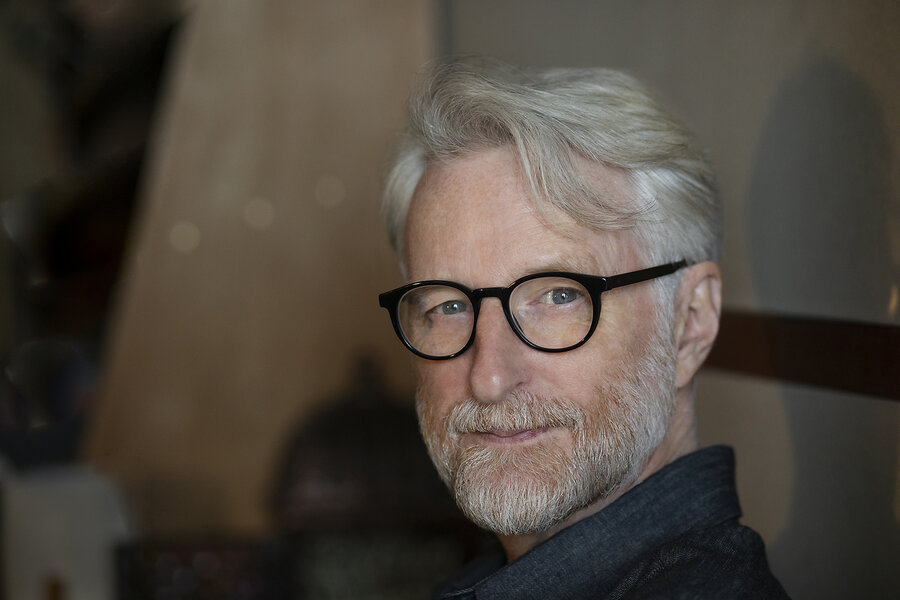
“He wasn’t much of a guitar player,” says Billy Bragg, Britain’s most famous contemporary protest songwriter. “He was, bottom line, a communicator by any means necessary. He would write books, he would paint, he would write pamphlets, he’d write songs. He was desperately trying to communicate his views. And I’m the same.”
That’s why, when Mr. Bragg heard about the shooting of Alex Pretti by U.S. immigration agents in Minnesota, he was inspired to write, record, and release a song within 24 hours. “City of Heroes” came out on Tuesday. It’s one of several protest songs about Minneapolis released this week – including one by Bruce Springsteen. Mr. Bragg’s “City of Heroes” lauds citizens in the North Star State for their bravery in standing up for their neighbors. His song also draws historical parallels to other resistance movements against tyranny. That’s why Mr. Bragg says that if his guitar had a slogan on it, he would choose a different phrase than Mr. Guthrie’s. Mr. Bragg’s motto would be “Death to Cynicism.”
Why We Wrote This
Musician Billy Bragg talks about writing “City of Heroes” after watching the heroism and solidarity of ordinary people in Minneapolis. His protest song carries forward the lineage of such troubadours as Woody Guthrie and others.
It’s a riposte, he says, to people who have given up. To those who believe nothing will ever change or that no one else cares about helping the world. Like other political musicians – whether it’s Thomas Mapfumo calling attention to corruption in Zimbabwe, Egypt’s Ramy Essam giving voice to the 2011 Arab Spring protests, or Les Amazones d’Afrique’s calls to empower women against female genital mutilation – Mr. Bragg is continuing a lineage of utilizing song as a rallying cry for those envisioning a more just world.

“During times when protest feels necessary, those who are protesting need ways to feel encouraged,” says James Sullivan, author of “Which Side Are You On?: 20th Century American History in 100 Protest Songs.” “The reason why we sing at protests is that it builds this sense of community, and it’s a morale booster. It’s a way to bring everybody together.”
Mr. Bragg’s rough-hewn folk music, spiky as his hair, bears the influence of punk. His formative musical influence was The Jam rather than Joan Baez or Joni Mitchell. Mr. Bragg has twice been nominated for Grammy Awards. The first time was for a 1998 album with Wilco titled “Mermaid Avenue,” in which the collaborators set unpublished Woody Guthrie lyrics to newly composed melodies. (In June, they’ll reunite to reprise those songs at the Solid Sound festival in North Adams, Massachusetts.)
The affable songwriter has a distinctive East London accent in which he sometimes drops his h’s and t’s. When Mr. Bragg guested on “Late Night with David Letterman” on NBC in 1988, host David Letterman quipped, “I’d give a week’s pay if I could talk like you. … It’s a very engaging, kind of appealing sound.” Mr. Bragg’s accent carries over into his singing voice. It lends authenticity to advocacy songs for the working class, including miners, factory workers, and farm laborers.
“It’s not surprising to me that Billy Bragg, of all people, who has focused his entire career on the power of people over government and over authority, would focus on the protest efforts of the ordinary folks of Minneapolis,” says Mr. Sullivan.
Mr. Bragg isn’t alone. Indie rock band My Morning Jacket issued a protest album, “Peacelands,” and cited a need to find “a new path together to safe and humane immigration policy and reform rooted in peace and love.” The Marsh Family updated the 1960s song “San Francisco (Be Sure to Wear Flowers in Your Hair)” with lyrics referencing current events in Minnesota. Mr. Springsteen dedicated “Streets of Minneapolis” to the memory of Renee Good and Mr. Pretti, the two U.S. citizens fatally shot this year in two separate incidents.
“It’s great that Bruce has got involved. … We need new songs. We can’t keep going back and singing ‘Ohio,’” says Mr. Bragg, referencing the 1970 Crosby, Stills, Nash & Young track about the Kent State students shot by state troopers.

Charles Sykes/Invision/AP/File
Mr. Bragg’s “City of Heroes” will be controversial to some listeners. His emphatic use of the word “fascism” closes the song with an exclamation mark.
“‘Fascism’ is a gravis accusare, isn’t it?” Mr. Bragg muses. He stresses that he doesn’t think the United States is a fascist country. On Facebook, he often finds himself pushing back against fans who “believed it was a fascist state when [Barack] Obama was president, when [Bill] Clinton was president.” Nevertheless, he believes America is headed in that direction. Yet, “City of Heroes” also offers an optimistic counterpoint.
Mr. Bragg’s lyrics draw connections to Martin Niemöller. The German Lutheran minister penned an often-cited poem about not saying anything when the Nazis first rounded up the Communists, then the Socialists, then the Trade Unionists, and finally, the Jews.
Mr. Bragg thought about how, in stark contrast to Niemöller’s lament about what happened in Germany and Poland in the 1930s, Americans have rallied to defend their communities against what the songwriter calls “acts of impunity.” The artist’s song – and views – won’t resonate with everyone. Public outcry over the deaths in Minneapolis has been broad-based, but at the same time, many Americans support some level of immigration enforcement, including against people who have committed crimes.
Protest songs are, by nature, intended to provoke thought. Mr. Sullivan, who cohosts a podcast that features live musical performances of political music, cites Billie Holiday’s “Strange Fruit” as an example. It directed a spotlight to the horrors of the lynching of Black Americans. In a social media age, in which one can become desensitized to injustice through watching endless videos, songs have the potential to cut through numbness.
Mr. Bragg, however, pushes back on the grandiose claim that songs have the power to change the world.
He recalls attending the 1978 Rock Against Racism festival in London featuring The Clash. It changed him. When he returned to his job after that weekend, he no longer ignored the casually racist, sexist, and homophobic jokes by co-workers. He became intensely interested in politics.
“I’ve … come to the conclusion that it wasn’t The Clash that had that effect on me,” says the musician. “It was being in that audience that gave me the courage of my convictions. And I think the great thing about music [is that] it has that communal experience.”
Mr. Bragg doesn’t just write political songs. For instance, “A New England,” a British Top 10 hit sung by Kirsty MacColl, is about getting over a heartbreak. Nevertheless, a hefty portion of his catalog consists of songs associated with left-wing causes. Mr. Bragg says his politics are rooted in empathy. When it comes to religion, he describes himself as a nonbeliever, but he nonetheless cites Jesus’ command to “Love God with all your heart,” and also “Love your neighbor as yourself.”
Sometimes, that starts with understanding how others view the world. Mr. Bragg’s 2017 song “Full English Brexit” is sung from the outlook of an older man who looks askance at his immigrant neighbors. The character voices a fear that the country is changing in ways he doesn’t like.
“Empathy is the currency of music,” says Mr. Bragg. “We’re offering [people] an opportunity to … listen to a story about someone they’ve never met, in a situation they’ve never experienced, and to feel some compassion for that person in some way.”
Mr. Bragg hopes that songs such as “City of Heroes” will send a positive message – not just of solidarity, but of encouragement. He wants protesters to realize three things: “One, that they’re not alone,” he says. “Two, that they are not the first people that have ever faced this. And three, that what they’re doing is exceptional.”