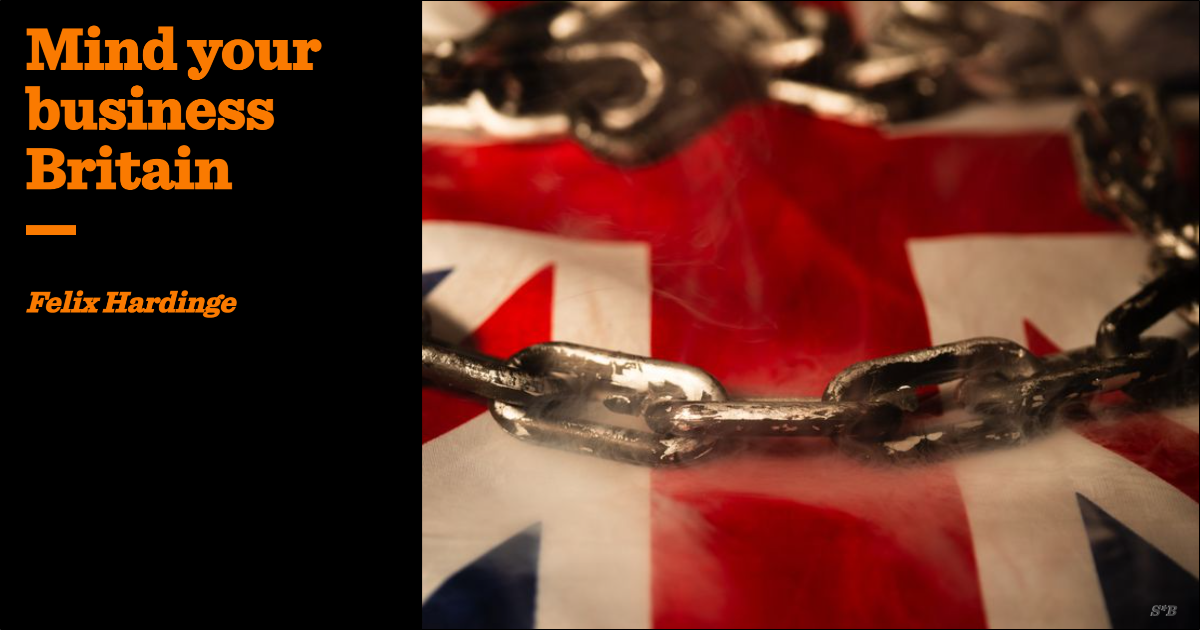
A struggling government turns to prohibition and regulation; a restless public may yet rediscover its taste for freedom.
It is well known when administrations reach their terminal phase, they look for a legacy. Rishi Sunak famously attempted to stop 65-year-olds from buying cigarettes. Given that Keir Starmer’s government (or whoever will be in charge when this goes to print) is in an order of magnitude more trouble, what with the recent Epstein sleaze and general unpopularity, who knows what they might cook up to have themselves a legacy.
There has, of course, been no shortage of Labour authoritarianism. The mooted lowering of the drink-drive limit, despite Britain having the lowest road safety deaths in Europe. The now abandoned but seriously considered ban on smoking outside pubs, an attempted murder of perhaps one of the most recognisably cosmopolitan scenes in London.
Labour is also recognising on a subconscious level that farmers are a hostile class to be regulated out of existence. To this end there is also a review of shotgun legislation and abolishing the stand-alone licence and rolling it into a more stringent firearm test on the basis that farmers regularly carry out acts of domestic terrorism. The now-reversed changes to Inheritance Tax caused months of anxiety for the industry.
Governments in decline don’t become reflective, they become twitchy. And twitchy governments legislate. The wounded-animal phase of politics is rarely dignified; it’s more like an attempt to flip the Monopoly board before anyone can count the money.
The trouble with libertarian politics in Britain is that it’s started to feel oddly timid, almost embarrassed by itself
The trouble with libertarian politics in Britain is that it’s started to feel oddly timid, almost embarrassed by itself. For the past decade and a half, it’s been spooked by the legacy of the financial crisis, allowing free-market economics to be lazily conflated with bank bailouts and cronyism. Instead of defending markets as engines of growth and independence, many libertarians retreated into the background, worried about sounding unfashionable or insensitive.
Meanwhile, the public conversation moved on. Only recently have people begun to notice the practical, everyday, grinding effects of an overextended state, high taxes, stagnant growth, brittle public services, and the quiet suffocation of regulation. The failures of managerial socialism have become harder to ignore.
On social matters too, issues-based polling systematically overstates Britain’s appetite for control, because it measures low-cost, abstract value judgements from incentivised panel respondents rather than revealed preferences under real constraint; when policies move from survey hypotheticals to lived experience, consent for central control consistently collapses (as we have seen with Labour’s disastrous digital ID plans). Treating such polling as a mandate is also an insane way to make policy: it is the equivalent of taking out a mortgage or moving a pension based on a 15-second thought experiment, yet governments repeatedly claim this is sufficient democratic legitimacy for decisions with long-term financial and civil consequences.
I’ve said before that the belief authoritarian politics is popular rests heavily on issue-based polling, filtered through a professional class reacting against the provincial, small-c conservatism of their childhood. This has causality backwards, the curtain-twitcher is mocked because busybody enforcement offends British social instinct. The nosy neighbour survives as a figure of comedy precisely because such behaviour is aberrant. British manners default to mind your own business: people do not discuss their salary, do not trumpet credentials, and do not boast, because doing so is considered gauche and intrusive. Most contemporary prohibitions (speech codes, licensing creep, online safety rules, public-health) are not therefore demanded by the masses banging pots and pans for more regulation.
Reform UK has mostly avoided authoritarian posturing so far. Euroscepticism was inherently libertarian, which is why UKIP attracted voters who valued “boozy, defensive liberty.” Some worried Tory defectors might import paternalism, so it matters that Reform draws a clear line: there’s a difference between performative power-worship and simply expecting crime to be punished and public order maintained.
Reform policymakers should recognise that this is a rare political window. Unpopular authoritarian measures are increasingly being associated in the public’s mind with Keir Starmer himself, and opportunities like that do not come along often.
If there is ever a moment to argue for rolling back the frontiers of the state, whether on speed limits, smoking restrictions, firearms licensing, or freedom of speech, it is when public frustration and moral indignation are already doing half the work for you.
There’s a useful historical reminder here. Americans like to talk about the First Amendment as though it has always guaranteed an expansive, almost absolute freedom of speech. That isn’t true; for most of the history of the land of the free, speech was restricted in all sorts of ways that would look extraordinary today — sedition prosecutions (for which people went to prison for decades), wartime censorship, and broad “public order” doctrines that allowed governments to silence people they disliked.
The modern American settlement on free speech is surprisingly recent. It was hammered into place during the social and political chaos of the 1960s, when a handful of stubbornly libertarian lawyers and activists forced the courts to draw a line the state could not cross. The decisive moment came with Brandenburg v. Ohio in 1969, which established the principle that speech can only be punished if it is intended and likely to produce imminent lawless action (i.e. direct incitement). What is now treated as a sacred constitutional norm was, at the time, a radical clarification pushed through during a period when public trust in authority was already collapsing. Sound familiar?
Liberty rarely advances when governments are confident and respected. It advances when institutions overreach, reputations crumble, and the public mood crumbles with it. Suddenly, then all at once, the old arguments for control stop sounding persuasive. That is when the determined can redraw the boundaries of the state.
Britain now feels closer to one of those moments than it has in decades. The deference is gone. We have all had just about enough of the experts, and as a result the managerial class looks smaller than ever — and more frightened. If the reclamation of our ancient liberties cannot be made now — loudly, maximalist, and without apology — it probably never will be.
History suggests one thing above all: the frontier of the state only moves backwards when someone pushes it.