From the cigar nestled in the brickwork to ‘The Dress’, many optical illusions have left viewers around the world baffled over the years.
But the latest illusion is arguably one of the most bizarre yet.
Dr Dean Jackson, a biologist and BBC presenter, has shared a strange illusion on TikTok, which tricks your brain into seeing two eyes as different colours.
In the video, a cartoon face is split down the middle, with the left half coloured red, and the right half coloured blue.
While the two eyes appear to be different colours, Dr Jackson explains that they’re actually identical.
‘This girl’s eyes are the same colour as each other,’ he says.
‘You are seeing the same colour too, but your brain is treating the background as two separate filters and cleverly working out what the eyes would be under those filters.
‘But it’s actually being too clever for its own good.’
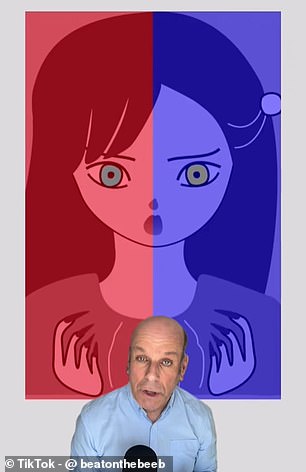
Dr Dean Jackson, a biologist and BBC presenter, has shared a strange illusion on TikTok, which tricks your brain into seeing two eyes as different colours
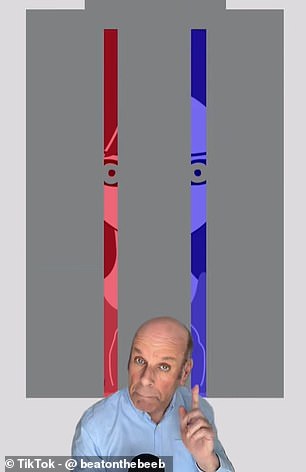
In the video, Dr Jackson brings up a grey square on screen, and explains that this is actually the colour of both eyes.
‘Both of her eyes are that shade of grey, but your brain is telling you otherwise,’ he explains.
To prove that this is the case, Dr Jackson covers the coloured background with grey bars which are the same colour as the girl’s eyes.
‘I’m not changing the colour of the girl’s eyes, I absolutely promise you of that,’ he reassures.
As the grey bars are placed over the coloured background, it immediately becomes clear that Dr Jackson is telling the truth – the eyes really are identical.
The baffling optical illusion has garnered huge interest on TikTok, with hundreds of confused viewers taking to the comments.
‘I saw her left eye as blue and her right eye as yellow! I love your content but I’m now finding it difficult to trust my own brain!!!!’ one user commented.
Another wrote: ‘THE EYES ARE NOT GREY! HELLPPP.’


This isn’t the first time that Dr Jackson has amazed viewers with his colour-based optical illusions. Earlier this year, he posted a video showing a picture of a red fire truck on a road, before adding a cyan filter, and asking what colour you think the fire truck is
And one joked: ‘My brain is not my friend, pranking me like this.’
This isn’t the first time that Dr Jackson has amazed viewers with his colour-based optical illusions.
Earlier this year, he posted a video showing a picture of a red fire truck on a road, before adding a cyan filter, and asking what colour you think the fire truck is.
While your initial reaction is likely ‘red’, Dr Jackson explains that the fire truck is actually now grey.
‘Red light cannot pass through a cyan filter, it just can’t,’ he explained.
‘So now there is no red light in that picture, I can promise you. And yet your brain is still telling you that it’s red.’
WHAT IS THE CAFÉ WALL OPTICAL ILLUSION?
The café wall optical illusion was first described by Richard Gregory, professor of neuropsychology at the University of Bristol, in 1979.
When alternating columns of dark and light tiles are placed out of line vertically, they can create the illusion that the rows of horizontal lines taper at one end.
The effect depends on the presence of a visible line of gray mortar between the tiles.
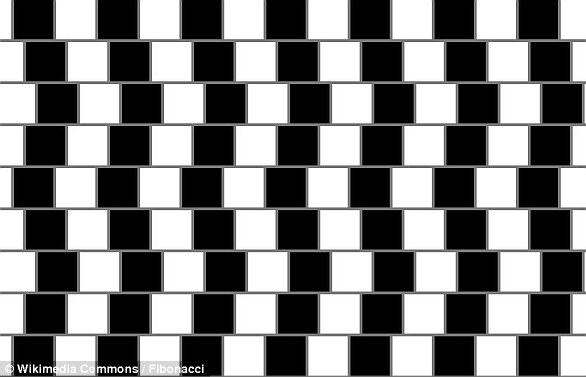
When alternating columns of dark and light tiles are placed out of line vertically, they can create the illusion that the rows of horizontal lines taper at one end. The effect depends on the presence of a visible line of gray mortar between the tiles
The illusion was first observed when a member of Professor Gregory’s lab noticed an unusual visual effect created by the tiling pattern on the wall of a café at the bottom of St Michael’s Hill in Bristol.
The café, close to the university, was tiled with alternate rows of offset black and white tiles, with visible mortar lines in between.
Diagonal lines are perceived because of the way neurons in the brain interact.
Different types of neurons react to the perception of dark and light colours, and because of the placement of the dark and light tiles, different parts of the grout lines are dimmed or brightened in the retina.
Where there is a brightness contrast across the grout line, a small scale asymmetry occurs whereby half the dark and light tiles move toward each other forming small wedges.
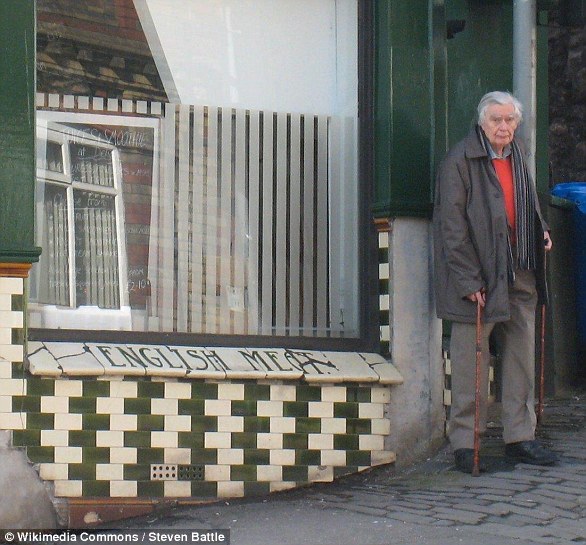
The café wall optical illusion was first described by Richard Gregory, professor of neuropsychology at the University of Bristol, in 1979. The unusual visual effect was noticed in the tiling pattern on the wall of a nearby café. Both are shown in this image
These little wedges are then integrated into long wedges with the brain interpreting the grout line as a sloping line.
Professor Gregory’s findings surrounding the café wall illusion were first published in a 1979 edition of the journal Perception.
The café wall illusion has helped neuropsychologists study the way in which visual information is processed by the brain.
The illusion has also been used in graphic design and art applications, as well as architectural applications.
The effect is also known as the Munsterberg illusion, as it was previously reported in 1897 by Hugo Munsterberg who referred to it as the ‘shifted chequerboard figure.’
It has also been called the ‘illusion of kindergarten patterns’, because it was often seen in the weaving of kindergarten students.
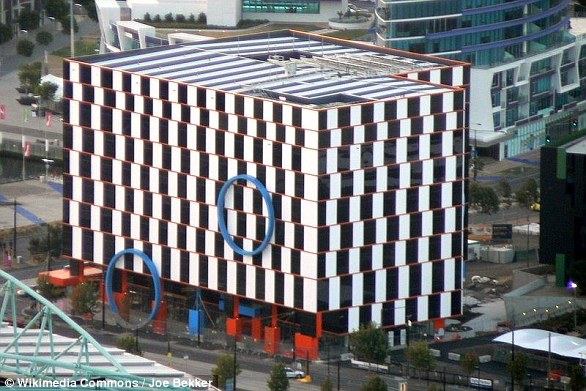
The illusion has been used in graphic design and art applications, as well as architectural applications, like the Port 1010 building in the Docklands region of Melbourne, Australia