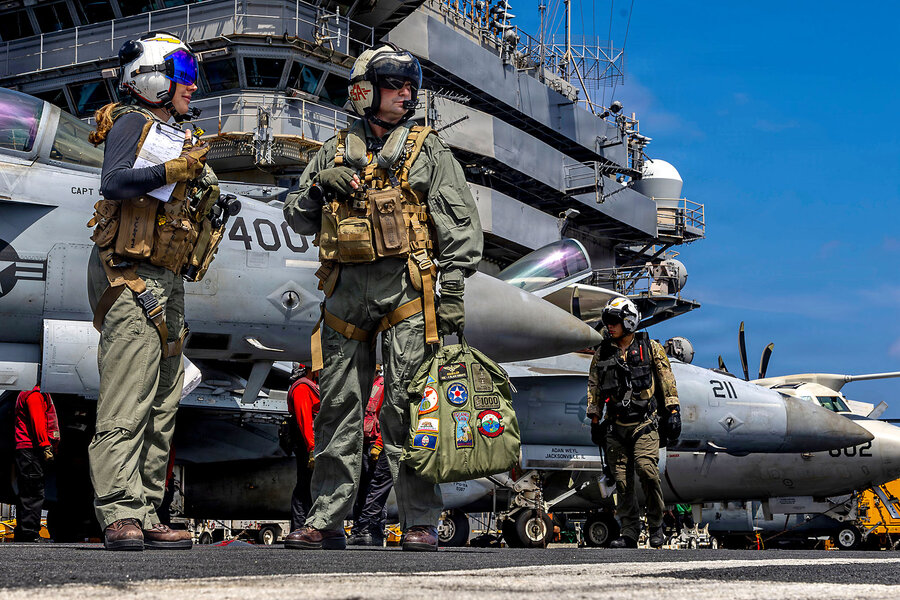
American military forces are building in the Middle East daily, arriving on a threat from U.S. President Donald Trump Wednesday that “time is running out” for Iran to do a deal, or face military action from a “massive armada.”
Iran’s leadership, still smarting from Israeli and U.S. strikes last June, is trying to find its feet after a crackdown on nationwide anti-regime protests this month left thousands dead. It’s responding to Mr. Trump’s threats with combative rhetoric of its own that aims to project strength and deter U.S. action by signaling the high cost of Iranian retaliation.
“It is our armed forces that decide the endgame of any war,” Iran’s Revolutionary Guard spokesman, 2nd Brig. Gen. Ali Mohammad Naini, told state-run TV Wednesday. “Intimidation through war imagery and the deployment of an aircraft carrier is an old tactic.”
Why We Wrote This
Amassing military forces and bolstered by Iran’s perceived vulnerability, President Donald Trump says “time is running out.” Replying with threats of its own, the Islamic Republic is trying to restore its deterrence and survive what it realizes is an existential challenge.
Echoing other Iranian officials and commanders, General Naini claimed the White House was “in a state of confusion” after the “rapid and decisive failure of the American-led sedition [protests]” in Iran.
The official bravado, analysts say, is designed to avoid conflict, to counter the perception in Washington of Iranian vulnerability, restore deterrence, and ensure the Islamic Republic survives what it realizes is the most existential challenge to its 47-year rule.
General Naini portrayed the 12-day war last June, during which Iran fired more than 550 ballistic missiles at Israel, and at an American base in Qatar, as proof that the “military option against Iran has failed.”
“We are in full control of the situation on the ground,” he said, “and have action plans for all their scenarios.”
Seeking regime change?
Yet the menu of American options is broad, honed by decades of strategic brinksmanship with Iran. It ranges from the assassination or capture of leaders, and targeting urban Revolutionary Guard bases responsible for the recent crackdown, to striking remaining nuclear and missile facilities and even wholesale attempt at regime change.
Reuters cited two U.S. sources Thursday saying Mr. Trump wanted to create conditions for “regime change,” but had not yet decided on a military path.
Israel’s surprise attack last June, after nearly two years of war with Hamas and other Iranian allies, killed several of Iran’s key commanders and struck its nuclear and military infrastructure. The United States joined the battle, and analysts assess the American bunker-buster bombs severely damaged Iran’s nuclear program.

“Trump’s presidency comes at this time when [Iran’s leaders] are so vulnerable, and he is a wild card,” says Afshon Ostovar, an Iran specialist and associate professor of National Security Affairs at the Naval Postgraduate School in Monterey, California.
“As much as the Iranians probably think, ‘The Americans won’t go for regime change. The most they’re going to do is hit us from the air. We can survive,’ they don’t know. Venezuela throws all that out,” says Dr. Ostovar, referring to the surprise Jan. 3 seizure of President Nicolás Maduro in Caracas by U.S. Special Forces.
“That gives the U.S. a lot more leverage in negotiations, but also makes it much more difficult for the Iranians to plan for this variety of possibilities,” he says.
Existential crisis
Blows to Iran’s regional prowess the past two years include the weakening of “Axis of Resistance” allies like Hezbollah in Lebanon, Hamas in Gaza, and the Houthis in Yemen, and the collapse of the Syrian regime of Bashar al-Assad. Israeli and American strikes last June further degraded Iran’s capabilities. And the recent protests – put down with unprecedented bloodshed – added more uncertainty.
“They realize very acutely that they are in an existential crisis. Everything is going wrong for them, and the regime is in the biggest danger it has ever been,” says Dr. Ostovar. “It’s very clear that the ruling clique … cannot agree on a different path. There is no obvious consensus of, ‘Where do we go from here?’”
The USS Abraham Lincoln carrier strike group arrived in Middle East waters this week. American jet fighter squadrons and air and missile defenses have also reportedly been forward deployed around Iran in recent weeks. Electronic surveillance aircraft are now flying nonstop.
“Hopefully Iran will quickly ‘come to the Table’ and negotiate a fair and equitable deal – NO NUCLEAR WEAPONS,” Mr. Trump posted on Truth Social Wednesday, adding that “the next attack will be far worse.”
Iranian officials say there are currently no negotiations, and that previous administration demands to shackle Iran’s nuclear program, curtail its missile arsenal, and rein in regional allies are unacceptable.
“Iran’s position is clear: Diplomacy conducted through military threats cannot succeed,” Iranian Foreign Minister Abbas Araghchi posted on X Wednesday. Any renewal of talks “must abandon threats, excessive demands, and illogical issues.”
Iran’s armed forces “are prepared – with their fingers on the trigger – to … respond to ANY aggression,” Mr. Araghchi posted later. In response to Mr. Trump’s ultimatum, Iran’s mission to the United Nations posted that, when the U.S. “blundered” into wars in Afghanistan and Iraq, it “squandered” $7 trillion and more than 7,000 American lives.
Cautionary voices
Saudi Arabia, Qatar, Oman, and Egypt have warned against U.S. strikes. Turkey has offered to mediate, and hosts Mr. Araghchi Friday. Even Israel, whose missile defenses, including interceptors supplied by the United States, were depleted in the June war, reportedly has counseled Mr. Trump to consider delaying military action.

The view that has gained traction across much of Iran’s security establishment is that “pressure persists because the United States believes Iran has been weakened,” writes Hamidreza Azizi, an Iran expert at the Berlin-based German Institute for International and Security Affairs, in Iran Analytica.
The June war, “the cumulative impact of sanctions, and the eruption of large-scale protests have combined to produce a perception in Washington that Iran’s capacity to absorb further coercion is limited,” writes Dr. Azizi.
Iran’s “warnings that even a limited strike would be treated as an all-out war are not expressions of eagerness for confrontation. Instead, they reflect an effort to restore deterrence.”
Still, notes Dr. Azizi, this bid to restore deterrence “has unfolded under conditions of evident strategic stress” in Iran.
Before the protest crackdown, Mr. Trump said Iran would be “hit very hard” if protesters were killed. After they were crushed, he posted: “Iranian Patriots, keep protesting – take over your institutions!!! … help is on its way.”
Confirmed deaths have since risen to 6,373, with more than 17,000 fatalities still “under review,” according to the Human Rights Activists News Agency, which has tabulated accurate figures in the past.
“‘Help is coming,’ but when?”
In his Wednesday warning, Mr. Trump did not mention the protests or the death toll. Some Iranians who took to the streets, buoyed by the U.S. president’s promise of help, say they feel let down.
“Our fate is now in the hands of this orange maniac [Trump], but he himself has no idea what his next move is,” says a jeweler in Tehran, who gave the name Yousef. “He encouraged our youth to rise up, but they lost their lives. If he had acted on time, the regime would not have dared to open fire on our friends. He betrayed them all.
“They went out because they thought he would support them. They counted on him,” says Yousef. “‘Help is coming, help is coming,’ but when? How many more of us should die before that so-called help arrives?”
As American forces continue the buildup, the timing of any action, its effectiveness, and the form it takes, remain uncertain.
An 8-minute video released Wednesday by the office of Iran’s supreme leader, Ayatollah Ali Khamenei, sought to boost spirits in case of war, by invoking a 7th-century battle of the prophet Muhammad, with the words: “Shall we have fear? God suffices.”
“Now that they’ve calmed the streets, I think they are in bunker mode,” Dr. Ostovar says of Iran’s leadership. “I think what they hope, more than anything, is that they can outlast this president, they can survive three more years, and have a better chance under whoever replaces President Trump.”
An Iranian researcher contributed to this report.