MANCHESTER UNITED are on course to get back into the Champions League after an incredible run under Michael Carrick.
The interim head coach has transformed things at Old Trafford, winning seven of their last 10 games.
Under previous head coach Ruben Amorim it was just three victories in 11 before that, and European football looked a challenge, let alone the UCL.
It hasn’t been by luck either, with United and Carrick outsmarting opponents with clever tactics.
With no game this week, SunSport and Tactics Exposed has taken a look at the five key changes made by Carrick since his arrival in January.
Rope-a-dope set-up
United’s early defensive and passive shape, which, despite Carrick returning to a back four, can often look like a 5-2-1-2, lets opponents exhaust themselves before hitting on the counter, has been a key.


They utilised it to beat Arsenal and Manchester City in the first two games of Carrick’s (so far) temporary tenure.
Far from completely ripping up Amorim’s much-derided 3-4-3 set-up, the United average position map under Carrick was initially extremely close to his predecessor.
United used Arsenal’s own shape against them, playing outside of Mikel Arteta‘s formation.
Arsenal were allowed to play ‘inside’ of United before a killer blow was sprung the other way as Diogo Dalot held his width, dragging Piero Hincapie with him.
Tactics Exposed is Sponsored by Midnite

Midnite is definitely not your grandad’s bookie. Built from the ground up in the UK for 2026 not 2006 , it’s fast, slick, with simple deposits and Rapid Withdrawals.
Check out the new customer welcome offer @midnite.
Always remember to gamble responsibly — 18+, T&Cs Apply, BeGambleAware.org
That gave space to Amad in the middle, taking an ‘outside’ Arsenal player away from being the desired out-ball.
With an ‘extra’ man, effectively, in midfield, United had Bruno Fernandes more involved than before, Bryan Mbeumo receiving possession again, and cover at the back.
By hitting back against Arsenal, it felt like United had two additional men on the pitch.
Fake offside
With pace to play with in Mbeumo and Benjamin Sesko up front, United have freed their passers to release forwards directly.
Although it does not always pay off, and in the first half against Aston Villa Mbeumo was regularly ignored as he sprinted through Unai Emery‘s backline, there is a hidden benefit.
By stretching the Villa defence backwards with his runs, United had more space to play into in front of Mbeumo.
He occupied the last man, aiming to either receive the ball in a good position or force a Villa defender to follow him slightly deeper than planned.
Carrick’s further tweak to get men around Mbeumo – Cunha in this example – meant that United could take advantage of the uncertainty and room created by threatening more Villa bodies.
Villa’s line dropped to cover for Mbeumo’s movement, and even if he isn’t being sent through with the goalkeeper, United have others attacking the through balls in the typically high line.
Freeing Mainoo
Is this the biggest thing Carrick has done so far?
He brought midfielder Kobbie Mainoo back from the cold when Amorim had been forcing him to consider his future.
Well, Mainoo has been allowed to not only work in his defensive third as a ball-player and press-evader, but Carrick has him doing more and more further forward as well.
In the dramatic win over Fulham, Mainoo and Casemiro were paired together and got United pinning their opponents back rather than it being tippy-tappy with the goalkeeper.
Mainoo’s passing range after taking the ball on the half turn combined with willing runs from Amad and Mbeumo eventually unlocked Fulham.
The England youngster was held into his position by ‘father’ Casemiro, always knowing where to stand in relation to his more experienced team-mate.
And that was shown even more when major flop Manuel Ugarte came on and United were baited into pressing, leaving a hole in front of their centre-halves.
Limiting their defensive actions to being within the width of the box, Mainoo and Casemiro’s surprise relationship has been central (literally) to progression under Carrick.
Shawshank Flank
With Luke Shaw back in a more natural role rather being the outside defender in a three, Carrick has shown flexibility.
Thomas Tuchel‘s quote comes to mind when he says that formations are a framework for players to play within, and that can then be altered for each specific game.
Shaw’s arc, pushing on in the win against Arsenal – when Patrick Dorgu was used as somewhat of a winger, albeit one that positioned close to a wing-back like Amorim had played – is evidence.
He was, on paper, at left-back, but had the freedom and intelligence to decide when to tuck inside or attack outside.
Within Carrick’s general remit, Shaw has been able to show his quality once again.
Bruno unleashed
Now chasing Thierry Henry‘s 20 Premier League assists record – and in contention to win Player of the Season – United’s talisman is dominating again.
Why? He isn’t doing the donkey work anymore, for one.
The midfield pivot of Mainoo and Casemiro – which Amorim previously had Fernandes in – gives less defensive responsibility and puts Bruno at the epicentre of everything.
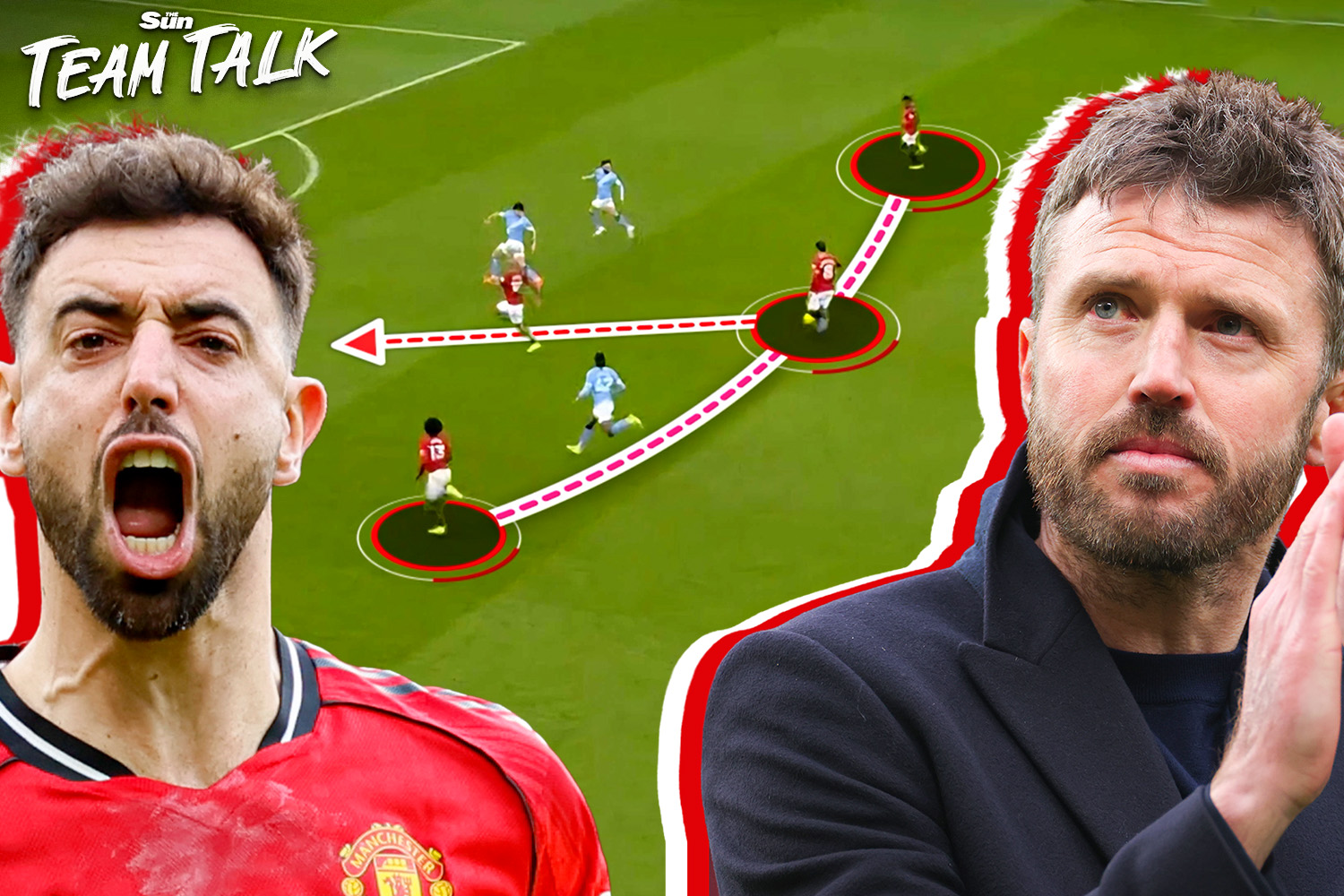
Finding the ‘Jack-in-the-box’ position between the midfield and defensive lines against City, Fernandes caused havoc for Pep Guardiola.
He can either go in-behind, asking questions of the defenders and pushing them back, or he can pick the ball up deeper in build-up, moving off Rodri the other way, and seeking Mbeumo’s runs.
Leaving the defending to his mates, Fernandes has been allowed to spend more time finding the best position to get the ball in when it’s won back.
As United wind up like a Jack-in-the-box with City probing on an attack, Bruno getting the ball is the sign for his fellow forwards to sprint up-field.
The Portuguese playmaker is at the heart of it all.
He is more than a headless hard worker as well, doing his job as the spearhead of a disciplined 4-4-2 press.
Rather than chasing the ball around, Fernandes sat off and allowed City to circulate the ball to Prem newbie Max Alleyne.
His role in the mid-block narrowed United’s lines and suffocated City.
So, what is to come from Carrick and United next?
With Leeds, Chelsea, and Brentford on the horizon, they could take a giant leap towards UCL qualification.
Historic rivals Leeds are likely to be in a back five, so Carrick might turn to wingers to offer width.
For the trip to Chelsea, a game which may well be crucial for both teams in the top five race, it may well be a vintage counter attacking performance.
Rolling it back to the City win, United’s pace on the break is a great weapon.
But Keith Andrews‘ Brentford could actually be the hardest of the trio.
How will United deal with huge defenders in a deep block when they have to take the initiative? That could define the second half of their season.