“We can’t go to Estacíon Camarón because Estacíon Camarón doesn’t exist, but we go there anyhow.”
So writes Cristina Rivera Garza in “Autobiography of Cotton,” translated by Christina MacSweeney. Garza’s eloquent and beautifully written book is not quite a memoir, a novel, or a work of history, although it contains elements of all three. By imagining the lives of her Mexican grandparents amid a cotton pickers’ strike in the 1930s, she builds a story that is not just about Mexican history, but also about laborers everywhere demanding fair wages and humane treatment.
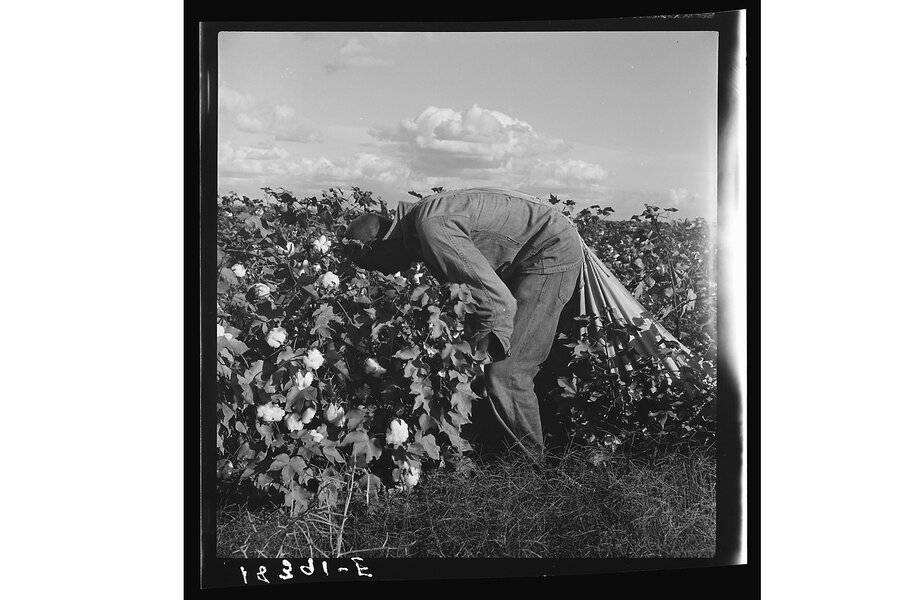
Nearly a century after the strike, Pulitzer Prize-winning author Rivera Garza travels to Estacíon Camarón, a town in northern Mexico that borders the United States. She seeks remnants of the once-thriving community and evidence of the labor action, which involved communist activist José Revueltas. His experiences inspired his 1943 novel, “Human Mourning.” Rivera Garza knew that two laborers, José María Rivera Doñez and Petra Peña Martínez, had also been involved in the strike. Though she never met them, they were her paternal grandparents. She doesn’t know whether her grandparents and Revueltas ever met, but there is evidence that they were all there at the same time. She considers that her grandparents could have been two of the workers whose images provoked his remarkable novel.
Why We Wrote This
In “Autobiography of Cotton,” Cristina Rivera Garza imagines the lives of her Mexican grandparents amid a cotton pickers’ strike in the 1930s. She builds a story that is not just about Mexican history, but also about laborers everywhere who demand fair wages and humane treatment.
The book opens with a fictionalized account of Revueltas’ arrival at the site of the labor uprising among cotton workers. Though Rivera Garza takes liberties with details of the events, her decision to fill out the narrative with the thoughts and emotions of the characters feels authentic. Her astute observations threaded throughout also render it a sociological critique. The book substantiates labor practices that have recurred throughout history, actions that often produce great wealth for a few, while negatively impacting the culture and the environment that the majority depends upon.

Cotton cultivation was of great importance to Mexican industry. The uprising that Revueltas came to support involved about 5,000 men and their families who picketed at the Don Martín Dam, the source of irrigation for the cotton fields. The workers struck against former landowners J. Américo Ferrara and Otilio Gómez Rodríguez, who were paying starvation wages to field-workers and migrant pickers. Revueltas and several of the organizers were rounded up and jailed, even though their right to unionize was protected under the Mexican Constitution. Law enforcement was on the side of the former landowners, who also controlled the local magistrates.
The strike continued after the arrests, but heavy rains overwhelmed the dam and the fields were inundated. A drought followed. The people, who had very little to begin with, left. The dream of farming their own parcel of land, which had been promised by the federal government, was dead. “No one wanted to stay on a dry land without rain beside a useless river and an unusable, cracked dam,” Rivera Garza writes.
Today, Estacíon Camarón evinces none of its agricultural past. The stories of the people who once fought for fair wages and a better life are lost, and few people remaining in the area even know what happened here.
The powerful industrialists won the battle against the impoverished strikers, and they also controlled the story that has come down through the decades. Rivera Garza was frustrated by the lack of documents about the strike. Ironically, it was the telegrams exchanged among government officials attempting to suppress the labor actions that enabled her to confirm the uprising.
And if Revueltas had not come to the region and had not written “Human Mourning,” a key eyewitness account would not have existed.
Rivera Garza amplifies the vital efforts of the residents, though scant proof of their lives endures. Her own existence, though, is proof of the existence of those who contributed to this pivotal era. She writes: “Even before my birth, cotton formed me.”