The Metropolitan Police is facing a £5million bill for new toilets and changing rooms for its 12 transgender staff.
Following a legal challenge over the rights of transgender people, Britain’s largest police force has assessed the cost of dedicated transgender facilities.
The Good Law Project argued that guidance that single-sex toilets should only be used by people of the same biological gender breached the rights of transgender people.
The guidance was temporarily withdrawn after the claims, and the Met Police have since calculated the costs to fit new toilets.
‘The overall cost of providing new toilets and changing spaces for transgender people at stations and main police buildings is conservatively estimated to be £5million,’ one source told The Sun of the Met’s financial assessment.
‘There would also be a £300,000-a-year bill for maintenance.’
It comes as Commissioner Sir Mark Rowley said his already overstretched force has faced ‘eye-watering cuts’ with the force plugging a £260million funding gap.
Retired Met chief superintendent Simon Ovens said: ‘Most of the Met estate is old and not easily converted. At a time of withering financial cuts, spending £5million on such things is frankly ridiculous.’
A Met Police spokesperson said: ‘We are reviewing our options to understand how any potential legal requirements could be met in the most cost-effective way.’
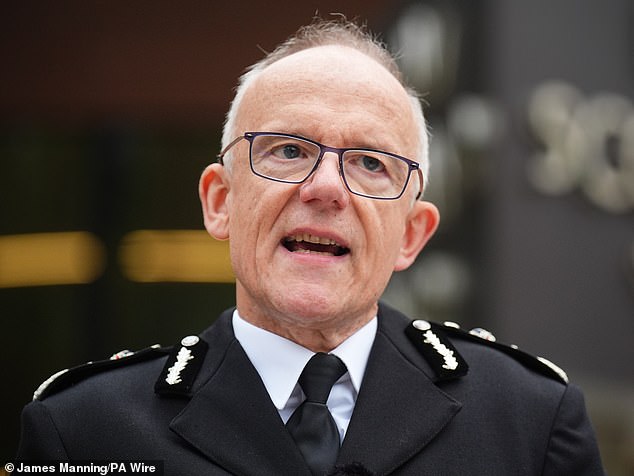
It comes as Commissioner Sir Mark Rowley (pictured) said his already overstretched force has faced ‘eye-watering cuts’ with the force plugging a £260million funding gap
Earlier this year, Sir Mark Rowley accused ‘pundits’ of damaging London‘s reputation after he was confronted with the force’s disastrous record on mobile phone theft in the capital.
Sir Mark launched an impassioned defence of the Met’s crime statistics, claiming one news organisation was ‘allergic’ to a ‘good news story about London’.
It came after figures published today showed the rate of unlawful killings in the capital dropped to an historic low last year, while the number of homicides dropped below 100 for the first time since 2014.
But Sir Mark was clearly aggrieved when he was presented with other statistics, first released last year, which showed shoplifting offences increased by 54 per cent in 2024, and was asked about claims an estimated 100,000 mobile phones were stolen on city streets during those 12 months.
Sir Mark, who has led Britain’s largest police force since 2022, told presenter Stig Abell Times Radio: ‘The fact that so much public debate is now more on rhetoric than it is on facts is not my responsibility.
‘It’s the rhetoric of, frankly, pundits like yourself rather than looking at the evidence. My point is simply, people who live and work in London generally feel safe.
‘I don’t claim it’s perfect.’
He added: ‘What I am pushing back on is the idea that crime in London is somehow out of control.
‘London is a safe city and it’s going in the right direction.’
Mr Abell denied he was a pundit.
A YouGov survey published earlier this month found nearly two-thirds of Londoners (63 per cent) felt the city was ‘safe’, compared with one-third (34 per cent) who felt the opposite. Four per cent of those polled were unsure.
But across Britain, 61 per cent of respondents said they thought London was an unsafe place to live.
According to the Office for National Statistics, almost 90,000 shoplifting offences were recorded by police in London in 2024, up from just over 58,000 in 2023.
Sir Mark said the force was working on reducing mobile phone theft, and estimated it would be down by ’15 to 20 per cent’ by the end of this year.
But he added: ‘Why are you so allergic to a story about good news about London?’
London Mayor Sir Sadiq Khan also said there had been a significant recent reduction in street theft.
He said he was working with mobile phone manufacturers to ‘design-out crime’, for example by introducing ‘kill switches’ to mean stolen phones cannot be used, making device theft less attractive to criminals.
Sir Sadiq told BBC Radio 4’s Today programme: ‘I fully accept the perception of crime, we are going to address that by tackling crime.’