Equus Trundy, wearing a black-and-red buffalo check shirt and a sturdy pair of boots, takes her spot in front of 30 people at the edge of a cranberry bog in Carver, Massachusetts.
“Welcome to Red Meadow Farms,” she says into a headset. “I am a cranberry farmer.” The crowd bursts into applause. It’s a bluebird-sky October afternoon.
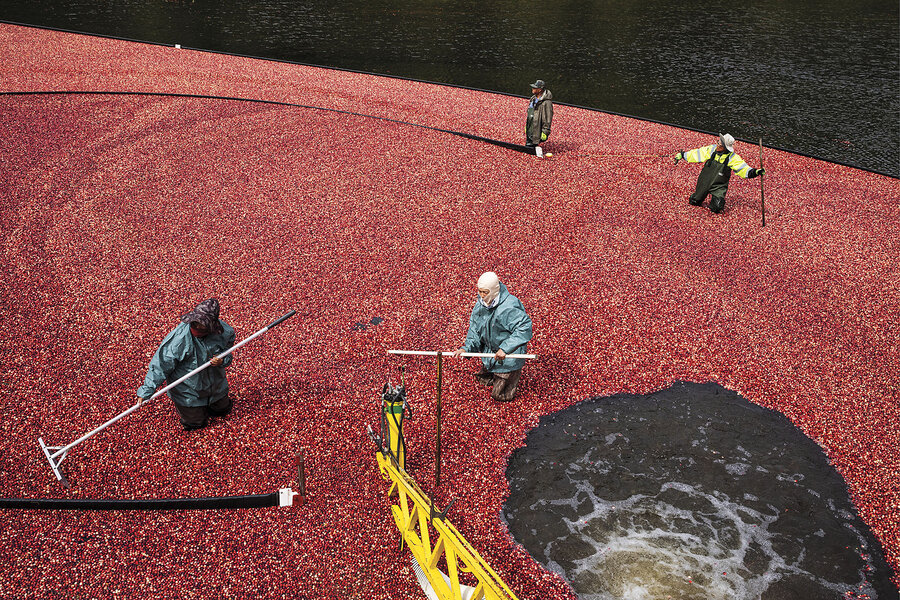
This is the third group of tourists who have paid up to $80 each for an opportunity to learn about the annual cranberry harvest. Soon, they will pull on waders and squish through a flooded bog bobbing with crimson berries. The Red Meadow weekend tours are so popular that they sell out before the end of the month.
Why We Wrote This
Cranberries are a holiday tradition – and the Massachusetts state fruit. Our reporter takes a look at the past and present of the festive berry and how it became a Thanksgiving staple.
“We tried for several years to try to catch the cranberry harvest season, but we did not make it,” says Wan Yee Leong, who traveled down from Boston with her husband, Gerald Klickstein, for Red Meadow’s Wade in the Bog Tour.

Melanie Stetson Freeman/Staff
Ms. Leong, who grew up in Malaysia, finds the cranberry somewhat exotic but has grown to love its tart juice. “Of course, the first introduction of cranberry to me as a Malaysian is – you eat it with turkey, right?”
The reaping of the Massachusetts state berry is as much a cherished autumnal backdrop in Carver as the landscape trimmed in hues of red, gold, and burnt umber – or the Renaissance booths at the local King Richard’s Faire. And cranberry dishes, of course, are often staples of traditional Thanksgiving feasts.
Watching the watery cranberry harvest is a visually stunning experience. At other times of the year, bogs appear as scruffy meadows, their berries unseen beneath low-lying vines that stretch across acidic, sandy soils.
But for a few brief weeks each fall, as the bogs become flooded fields, the berries emerge to dance in swirls of changing shapes. They are gathered together into floating bordered rings, vacuumed up into trucks, and then carted away to be processed.
Cape Cod cranberries have as much of a storied place in the United States’ founding narrative as the native Wampanoag and the settling English. They are one of a number of iconic regional crops – like Florida oranges and Vermont maple syrup – that are associated with the culture and flavor of a place.

Melanie Stetson Freeman/Staff
Cranberries are indigenous to North America, and the U.S. and Canada produce about 98% of the global supply. Chile has recently become a significant grower, and countries such as Belarus, Azerbaijan, and Ukraine are among other nations producing a small amount of commercially grown cranberries.
But the number of bogs producing the tart berry in Massachusetts is dropping, as are its prices. Once considered the cranberry capital of the world, Massachusetts has seen its production outpaced by Wisconsin for the past 30 years. It’s now also squeezed by rising production in eastern Canada. Today, a growing number of Massachusetts farmers are closing operations and using state funds to convert their bogs to wetlands.
And yet, there are signs of resilience and cooperation – and even joy – among the roughly 300 farmers left in the Bay State. They are fierce defenders of a vocation and a crop they treasure.
Some are installing solar panels, developing new products, and running agritourism events to increase their revenue. Others are undergoing costly renovations to their century-old bogs to make them more
water-efficient and planting higher-yielding hybrid varieties. Still others are committed to preserving heritage berries as part of Massachusetts’ identity.
“I’ve been very fortunate where I’ve been able to build a career doing what I love,” says John Mason, a second-generation
cranberry farmer in Carver. “But it’s changing, and it’s changing faster than any of us expected it to.”

Melanie Stetson Freeman/Staff
The history of the cranberry in North America
In contrast with current market forces driving change, the Massachusetts cranberry has had an unhurried history.
One of North America’s three commercially grown native fruits, it emerged in the marshy lowlands carved out by retreating glaciers 12,000 years ago. Alternating layers of sand and organic matter allowed for good drainage while retaining moisture, spurring the vines to spread across Cape Cod, Martha’s Vineyard, and Nantucket.
The Wampanoag people gathered the tart sasumuneash, their name for wild cranberries, for medicinal purposes. They also used the fruit to enhance dishes of squash, corn, beans, and game. They beat the berries into a paste that was mixed with fat and dried meat to create pemmican, an early kind of protein bar that could keep for years.
When the English settled in Massachusetts in the 1600s, they were quick to adapt the cranberry into their diet. The British fenberry and gooseberry – close cousins to the cranberry – were traditionally stewed with sugar and served with meat and poultry.
Some historical accounts suggest the English named the sour and astringent fruit “crane berry” since the blossoms’ color and shape resembled the crimson-capped head of the sandhill crane. The harvest of wild cranberries was so prolific in the Massachusetts Bay Colony that barrels were sent from Boston to appease King Charles II in 1677.

Melanie Stetson Freeman/Staff
But the father of the cultivated cranberry is purportedly Capt. Henry Hall, who was said to be present at the Battle of Bennington in 1777 when the tide turned against the redcoats in the Revolutionary War.
As a retired sea captain on Cape Cod, he noticed something unusual in 1816. A wild-growing cranberry patch, half buried by sand, showed an abundance of berries the following spring.
Soon after, he fenced off a “cranberry yard” and set to work cultivating the crop. He eventually started putting his yield in barrels and shipping them to New York. His success inspired others to carve out their own cranberry yards.
In 1821, Boston journalist William Tudor penned an essay, “Memoir on Cranberry Sauce.” He noted that “cranberry sauce, vulgarly called cramberry sauce from the voracious manner in which they eat it,” was so abundant in the region that formal dinners often featured “four soup plates” of the sauce “at four corners of the table.”
Marcus Urann, a lawyer-turned-farmer known as “Mr. Cranberry,” started experimenting with canning cranberry sauce in 1912. He later founded the Ocean Spray company in Plymouth, Massachusetts. Today, 700 farmers from Massachusetts, Wisconsin, New Jersey, Washington, Canada, and, recently, Chile sell their berries to Ocean Spray as part of its cooperative.
Wisconsin, with its ample, affordable acres, perfected building efficient square bogs in the 1960s and planted hybrid varieties. Farmers there also employed the technique of wet harvesting, and they soon leapfrogged Massachusetts to the front of the industry.

Melanie Stetson Freeman/Staff
The vast majority of cranberries are turned into juice, made palatable for those unaccustomed to its tart taste by combining it with other fruit juices, such as apple, grape, or pear. Only 5% of cranberries are harvested to be sold as whole berries. In 1993, Ocean Spray introduced dried, sweetened cranberries, which gave the industry a needed boost.
The state’s No. 1 agricultural product, the cranberry as well as its related industries contributed a total of $1.7 billion to the Massachusetts economy in 2022, according to Farm Credit East, a regional agribusiness cooperative. Last month, Gov. Maura Healey declared October “Massachusetts Cranberry Month” as a way to promote local growers and encourage consumers to buy Massachusetts-grown cranberries and cranberry products.
But the industry needs to innovate to stay relevant and competitive, experts say. Massachusetts cranberries, once the industry leader, now make up only about 27% of the nation’s total crop.
Revitalizing the Cape Cod cranberry
Ten years ago, the state convened a revitalization task force to map out paths to renovate existing bogs, adapt new technologies, and establish “green” exit strategies. Under those guidelines, farmers who want to retire or off-load unproductive bogs without selling to developers can instead convert their land to wetlands with the help of the state. So far, Massachusetts has converted nine bogs into wetlands at a cost of $27 million, with 11 more planned.

Melanie Stetson Freeman/Staff
“It’s so much the fabric of southeastern Massachusetts. If we were to lose that, we’d be losing a lot of cultural as well as economic and environmental benefits,” says Brian Wick, executive director of the Cape Cod Cranberry Growers’ Association, who worked on the task force.
He’s encouraged by the number of farmers who are renovating their bogs and experimenting with new varieties and income streams to stay afloat.
“Not everyone can be a farmer,” says Mr. Wick. “You need to be stubborn, but you also [need] that ability to adapt and learn. That’s the genetic makeup of a cranberry grower.”
Mr. Mason, the second-generation grower, has wanted to be a cranberry farmer ever since he started picking next to his father as a tot.
He has fond memories of dry-harvesting cranberries with his father. He loved walking behind a picker that combed through the vines, depositing the berries into a box. As he grew older, he recruited friends on the soccer team to help lump the berries into bags.
But his parents had other plans. “They didn’t want me thinking 9 acres of cranberry farm was going to be, like, a career,” Mr. Mason says. “They sent me to private school, and they wanted me to do my own thing, and I came clawing back.”
His life, in fact, is now completely dedicated to the cranberry. He is an assistant general manager at A.D. Makepeace Co., the largest cranberry-growing company in the world. And as the owner of Tilson Brook Cranberry, the farm he grew up on in Carver, he is a member of the Ocean Spray cooperative. He’s also currently the president of the Cape Cod Cranberry Growers’ Association and sits on the board for the Cranberry Research Foundation.
As a farm owner, he first worked to make his 100-year-old, dry-harvested bogs more efficient. He stripped out the old vines, added new sand, and planted Haines berries, a higher-yield hybrid developed at Rutgers University in New Jersey.
He squared the edges of the bogs to make them easier to mow and installed new underground irrigation systems that draw water from a nearby pond. He laser-leveled the bogs so they require a lot less water to flood, and he monitors them with a meter.
“For this business to be sustainable and have the luster for the next generation, it needs to make money,” Mr. Mason says. “As I enjoy this, there aren’t enough crazy people out there who enjoy it as much as I do to do it for nothing.”

Melanie Stetson Freeman/Staff
Inside the Edgewood Bogs cranberry processing facility in Carver, things are hopping. Fresh cranberries are bebopping across a series of bounce board separators and conveyor belts. They are washed and blow-dried, preparing them for packaging as Cape Cod Select berries.
Berries that bounce are best because they will hold their form during shipping. Soft berries are sorted out to be turned into juice and other products.
Legend has it that the “bounce principle” was discovered by a New Jersey cranberry farmer, John “Peg Leg” Webb, in the 1840s.
Peg Leg Webb stored his berries on the second floor of a barn. Instead of trying to carry full barrels of cranberries down the steps, he simply tipped them over and let the berries pour down. Firm berries hop-skipped to the bottom while the inferior, soft ones schlumped.
Cindy Rhodes is a contemporary innovator. She married a third-generation cranberry farmer, and all three of her grown sons are part of the family business, Edgewood Bogs.

Melanie Stetson Freeman/Staff
Ms. Rhodes and her husband, Matt, took control of the family business in 2005, a bad year for cranberries. “We essentially had to borrow money to pay our borrowed money,” she says.
So when cranberry prices boomed again in 2008, she knew she had to act to improve the business.
“For years, I couldn’t understand why you couldn’t find cranberries at the grocery store when you can find every other food imaginable,” she says. She and her husband invested in market research and determined that there was indeed an opportunity in frozen cranberries beyond Thanksgiving. Then they launched a new brand: Cape Cod Select.
After some trial and error, Ms. Rhodes brought her product to a natural, organic food expo in 2010, and a major grocery store distributor immediately expressed interest.
“Shaw’s was the first retailer to really notice my product. And [the buyer] was in love with it,” she says. “He actually showed me all the ropes of how to work with retail.”
Cape Cod Select now grows 6 million pounds of cranberries each year and has a diverse product line, which includes fresh and frozen cranberries sold at 6,000 stores nationwide. (That’s in addition to bulk wholesale sales.) Each bag features recipes for smoothies, baked goods, and overnight oats to help consumers imagine other uses for whole cranberries – like cranberry squares. (See recipe above right.)

Melanie Stetson Freeman/Staff
Even with continual adaptation and innovation, however, it is challenging to survive in a market saturated with cranberries.
“You can’t make it on today’s prices,” says Ms. Rhodes. “We’re fortunate we’ve got this other retail outlet. But with today’s pricing in the cranberry industry – it costs more to grow them than what they are paying us.”
How cranberries became a Thanksgiving tradition
Kathy Rudder, curator of multisensory experiences at Plimoth Patuxet Museums in Plymouth, Massachusetts, often deals with tourists’ questions about the cranberry harvest when she is in character from the 1600s.
“I get a lot of questions that are hard to answer dressed like a Pilgrim,” says Ms. Rudder. “They are asking about, you know, the sand and the flooding, and so I finally just have to say, ‘Well, we just kind of pick them when it’s time to pick them.’”
Ms. Rudder credits Sarah Josepha Hale, a 19th-century writer and activist who wrote endlessly about New England harvest traditions. She campaigned for a national Thanksgiving Day, linking cranberry sauce and turkey to the holiday’s mythology. (Hale also wrote the nursery rhyme “Mary Had a Little Lamb.”)
There are more than 100 varieties of cranberries, and like apples, they have different sizes, shapes, colors, and tastes. While more than half of Massachusetts cranberry farmers have switched to higher-yielding varieties, some farmers remain dedicated to cultivating heirloom varieties.

Melanie Stetson Freeman/Staff
At Red Meadow Farm, the Trundys grow heritage cranberries native to Massachusetts. The Howes variety is tart, sour, and slightly astringent and has a firm texture. The Early Black variety is smaller and darker with a fresh, crisp flavor. Both of them are derived from cuttings of wild cranberries discovered and cultivated in the 1800s.
“We’re really excited about our heritage vines, not only because they are wild-type native plants from this area, but because, honestly, they taste really good,” says Ms. Trundy.
She and her husband, Jordan, bought the 17.5 acres that make up Red Meadow Farm in 2020. Both had worked as technology professionals in Boston, but during the pandemic’s upheaval, they took a leap to become first-generation growers.
The harvest is their busy season. As the last cranberry farm downstream on the Weweantic River, they patiently wait for their turn to dam its waters and flood their bogs. Like every other farm doing a wet harvest, they knock the tiny red fruit from the vines with a picker machine. Inside each cranberry are four tiny air chambers that keep the berries afloat. Then, the berries are corralled with a boom and vacuumed up with a large hose. Extended family members take time off from other jobs to help harvest the fruit, outfit and photograph tourists, and run the farm stand.
Equus is listed as the full-time cranberry farmer, while Jordan still treks into the city three times a week to continue working in the tech field, providing a necessary income stream to support farm operations. It’s a symbiotic relationship.
“Farmers [are] a lot like IT people in the sense that they are just problem-solvers,” says Mr. Trundy.
The other main income stream comes in the form of joyful tourists frolicking in the bog. They pose with rakes, gleefully toss cranberries into the air, and take cheek-to-cheek selfies.
Nati Punina, who grew up in Russia, loved the experience of wading into the bog with her husband, Nick Makridakis, who is from Greece, and their two young children, Alex and Anastasia, to pose for photos.
“They grow this tart berry in Russia, but you don’t get to do this,” she says, gesturing toward the bog. “It’s a real New England tradition.”
The tours are a huge moneymaker for the Trundys. In fact, the tours make five times what the Trundys will earn from selling their crop, says Mr. Trundy. After the tours are over, these berries will be composted and spread on a wildflower field rimmed with beehives. Red Meadow sells the honey at its farm stand.
“This probably represents the happiest part of the harvest process,” says Ms. Trundy. “You finished all the hard work, and now you just get to stand there and watch it go into the pump. It definitely feels the most rewarding when you’re standing in a circle [surrounded by] all of your year’s hard work.”