It was at the end of a long day of changing nappies and spoon-feeding that I decided to leave my husband.
One minute he thought everything was fine between us, the next I was telling him I was sorry, but I no longer loved him.
He looked so heartbroken, so confused. All he kept saying was ‘no’.
Because the thing is, that’s all he really could say. And the nappies I was changing? They weren’t our two children’s – they were his.
When people get married and say ‘in sickness and in health’, I’m not really sure they know what they’re signing up for.
My decision to divorce Martin might have been shocking enough, given we’d had a 43-year marriage. But, to make my departure even more controversial, three years before I walked out he’d suffered a stroke, leaving him a long-term invalid with little quality of life.
That’s right, two years ago I abandoned the life we’d built together because I couldn’t bear to be his carer any longer.
Martin and I had been happily married for four decades before his stroke. We’d met in our early 20s at a dinner party, where he charmed me so much I giggled the whole way home thinking about him. I knew we were destined to spend the rest of our lives together. Looking back, the memory feels almost cruel.
We got married within a year and had our son two years later, followed by a daughter. Martin had a well-paid job as a banker and I stayed at home in rural Hampshire to look after the children, who are now 43 and 40.
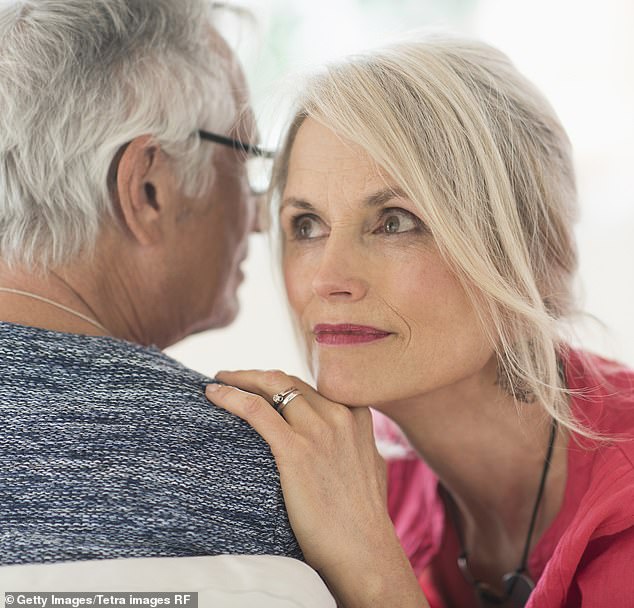
My decision to divorce Martin might have been shocking enough, given we’d had a 43-year marriage, says Daphne Ackrill (models pictured)
There were holidays, evenings out with friends drinking fine wine, ponies for the children, everything you could want. Most things we did together, from playing tennis regularly to skiing. He was also a brilliant dad.
Even once the children flew the nest nearly two decades ago, Martin and I remained close, enjoying an active lifestyle; we were both in rude health and spent most of our free time in each other’s company – something I knew was not true of many of our married friends.
Then one day five years ago, when Martin was nearly 64 and on the verge of retirement, our beautiful life was shattered.
I was 61 and had been out to an early morning yoga class. When I came back, I found Martin collapsed on the kitchen floor. I thought he was dying.
In a state of panic, the next few hours passed in a blur. I called 999 and went with Martin to the hospital. He stayed there for five days with me by his side. I couldn’t imagine a future without this man I loved so much.
For the first day he was comatose and 48 hours after he’d been admitted, doctors told me he’d suffered a major stroke. Brain scans showed significant damage – and they warned he might never be ‘normal’ again.
But by day three he had opened his eyes and could move his arms and legs; it felt like a miracle.
By day five he was able to eat and drink, but his movements were slow and clumsy. His speech was so slurred he was almost incomprehensible. Doctors said it was impossible to know what the future looked like at this stage – it would be a case of waiting to see what happened over the next three months.
Martin and I had often discussed that we never wanted to be a burden to our children as we got older, but we didn’t realise how soon we – well, he – would become infirm.
Our daughter rushed to the hospital, but she’d had her first baby just weeks before and eventually I told her there was little point in her staying. My son offered to come over from his home in Australia, but I told him not to bother.
I knew on the day Martin was discharged he’d need a lot of support and regular monitoring.
We were allocated a health care team who I could talk to, which felt reassuring, and who arranged for physiotherapy.
They suggested I might need some help, but I stepped into my role as his carer gladly – because I thought it would be temporary.
Once home, Martin was semi-bedbound. Doctors said he should be able to walk but I think he was scared; of falling, of having another stroke, of embarrassing himself.
I did try encourage him but, unless I was there to support him, he stayed in bed, so I gave him a little bell he could ring to get my attention.
He rang it constantly, wanting tea, water, help getting to the loo, help getting back again. He liked me being with him so I’d bring the papers up and read aloud.
While he could feed himself without my help, his speech remained very slurred and he could no longer express himself as he used to. Sometimes he was almost childlike. It was terrible to see this once erudite and witty man so reduced.
My daughter came to visit a few times, bringing her baby daughter to meet her grandad. Seeing Martin trying – and failing – to hold the baby was heartbreaking, and I think it really shook my daughter seeing him like that. From then on she preferred to check in on the phone, as did my son, who never did come to visit.
They were both worried I was doing too much by myself, but I was determined to look after my husband. I didn’t feel it was their responsibility.
I hoped, naively, that he would get back to normal. He was always such a strong man. We’d planned to spend his retirement years travelling: walking the Camino, sailing around the Greek islands, attending tennis camp in southern Spain.
Now, the only respite from our home routine was the endless appointments with doctors, physiotherapists and countless specialists. While they told me the damage to various parts of Martin’s brain meant he’d never get back to how he was pre-stroke, they hoped he might regain enough mobility to be independent.
But as anyone who has experience with a stroke knows that while some people recover well, others just get worse and worse despite all their efforts. Martin was in the latter camp.
In vain I spent hours online researching ‘cures’. I hired people to come and give him massages.
Sometimes – it took a lot of effort – I’d manage to get him up and take him for a walk. But he’d lash out at me verbally when I tried to get him dressed and in the end I only managed to get an overcoat and some trainers over his pyjamas.
I caught sight of us in the window of a shop once. I was shocked; him, a hunched old man shuffling along unshaven and grumbling, me looking like his carer. We were just two years apart in age, yet suddenly this gap had widened to a yawning gulf. It made me miserable.
In my frustration, I started to believe he liked being reliant on me – although he would occasionally mention how guilty he felt for the impact on my life.
It wasn’t just that the stroke had aged him, it had robbed him of the personality I fell in love with. I realised I might never get ‘my Martin’ back again.
He got worse and worse over the next year. He was doubly incontinent. Digestion was tricky so I had to cook him special meals and spoon-feed him like a toddler. His cognitive function continued to deteriorate. Sometimes he didn’t seem to understand anything I was saying.
Yes, there were some good days. Sometimes he’d come to the park and we’d sit with the sun on our faces. But other days I’d try to get him out of the house and he would just scream. It’s hard to find the words for how awful it was. I knew it was no fault of his but this man I loved so much had become a monster I didn’t recognise.
What’s worse, I realised I was a terrible nurse. I’d always thought I was compassionate, but I have no patience. Sometimes I’d look at him and feel unspeakably terrible things. I hated him, then I hated myself for hating him.
I’m ashamed, too, that I started drinking every night to cope.
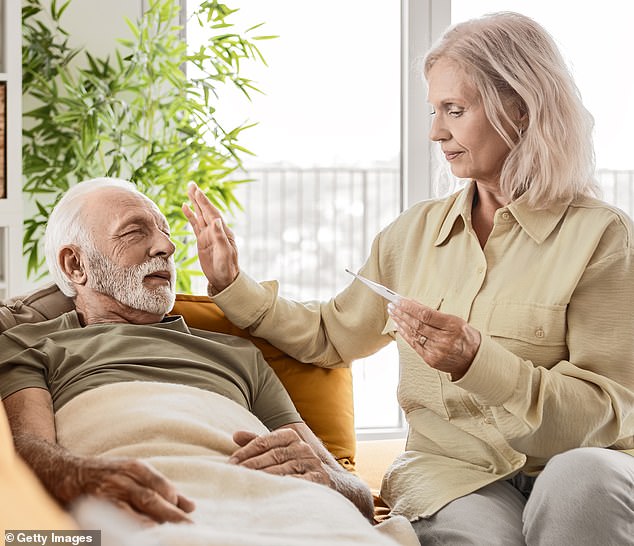
When people get married and say ‘in sickness and in health’, I’m not really sure they know what they’re signing up for (models pictured)
I’d become terribly isolated. While friends had been initially sympathetic, they melted away once it became clear Martin wasn’t going to make a swift recovery. I woke up one night and realised I hadn’t been out for dinner in almost a year.
We had been so sociable and yet now I felt like a pariah. I was in my early 60s and all I could see ahead of me was the drudgery of looking after this man I no longer felt I loved.
Yes, call me cruel, but it was impossible to love him. I recognised no part of the man I’d married.
In desperation, a year after his stroke I hired a carer at vast expense to work from 9am to 6pm. Despite this, Martin would insist on it being me who helped him, pathetically wailing ‘I want you!’
It used to break my heart – even as it deepened my resentment. Sometimes we’d both just sit and cry.
Then one day, I snapped. I told the carer I was going out and she would just have to cope with him.
I took the train to London and met an old friend. We walked around the National Gallery. We had lunch, one where we didn’t talk about Martin. We laughed. It was almost indescribable how free I felt. And after such a long, dark period of pain, I started wondering if my life could be different.
I realised if I continued being Martin’s carer I would only go downhill with him.
Removing the mantle of being a 24/7 carer, life started to change.
In his better moments, Martin would encourage me to go out. Some days he seemed fully lucid and was so understanding it left me ashamed and second guessing myself; why couldn’t I just stay at home with my husband?
But his mental state fluctuated wildly, and there were plenty of bad moments, where he’d rage at me simply for daring to go to the shops. That always helped to assuage my guilt.
Even with my newfound ‘freedom’, life was very lonely. After being Martin’s main carer for almost two years, I was used to the lack of invitations from friends, so I started going for dinner or to the theatre by myself.
While I could have reached out to my friends, I worried they’d judge me for leaving Martin alone.
Most people have no idea how difficult it is to care for somebody. People used to tell me I was amazing, and I wanted to say: ‘I’m not. I’m full of rage and I hate him.’
Others would say admiringly, ‘I don’t know how you do it.’ I wanted to scream that I had no choice.
But what if I did have a choice? Martin had health insurance, plenty of savings and a good pension from his banking career. Even though round-the-clock care would cost £70,000 a year at the bare minimum, we could afford it.
The money would buy Martin people who could actually look after him – and me a life.
By the third year since Martin’s stroke, we had a new normal.
I’d kiss him goodbye on the top of his head as if he was a child as I headed out. Sometimes he’d smile and wave me off. Other times he’d seem resentful and sulky.
It was after a day like this that I decided I wanted a divorce. It was one of the most painful decisions I’ve ever made.
There are some people who are happy to martyr themselves for the person they once loved. But I am not that person. Martin didn’t marry that person.
Would he really want me to wither and die alongside him? I told myself that if he was more compos mentis, he’d probably give me his blessing to leave.
That day, I went upstairs with his morning cup of tea and told him I needed to tell him something.
I said I could no longer live with him but he would be taken care of. I’m not sure if he understood until I started clearing out my wardrobe. Then he started shouting. It just served as another reminder that the man I loved wasn’t there any more. By this point, he’d changed to such an extent I wasn’t sure he loved me either.
Some of my friends and family understood, but many didn’t. I know people judge me. I judge myself.
I felt so guilty telling the children. My son seemed fine with it but he was so far away I don’t think he felt like part of things anyway. He’s still never seen his father in his current state.
My daughter was a different story. She thought I had been OK being her father’s carer, and was very upset with me. She said she’d never thought I was someone who could just ‘abandon’ my husband, and refused to even see me for a year.
It was devastating, because she was the one person whose approval I really wanted. I felt that if she had said it was OK then I really could believe I’d done the ‘right’ thing.
People asked me why I couldn’t just stay married to him, but – aside from not wanting to be responsible for him as his health continued to worsen – there were financial implications.
I hadn’t worked since we’d got married and had no savings of my own. I needed a divorce settlement to start a new life and, though leaving wasn’t easy, I refused to feel guilty about that part given the years I’d devoted to him and our children.
I made sure Martin kept enough money to be looked after, and with my share I bought a flat in London. I wanted the vibrancy of the city and a total change.
Two years on, my life now is wonderful. Living alone, I have total freedom to do what I like – after all, I know the future isn’t promised.
Though my daughter and I are rebuilding our relationship, I accept it’s changed her view of me. She still visits her father every so often, but finds it very upsetting.
And what of Martin? I understand he has full-time, live-in carers now. When I left, I told him I would visit, but I’ve found it too painful. Sometimes I feel guilty about this, but my life has moved on.
Other people aren’t judged for not seeing their ex when they separate and while you may argue my situation is different I don’t agree. I don’t think I’ll ever see him again.
While people may think me selfish I don’t regret my decision.
I look back on my marriage and it’s as if I was two different people: the woman before Martin’s stroke, and the one I became after.
I have no intention of dating; I won’t risk finding myself in the position of being a carer to a partner again.
These days, I don’t even tell people I have an ex-husband who is an invalid. I say he died. For me, he has.
Daphne Ackrill is a pseudonym. Martin’s name and identifying details have been changed
AS TOLD TO LUCY CAVENDISH